
The Swiggy Instamart Business Model of Dark Store Delivery
How Instamart earns from groceries delivered out of 1,240 dark stores.

Key Takeaways
- FY26 quick commerce revenue was ₹3,859 crore, up from ₹2,130 crore.
- The FY26 quick commerce segment result was a loss of ₹3,063 crore.
- Instamart had 1,240 dark stores in 133 cities in September 2026.
- Q2 FY27 GOV was ₹9,230 crore, with an adjusted EBITDA loss of ₹895 crore.
Table of Contents 13 sections
- Swiggy Instamart at a glance
- What Swiggy Instamart does
- How Swiggy Instamart makes money
- Instamart's share of Swiggy's consumer orders
- Swiggy Instamart's Business Model Canvas
- Is Swiggy Instamart profitable? Revenue vs segment loss
- Orders, dark stores and unit economics
- Swiggy Instamart business model shift to owning inventory
- Swiggy Instamart's journey so far
- Who Swiggy Instamart competes with
- Challenges Swiggy Instamart faces
- Conclusion on the Swiggy Instamart business model
- FAQs
The Swiggy Instamart business model delivers groceries and household items within minutes from dark stores, small warehouses that serve online orders only, and earns commissions, advertising fees and user fees. Instamart is the quick commerce business of Swiggy Limited, which reports it as its quick commerce segment.
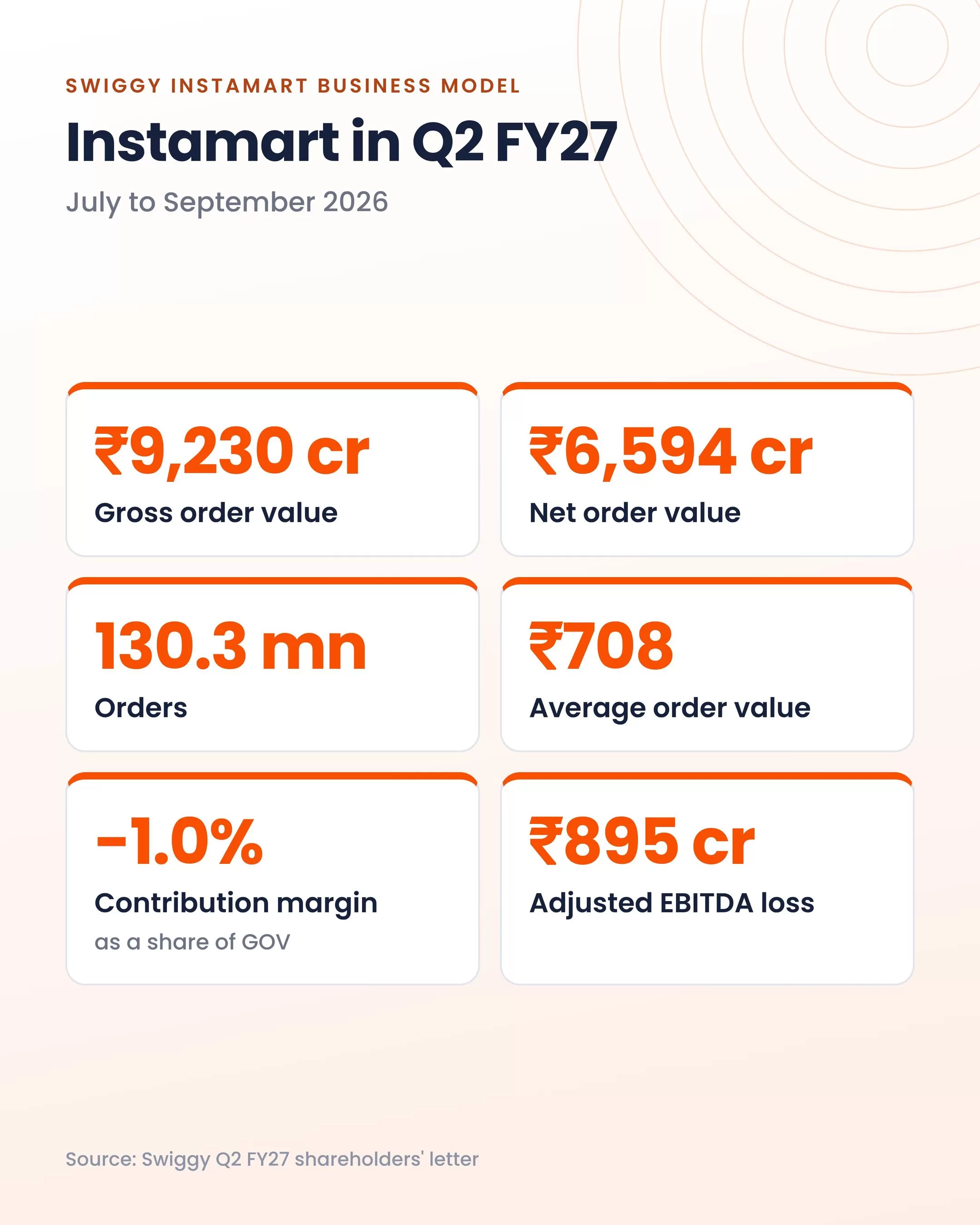
In FY26 Swiggy's quick commerce segment reported revenue from operations of Rs 3,859 crore and a segment loss of Rs 3,063 crore. In Q2 FY27 (July to September 2026), Instamart's gross order value (GOV) was Rs 9,230 crore and its adjusted EBITDA loss was Rs 895 crore.
Swiggy Instamart at a glance
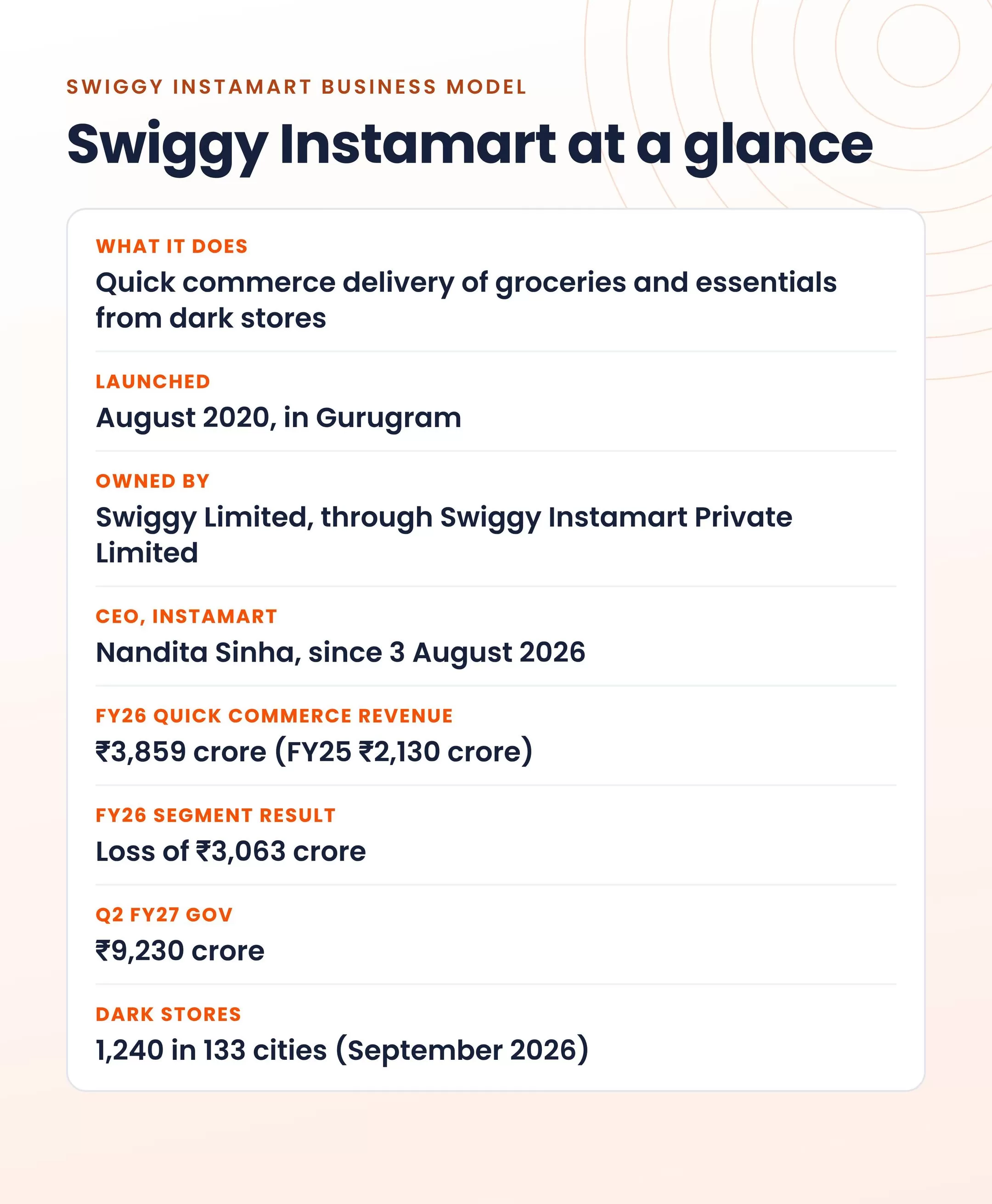
| Detail | Swiggy Instamart |
|---|---|
| What it does | Quick commerce delivery of groceries and household items from dark stores |
| Launched | August 2020, in Gurugram |
| Owned by | Swiggy Limited, through its step-down subsidiary Swiggy Instamart Private Limited |
| CEO, Instamart | Nandita Sinha, since 3 August 2026 |
| FY26 quick commerce revenue | Rs 3,859 crore (FY25: Rs 2,130 crore) |
| FY26 quick commerce segment result | Loss of Rs 3,063 crore (FY25: loss of Rs 1,896 crore) |
| Q2 FY27 GOV | Rs 9,230 crore, up 31.4% year on year |
| Scale | 1,240 active dark stores in 133 cities at the end of September 2026 |
| Listing | Not listed on its own; parent Swiggy is listed on NSE and BSE |
What Swiggy Instamart does
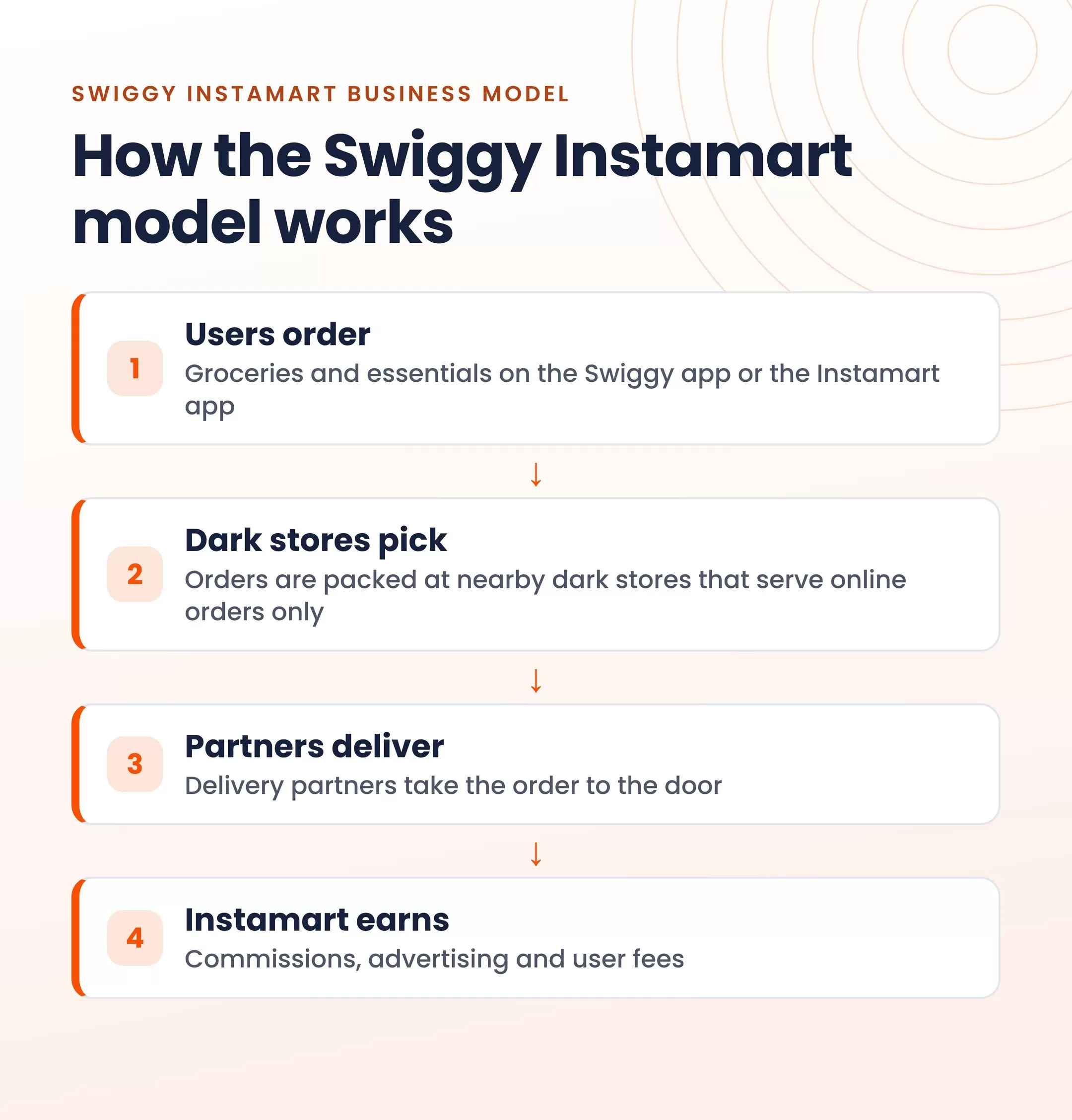
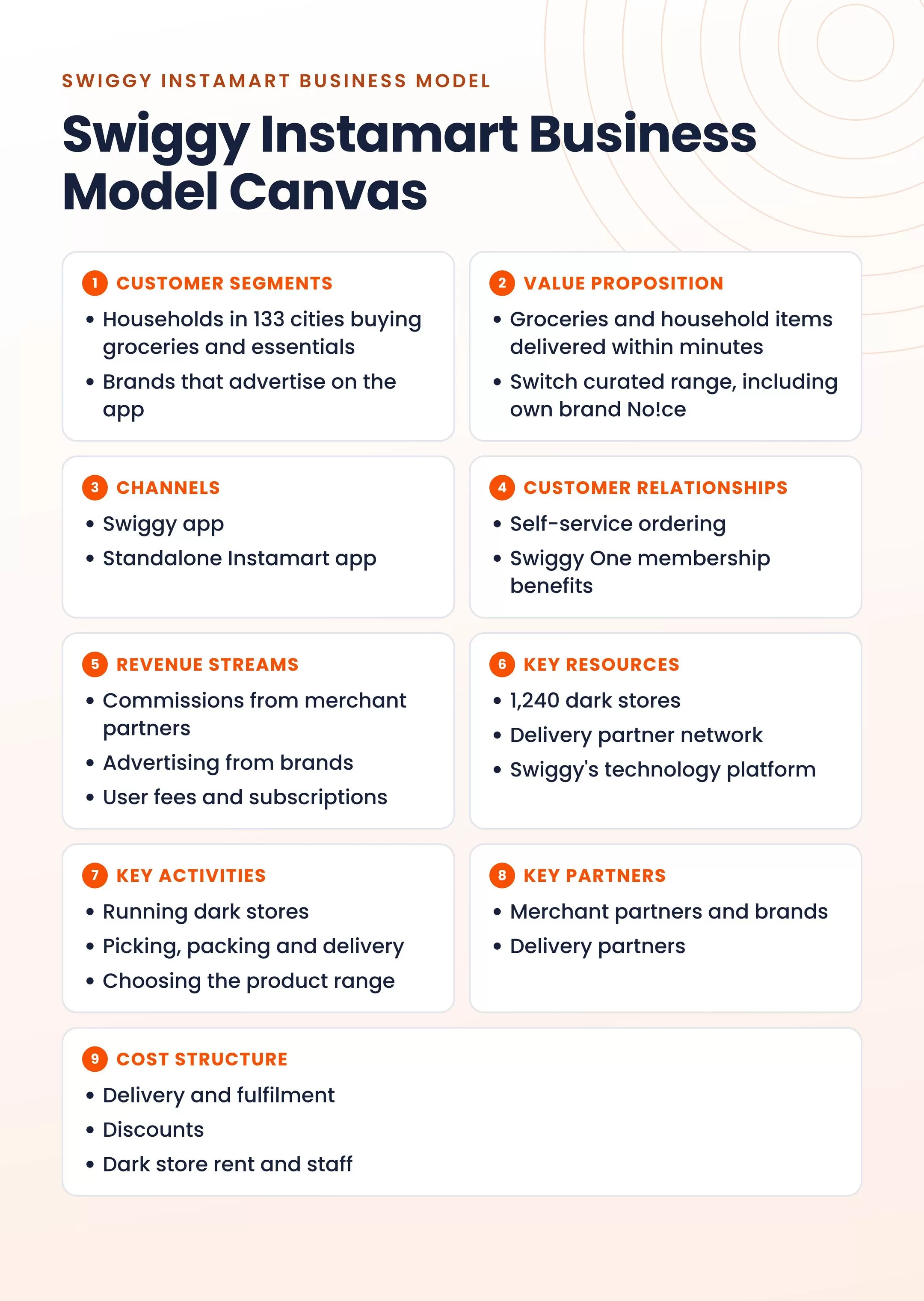
Instamart sells groceries and other essentials across more than 20 categories. Users order on the Swiggy app or on the standalone Instamart app, and the order is packed at a nearby dark store and taken to the door by a delivery partner. Swiggy One members get their membership benefits on Instamart too.
Besides branded products, Instamart offers Switch, a curated range that brings together its own private brand No!ce, its Nectr fruit and vegetable range and partnerships with brands.
How Swiggy Instamart makes money
Instamart revenue model
Swiggy's quick commerce revenue comes from these streams:
- Commissions agreed in advance with merchant partners, the sellers whose products are sold on Instamart.
- Advertising from brand partners that pay to promote their products in the app.
- User delivery charges, net of any discounts.
- Fees charged to users and delivery partners for using the technology platform, and subscription revenue.
- Business enablement services sold to merchant partners.
Swiggy does not report a separate amount for each of these streams. Together they made up quick commerce revenue from operations of Rs 3,859 crore in FY26, which was 16.7% of Swiggy's consolidated revenue from operations of Rs 23,053 crore.
Instamart's share of Swiggy's consumer orders
Swiggy reports the gross order value of its three consumer businesses. In Q2 FY27, food delivery GOV was Rs 10,054 crore, Instamart GOV was Rs 9,230 crore and out-of-home consumption GOV was Rs 1,508 crore. Instamart made up 44.4% of the total.
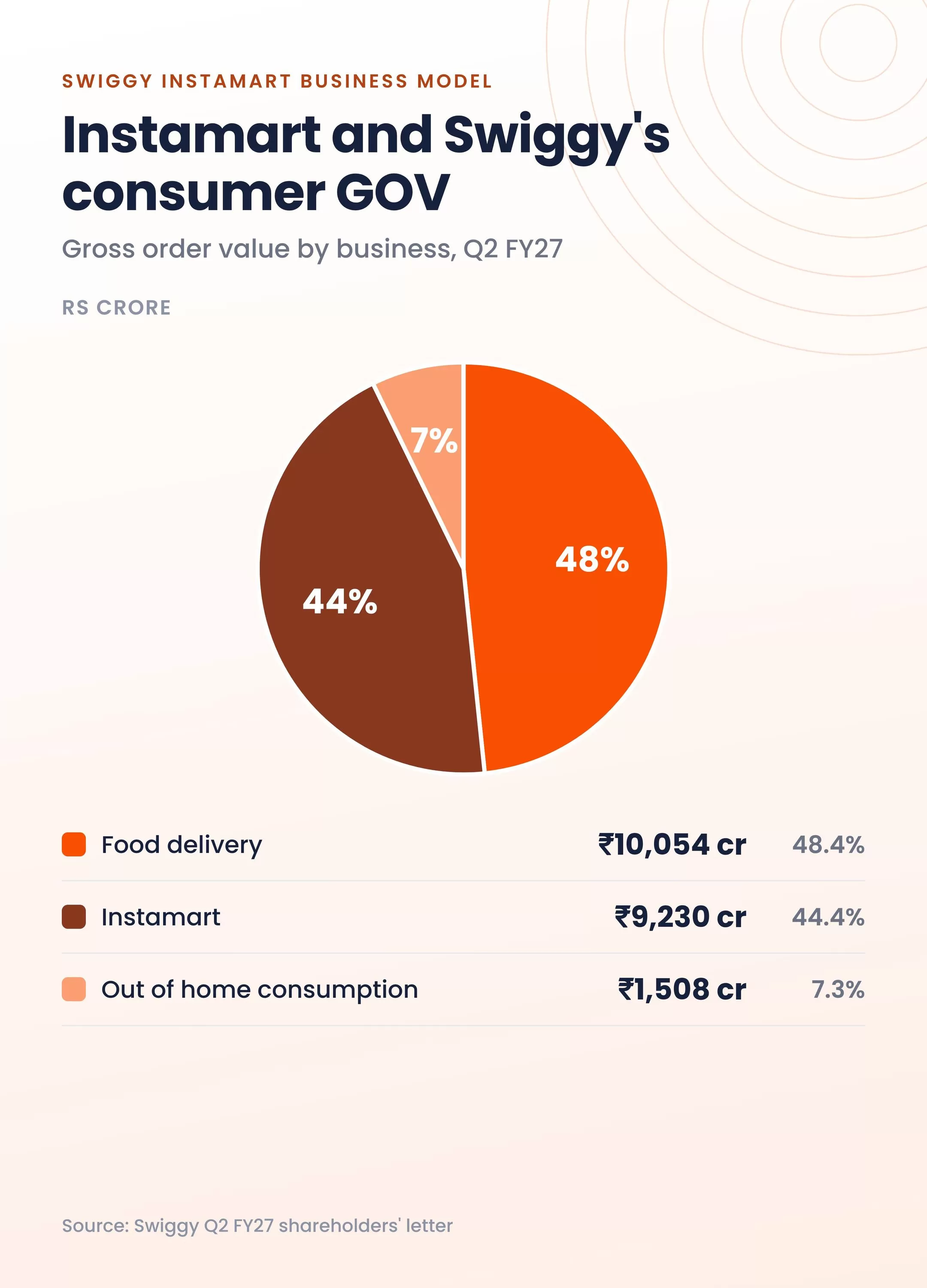
GOV is the value of orders at maximum retail price, before discounts, plus delivery charges, fees and taxes. It is not revenue. Net order value (NOV) is GOV less all discounts, and in Q2 FY27 Instamart's NOV was Rs 6,594 crore.
Swiggy Instamart's Business Model Canvas
Is Swiggy Instamart profitable? Revenue vs segment loss
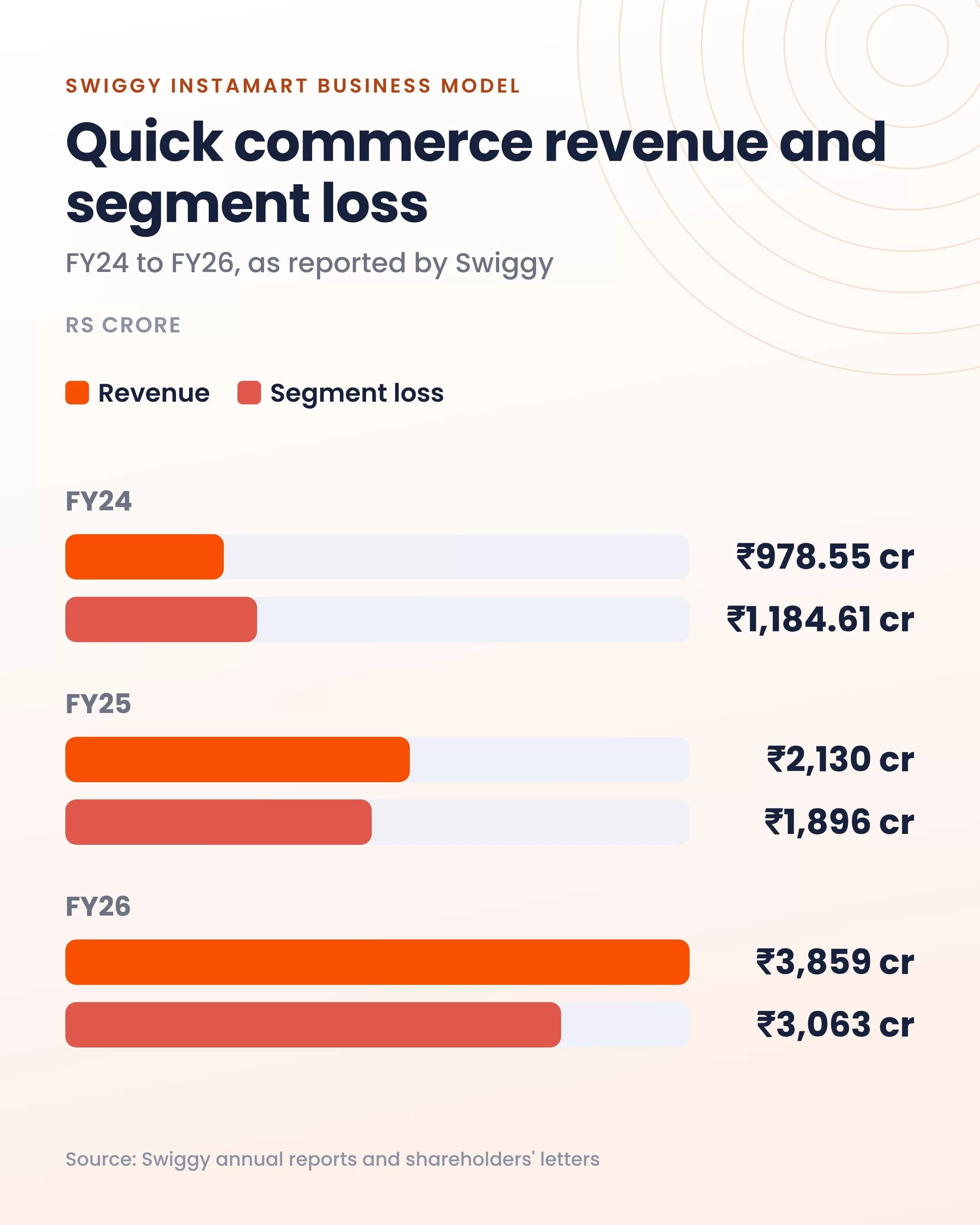
| Rs crore | FY24 | FY25 | FY26 |
|---|---|---|---|
| Quick commerce revenue from operations | 978.55 | 2,130 | 3,859 |
| Quick commerce segment result (loss) | 1,184.61 | 1,896 | 3,063 |
The segment result is the quick commerce result in Swiggy's segment information, before items Swiggy does not allocate to segments, such as other income, share-based payment costs, finance costs and depreciation and amortisation. Swiggy also reports an adjusted EBITDA for the business, which was a loss of Rs 895 crore in Q2 FY27.
Orders, dark stores and unit economics
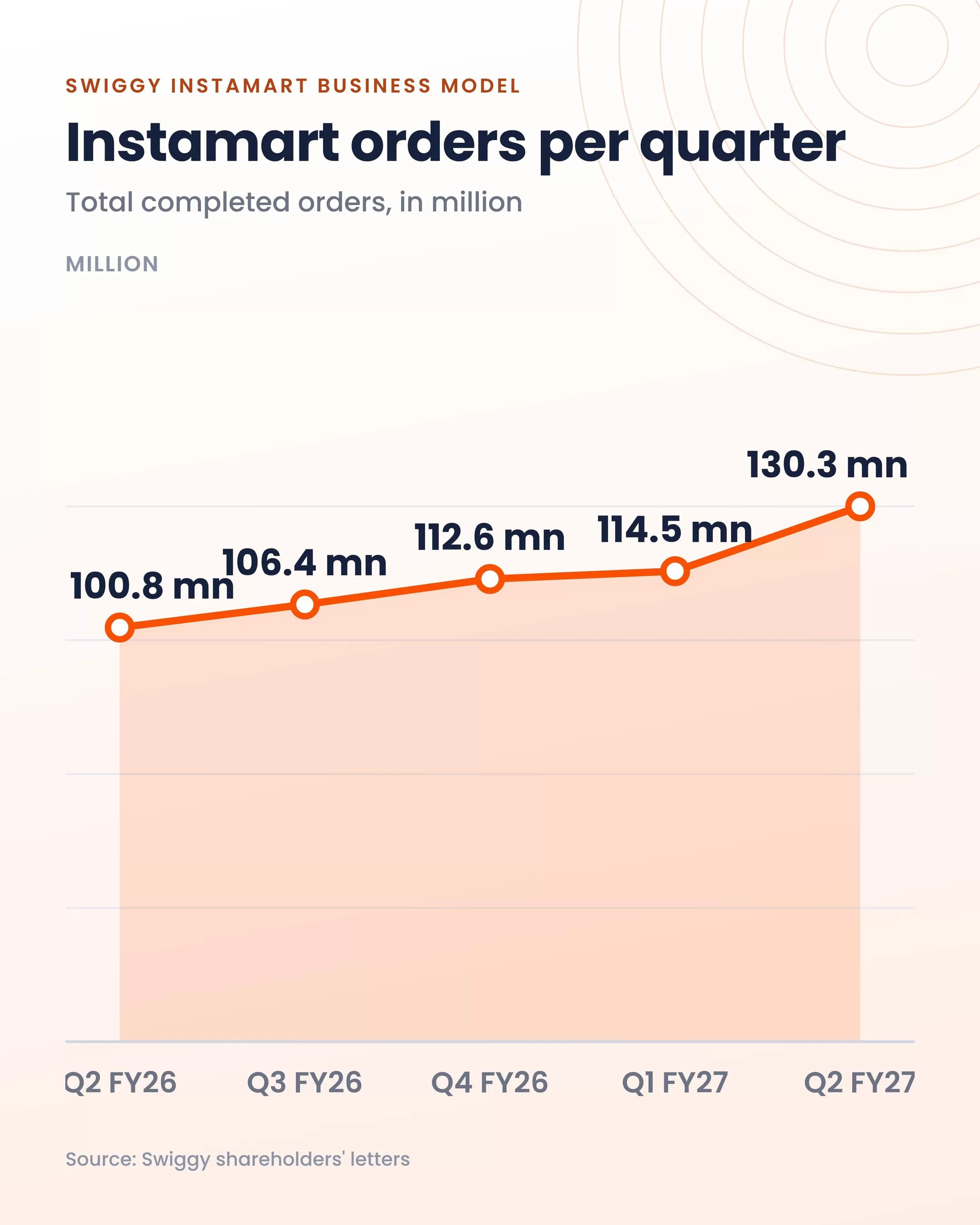
Instamart handled 130.3 million orders in Q2 FY27, up from 100.8 million in Q2 FY26. Its average order value was Rs 708, and it had 14.8 million average monthly transacting users in the quarter.
Instamart dark stores count
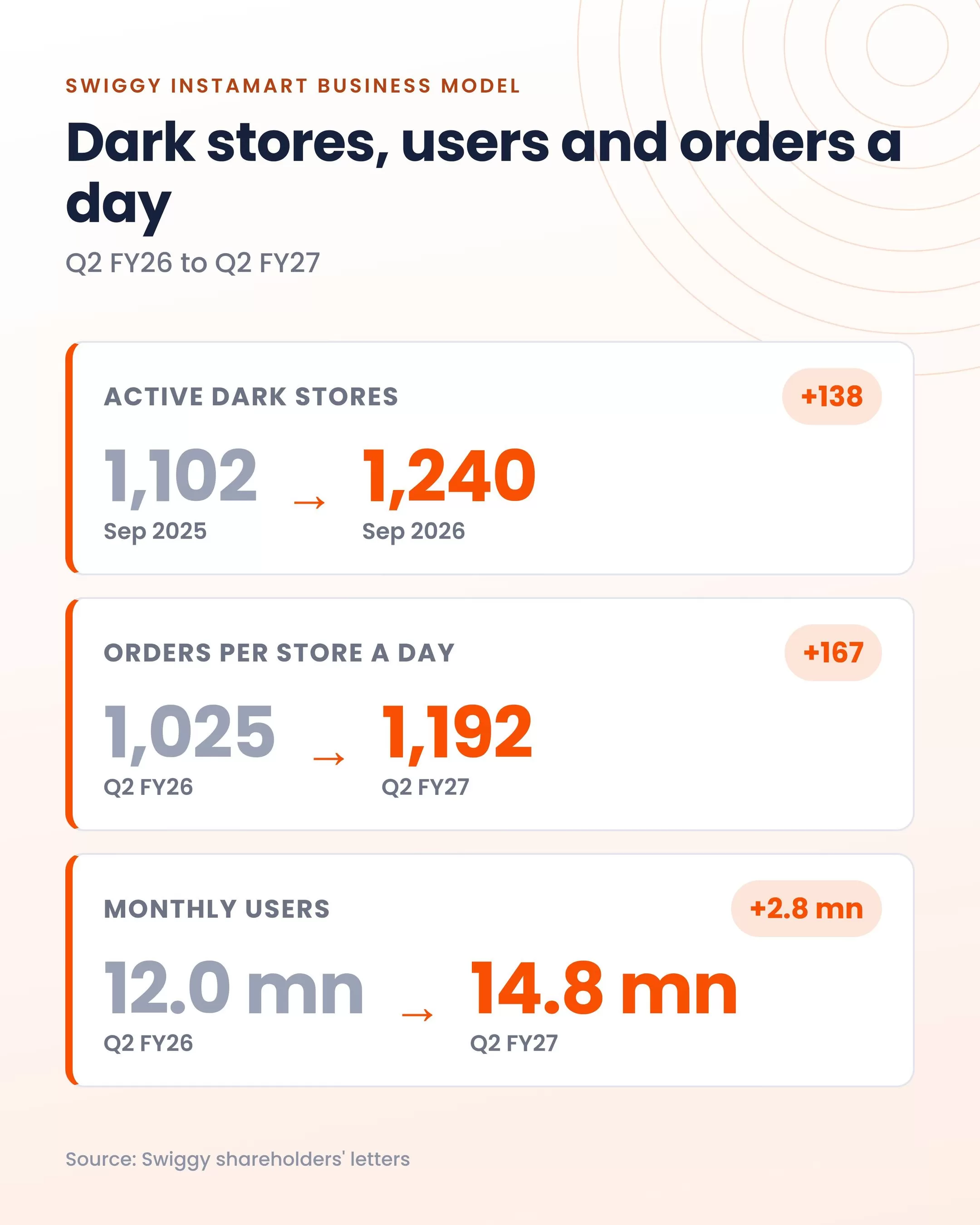
Instamart added 69 net dark stores in Q2 FY27 and had 1,240 active dark stores across 133 cities at the end of September 2026, with a total area of more than 5.2 million sq ft. Each active store handled 1,192 orders a day on average in the quarter, up from 1,025 in Q2 FY26.
Contribution margin is what is left from adjusted revenue after delivery costs, platform-funded discounts, fulfilment costs and other variable costs, shown as a share of GOV. Instamart's contribution margin was -1.0% of GOV in Q2 FY27.
Swiggy Instamart business model shift to owning inventory
Instamart today sells products listed by merchant partners and earns commissions and fees on those sales. Swiggy says that qualifying as an Indian owned and controlled company (IOCC) will allow Instamart to own and sell inventory directly.
At its annual general meeting on 18 August 2026, Swiggy's shareholders approved a cap of 49.5% on foreign shareholding. Swiggy says it has taken the necessary regulatory approvals, that the transition starts from mid-Q3 FY27, and that it could add about 80 basis points to Instamart's contribution margin when fully rolled out.
Swiggy Instamart's journey so far
| When | What happened |
|---|---|
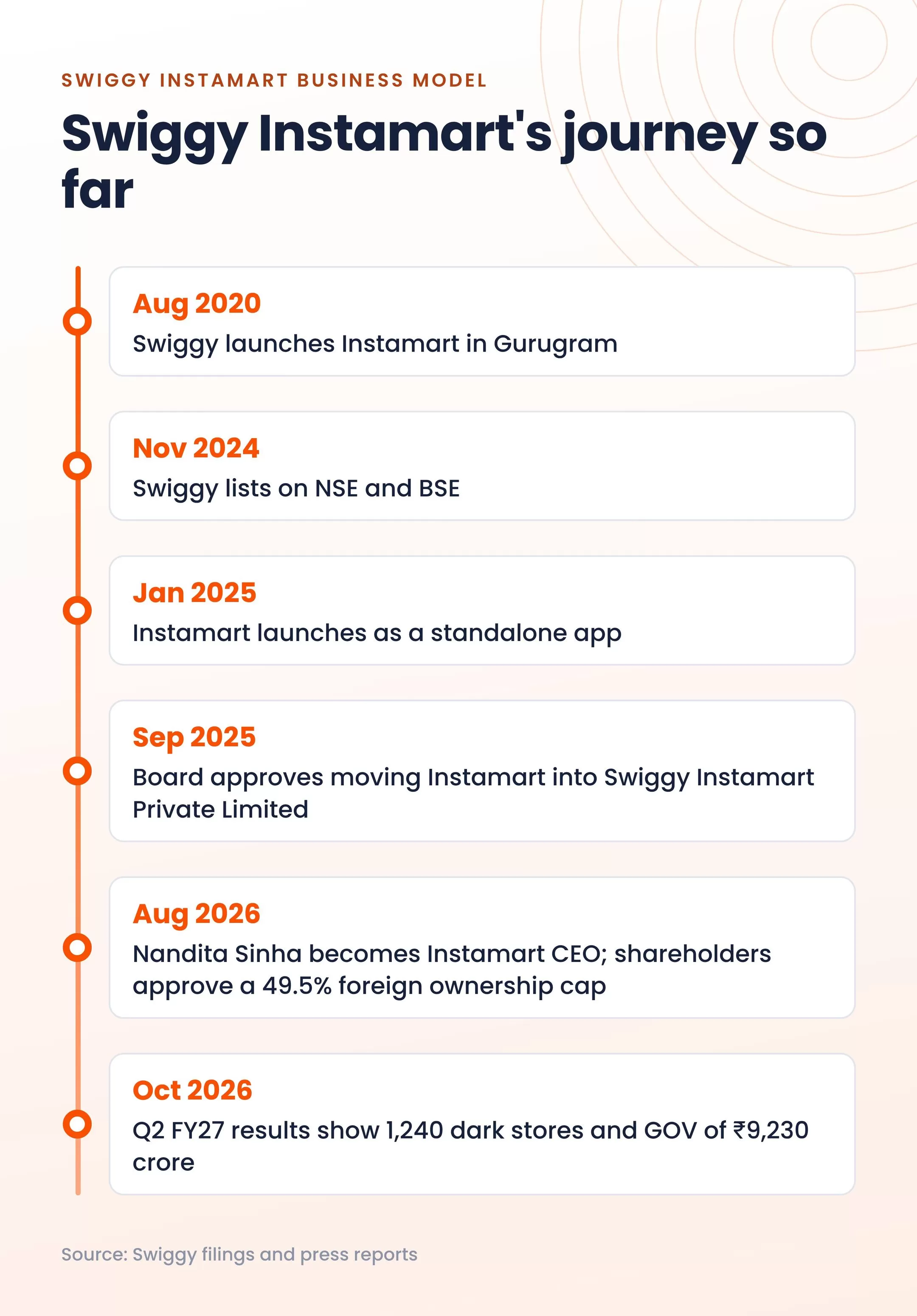
| Aug 2020 | Swiggy launches Instamart in Gurugram |
| 13 Nov 2024 | Swiggy lists on NSE and BSE |
| Jan 2025 | Instamart launches as a standalone app, alongside the Swiggy app |
| Sep 2025 | Swiggy's board approves moving Instamart into Swiggy Instamart Private Limited; the transfer took effect on 1 April 2026 |
| Aug 2026 | Nandita Sinha becomes CEO of Instamart; shareholders approve a 49.5% cap on foreign shareholding |
| 22 Oct 2026 | Q2 FY27 results show 1,240 dark stores and GOV of Rs 9,230 crore |
Who Swiggy Instamart competes with
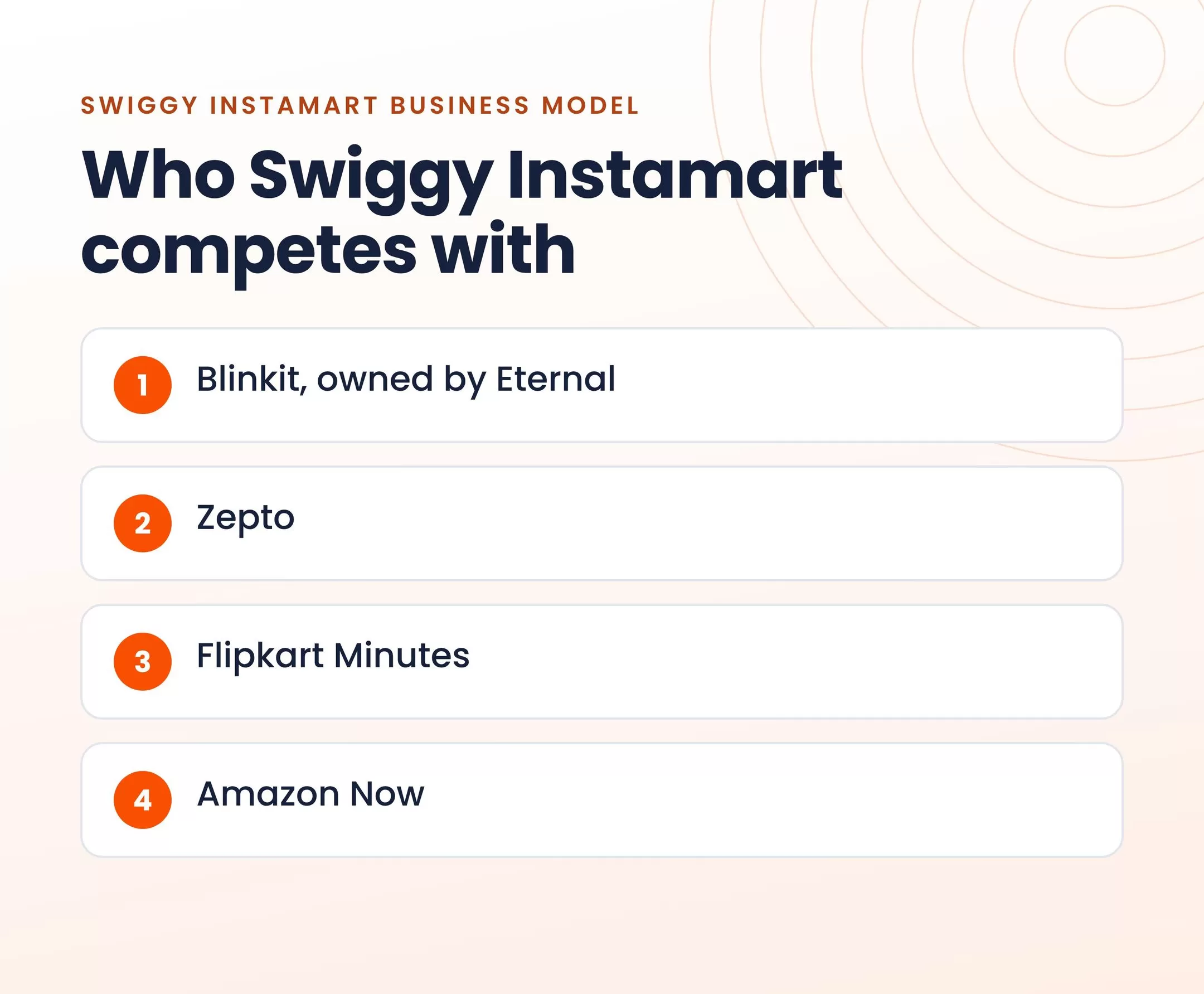
Instamart competes in quick commerce with Blinkit, which is owned by Eternal, with Zepto, and with the quick delivery services of e-commerce companies, Flipkart Minutes and Amazon Now.
Challenges Swiggy Instamart faces
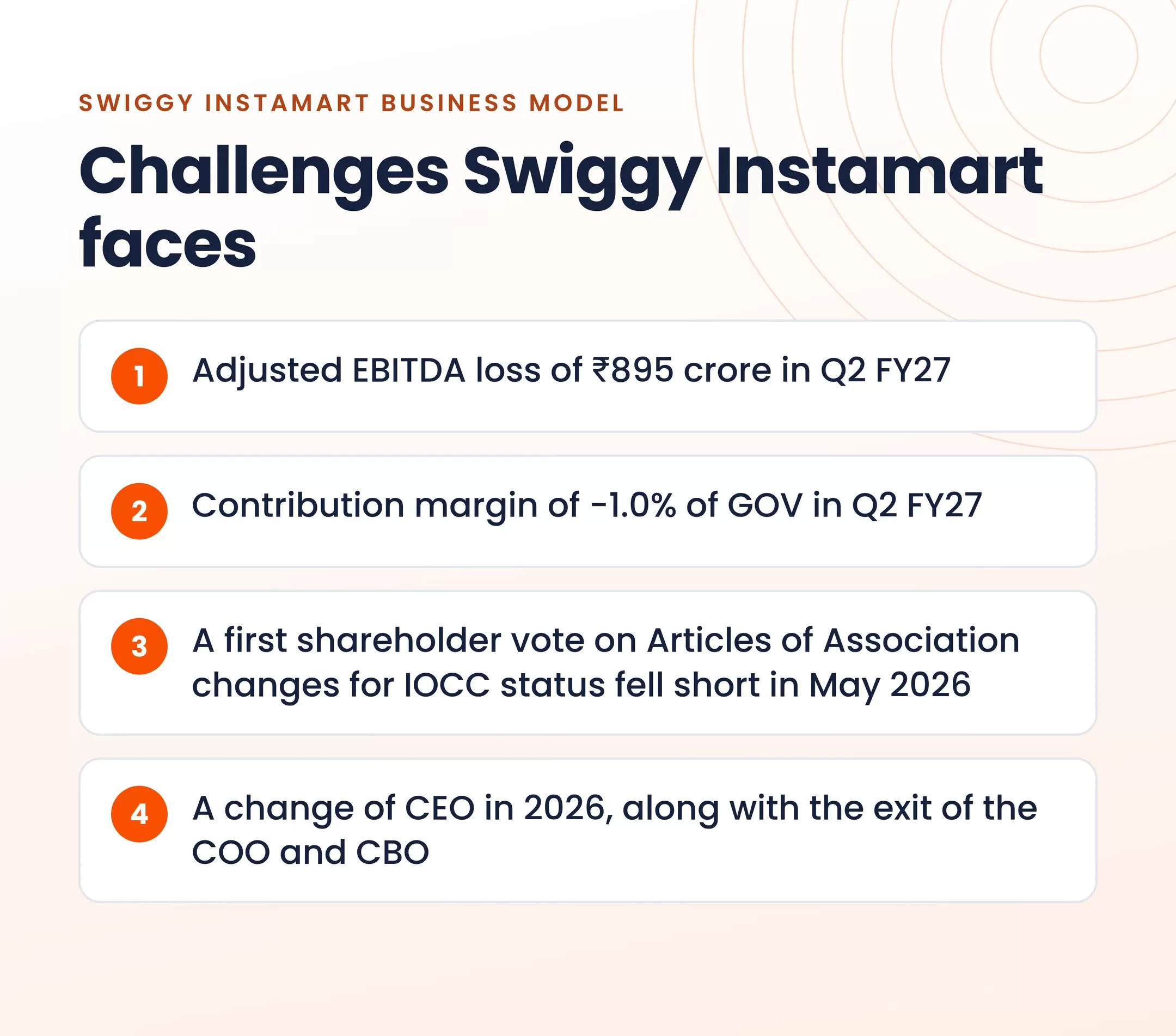
- Instamart reported an adjusted EBITDA loss of Rs 895 crore in Q2 FY27, up from Rs 778 crore in Q1 FY27.
- Its contribution margin was -1.0% of GOV in Q2 FY27.
- A first shareholder vote, in May 2026, on changes to Swiggy's Articles of Association linked to its plan to become an Indian owned and controlled company received 72.36% support, below the 75% needed for a special resolution. The 49.5% foreign shareholding cap was later approved at the August 2026 annual general meeting.
- Amitesh Jha resigned as Instamart CEO in July 2026, after the exit of Instamart's COO and CBO.
Conclusion on the Swiggy Instamart business model
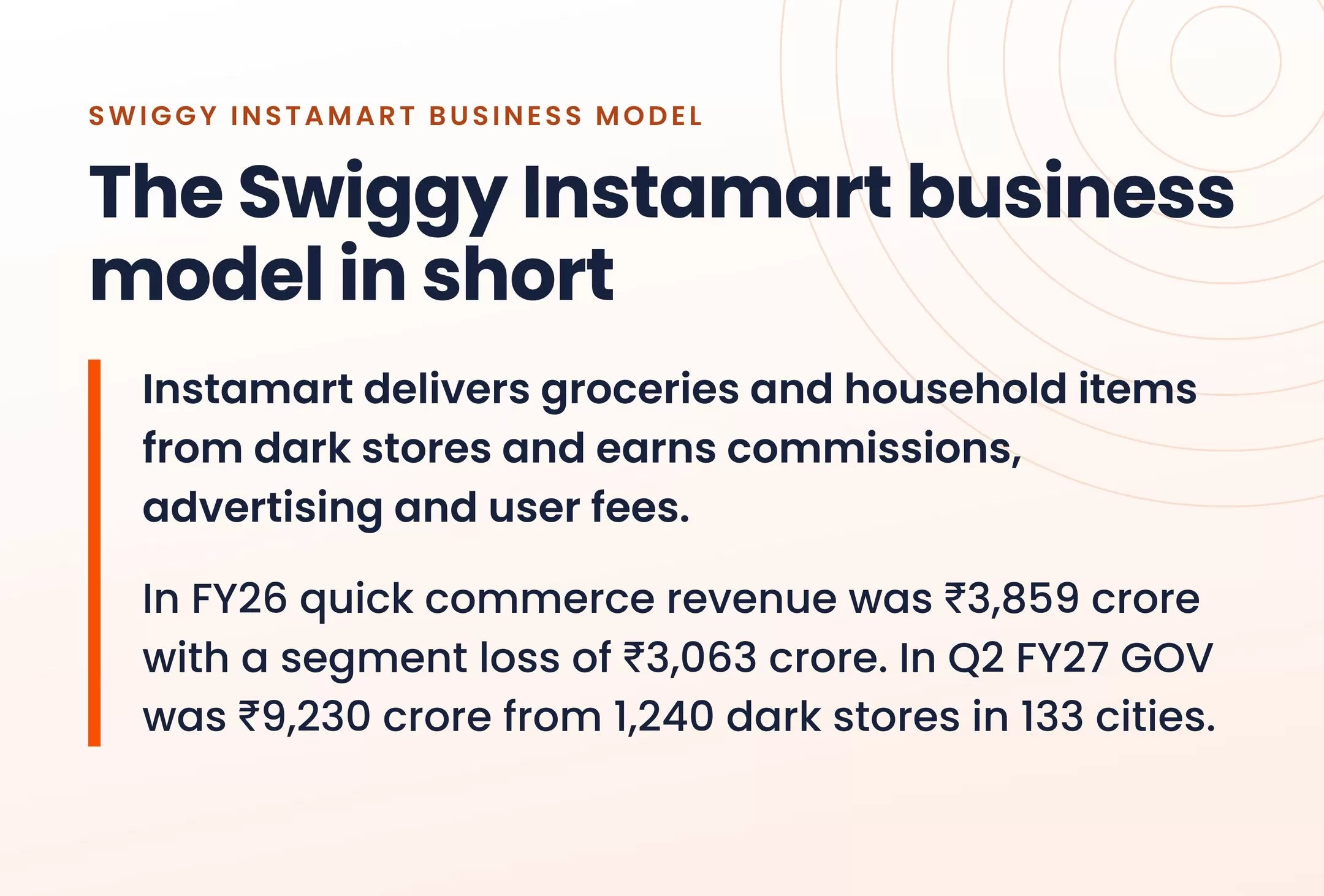
The Swiggy Instamart business model delivers groceries and household items from a network of dark stores, ordered through the Swiggy app or the Instamart app. It earns commissions from merchant partners, advertising from brands, and fees from users, and Swiggy is moving it towards owning the inventory it sells.
In FY26 quick commerce revenue from operations was Rs 3,859 crore and the segment loss was Rs 3,063 crore. In Q2 FY27 Instamart had GOV of Rs 9,230 crore, an adjusted EBITDA loss of Rs 895 crore and 1,240 active dark stores in 133 cities.
More from IncBusiness
Read our news report: Swiggy Net Loss Narrows to Rs 922 Crore in Q2 FY27.
Related: AI tools for e-commerce.


