India is home to more than 63 million people living with hearing loss, a stagnant IVF success rate for two decades, and millions of children overtreated with antibiotics. And these are just three of the gaps. Across diagnosis, treatment, recovery, and long-term care, the problems are far wider and far more varied than any single headline can hold.
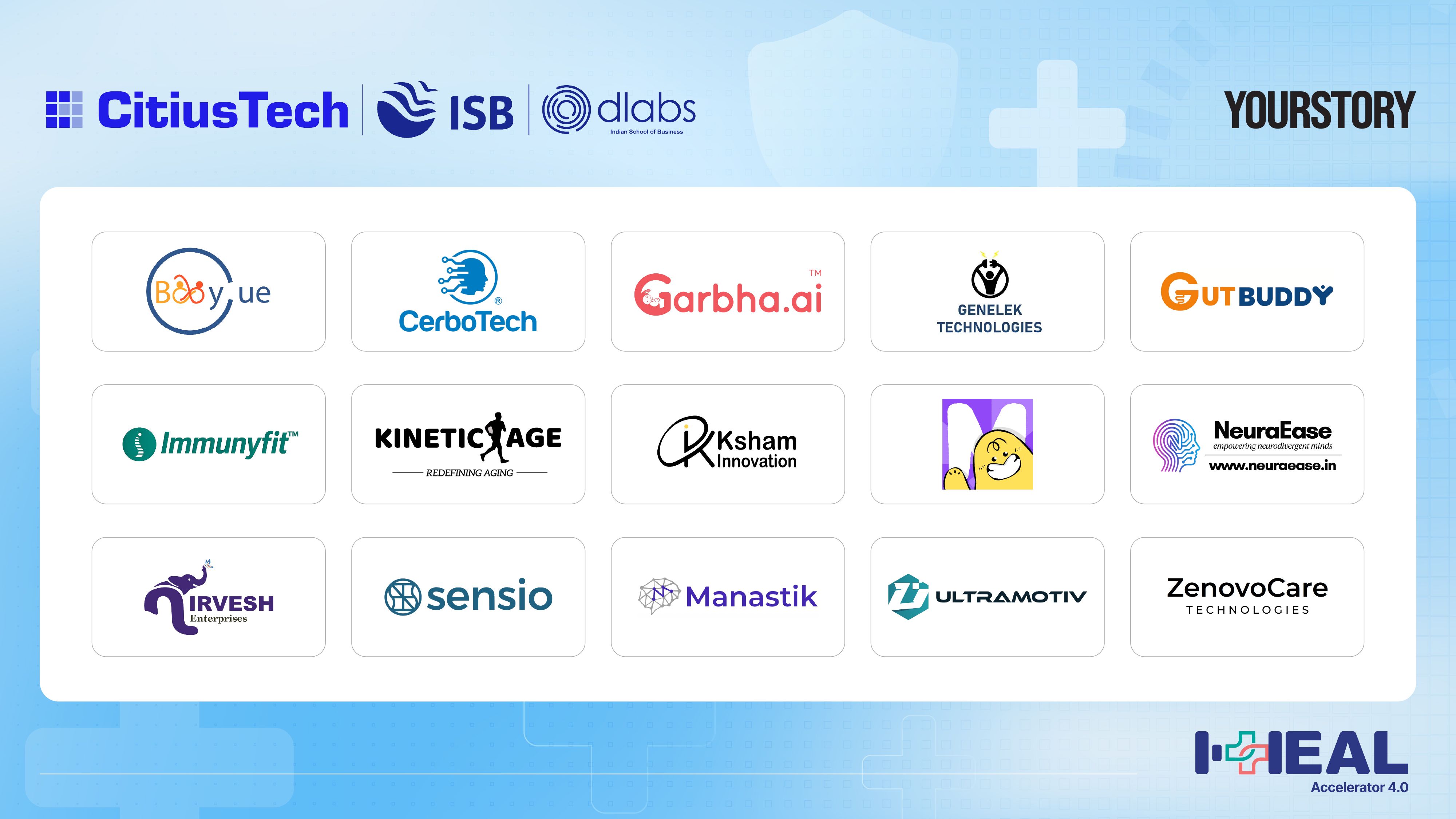
Enter the fourth cohort of I-HEAL, which is made up of founders who identified these gaps and decided to solve them. Fifteen startups, each working on a different problem, across digital health, diagnostics, neuro-rehabilitation, geriatric care, and women's health. Some of their solutions will find their way into hospitals. Others will reach people directly: in their homes, schools, and communities, bypassing the formal system entirely to get to the people who need them most.
Run by ISB DLabs at ISB I-Venture and powered by CitiusTech, I-HEAL is the Healthcare Entrepreneurship Acceleration Lab where these founders are turning ideas into scalable businesses.
Where early healthcare ideas are put to the test
I-HEAL takes in startups that already have a tested prototype or MVP, typically at Technology Readiness Level 5 or above, and focuses on what comes next: getting to market, validating clinically, and raising capital. The cohort is small by design, capped at 15, so that mentorship and support are concentrated rather than spread thin.
Each startup undergoes a gap analysis at the start of the program. What follows is tailored to where each company actually needs help, whether that is regulatory navigation, go-to-market strategy, business model refinement, or investor readiness. They can access mentorship from ISB faculty, clinicians, industry leaders, and investors, through a mix of one-on-one sessions, mentoring sprints, and Immersive workshops; Strategy Days.
Access to clinical partners and hospital networks is how I-HEAL separates itself from most accelerators. Startups get structured introductions to hospital partners and clinical sites for real-world validation, the kind that turns a product that works in testing into one that survives actual clinical workflows.
CitiusTech's involvement deepens this considerably. As one of India's leading healthcare IT companies, with roots in hospital systems and clinical infrastructure, it gives cohort startups a line into how healthcare organisations actually make adoption decisions.
“This cohort is tackling some of the most fundamental gaps in care delivery. At I-HEAL, our focus is on helping founders move from validation to deployment—ensuring their solutions can integrate into real-world healthcare systems and scale effectively.” said Saumya Kumar, CEO, ISB DLabs, and Director, ISB I-Venture.
Meet the startups tackling critical healthcare gaps
BabyCue is a rapid diagnostic kit that differentiates between bacterial and non-bacterial diarrhoea in children under five, addressing a key driver of antibiotic misuse and antimicrobial resistance. The kit integrates with a mobile app for AI-powered colourimetric results and is backed by clinical validation.
Cerbo Tech uses brain-computer interface technology and cognitive training games to address the mental wellness of students. Its flagship product, NeurOm, targets the brain health of over 100 million students in India. It has been downloaded more than 10,000 times and has 3,000 paid subscribers. The team is also eyeing markets in sports performance, defence training, and career counselling.
Garbha.aiis a B2B SaaS platform working on improving IVF success rates that have hovered in the range of 30-35% for years. Using multimodal AI for embryo grading, visual tracking, and heatmap analysis, the platform aims to make fertility care more intelligent and affordable. The founding team, which includes ISB and IIT-H alumni, is targeting 3,000+ IVF centres, with a $25 billion global market in view.
GenElek Technologies is building clinical exoskeletons for patients recovering from stroke, spinal cord injury, or other mobility-limiting conditions. Its exoskeleton provides coordinated multi-joint actuation across the hip, knee, and ankle, with kinematics logging to track recovery. Early pilot deployments have drawn positive clinician feedback.
GUTBUDDY addresses irritable bowel syndrome through an AI-powered platform combining screening, dietary guidance, voice-assisted therapy, and therapeutic yoga, while also serving as a diagnostic tool for doctors. Beta modules are live with 300+ freemium users, and four hospitals have been onboarded for multicentre studies.
Immunyfit is a biology-first digital twin platform for autoimmune and gut-immune conditions, using systems biology to deliver precision care where current medicine offers only generalised protocols. In 11 months, the startup has analysed 2,000+ patient datasets, signed three hospital partnerships, and built a paying user base of 800 to 1,000.
KINETIC AGE addresses the lack of structured health ownership, activity, and follow-through for senior citizens, whether after medical discharge or in their day-to-day lives. The platform delivers doctor-led physiotherapy, strength training, nutrition, and mental wellness programmes at home through an app, starting with Bengaluru before a planned 10-city rollout.
Ksham Innovation is solving for the 90% of India’s 63 million hearing-impaired people who do not use hearing aids. Its Able Glasses use a patented bone conduction transducer to enable communication, paired with an app for finding audiologists and hearing tests. The startup has partnered with 20+ audiologists and tested with 50+ users.
Manastik is a full-spectrum neurological recovery platform covering screening, personalised rehab plans, home-based daily therapy, and teleconsultation with neurologists and therapists. It brings together AI-generated rehab routines, cognitive exercises, progress tracking, and care coordination in one place.
Mimansa Play makes speech therapy accessible for young children, particularly those with autism spectrum disorder, through voice-activated games for ages 2-5. Its PIKO AI model, trained on children’s speech, adapts to each child’s ability. The child speaks, the AI listens, and the game responds, with guided reinforcement built in for parents.
NeuraEase is a hardware-enabled SaaS platform for individuals with autism, ADHD, PTSD, and anxiety. Custom sensors feed machine learning models that detect physiological distress before it escalates, predicting potential meltdowns with 84% accuracy and giving users a 15-minute window to act. The platform treats autonomic distress as a biological event, not a behavioural choice.
Nirvesh Enterprises (Synapsil) is developing a wearable brain health headband that combines neurofeedback-based neurostimulation with monitoring through EEG, HRV, and fNIRS, making clinical-grade neurological tracking affordable and accessible outside hospital settings.
Sensio is an original design manufacturer of health wearables across smart rings, chest patches, and smart bands, delivering vitals monitoring and health insights through edge AI. Its flagship Orbyt is India’s first ECG-enabled smart ring. Sensio also offers a ward ICU dashboard for nurses and patient health dashboards for doctors and families.
Ultramotiv is building MAURIS (Modular Adaptive Unified Rehabilitation Intelligent System), a modular robotic therapy platform that delivers high-intensity, standardised rehabilitation through a 6-degree-of-freedom robotic arm and an AI outcome engine. The startup has secured Rs 76 lakh in initial capital, multiple grants, and support from the NVIDIA Inception Program.
ZenovoCare Technologies is developing iThera, a wireless smart electrotherapy device for stroke rehabilitation, chronic pain, and muscle recovery. Using Pulse+ technology across TENS, NMES, and FES modes, integrated EMG sensors, and electrode pads that cut placement time by four times, the device is built for real-world clinical use. ZenovoCare has received support from IIT Roorkee, BSC BioNEST, Startup India, and Startup Haryana.
Where healthcare innovation is shifting next
What the fourth cohort makes clear is that the opportunity in Indian healthcare isn’t concentrated in one place. From brain health in schoolchildren to robotic rehabilitation to at-home geriatric care, the problems being worked on are varied, and so are the approaches.
What ties them together is a shared understanding that the current system has gaps, and that those gaps are large enough to build serious businesses in. Whether this cohort can prove that out is what comes next.
Original Article
(Disclaimer – This post is auto-fetched from publicly available RSS feeds. Original source: Yourstory. All rights belong to the respective publisher.)