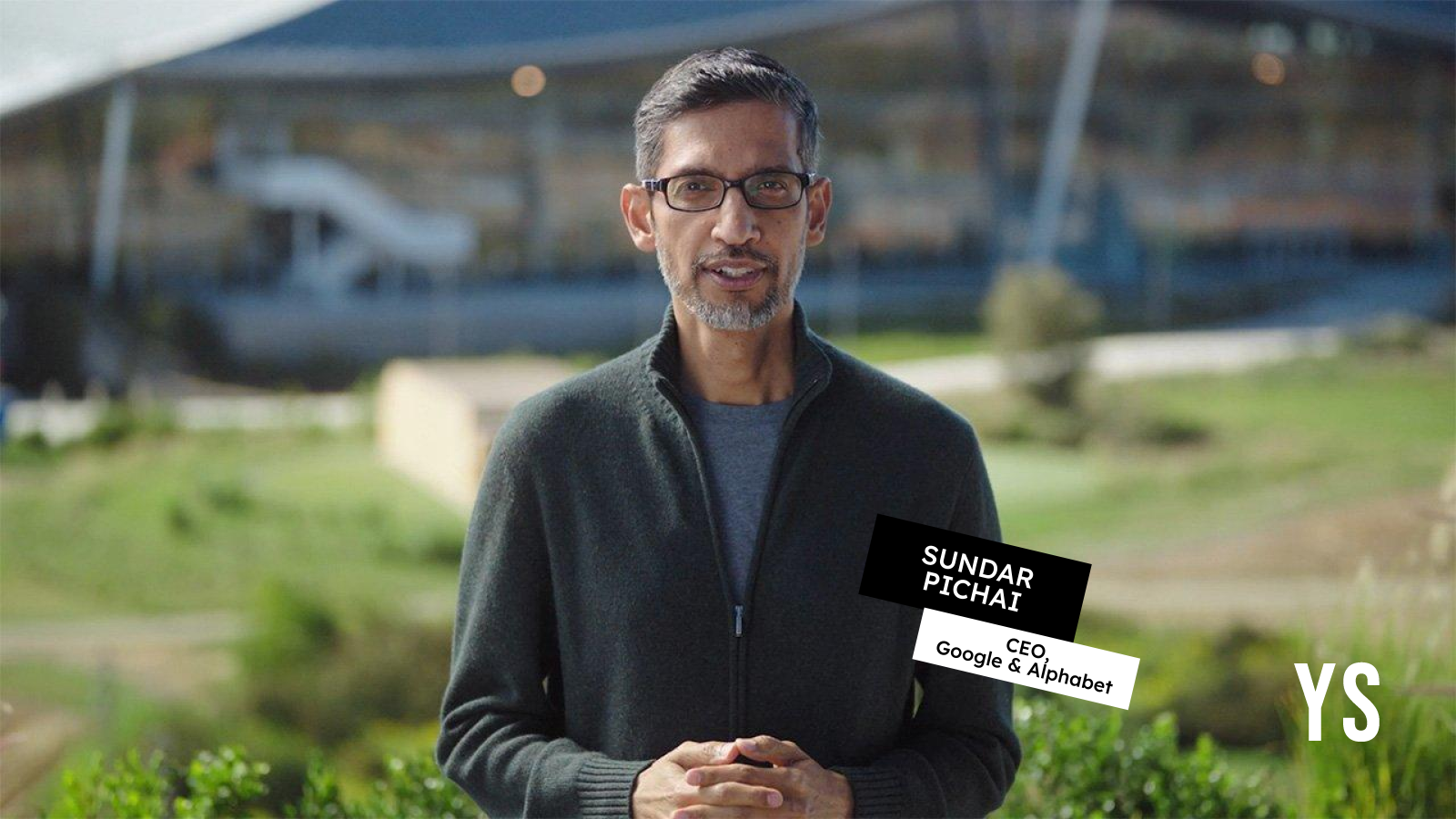
Google parent Alphabet is off to a “terrific start” in 2026, said CEO Sundar Pichai, as the company’s first-quarter net profit jumped 81% year on year. With the business, particularly cloud, benefitting from the AI momentum, it plans to increase investment to sustain this growth.
The California-based company’s net profit in Q1 was $62.6 billion compared to $34.5 billion in the year-ago period. This included the net effect of the gain on equity securities of $36.9 billion.
Meanwhile, its revenue in the quarter surged by 22% to $109.9 billion from $90.2 billion in the same period last year, making it the company’s 11th consecutive quarter of double-digit revenue growth.
Money cloud
Google Cloud continued to see strong customer demand, with revenue rising 63% YoY to $20 billion, bringing it to roughly a third of the size of Google Search, its largest business. Operating income in the cloud division surged to $6.6 billion, growing 32.9% YoY.
Google is the third-largest player in the cloud computing industry, competing with Amazon Web Services (AWS) and Microsoft.
“Cloud accelerated again this quarter due to strong demand for our AI products and infrastructure,” Pichai explained during the first-quarter earnings call. “Our enterprise AI solutions have become our primary growth driver for cloud for the first time.”
He also noted that Gemini Enterprise is gaining strong traction, with paid monthly active users up 40% quarter on quarter, while consumer AI subscriptions had their strongest quarter, driven by the Gemini app. First-party models now process over 16 billion tokens per minute via APIs.
The company is “compute constrained in the near term,” Pichai highlighted, adding, “Our cloud revenue would have been higher if you were able to meet the demand. So we are working through that moment, and we are investing.”
Anat Ashkenazi, Chief Financial Officer of Alphabet and Google, said Google Cloud’s backlog nearly doubled sequentially to $462 billion at the end of the first quarter, driven by strong demand for enterprise AI offerings and the inclusion of TPU (tensor processing units) hardware sales.
“The majority of the backlog is related to typical GCP (Google Cloud Platform) contracts and we expect to recognise just over 50% of the backlog as revenue over the next 24 months,” she added.
Recently, Google introduced its 8th generation TPUs , which are custom AI accelerator chips, used in AI model training and inference workloads, just like NVIDIA and AMD GPUs.
Earlier, these TPUs were available only through Google's cloud. But now the company plans to offer these TPUs to a select group of customers in their own data centres in the hardware configuration to expand its addressable market opportunity, said Pichai.
“We expect to begin recognising a small percent of the revenues from these agreements later this year with the vast majority of revenues to be realised in 2027,” Ashkenazi noted.
AI momentum
Pichai highlighted that AI infrastructure is the foundation of the company’s full stack approach to AI, which is driving customer growth and product adoption.
In the first quarter, the company’s capital expenditure (capex) was $35.7 billion, up 107% YoY. The bulk of spending was on technical infrastructure to support AI, said Ashkenazi, with about 60% allocated to servers and 40% to data centres and networking equipment.
“We are seeing unprecedented internal and external demand for AI compute resources,” Ashkenazi explained. “The strong results reinforce our conviction to invest the capital required to continue to capture the AI opportunity.”
She said the company has raised its full-year 2026 capital expenditure guidance to $180 billion to $190 billion from $175 billion to $185 billion, and expects 2027 capex to rise significantly further.
Alphabet’s big tech peers Meta, Microsoft, and Amazon have also sharply increased capital spending to expand server and data centre capacity as AI-driven growth lifts computing demand, despite concerns about a potential AI bubble, with their combined capex expected to exceed $650 billion in fiscal 2026.
Search and beyond
Most of Alphabet’s revenue still comes from Google advertising. In the first quarter, ad revenue, including Google Search, YouTube ads and the Google Network, rose 15.5% year on year to $77.3 billion.
“AI continues to drive search usage and queries are at an all-time high. We continue to invest in improvements to AI overviews, which are driving overall search growth,” Pichai noted.
The company’s revenue from Google Search, increased 19% to $60.4 billion in Q1. Meanwhile, YouTube ad sales climbed 11% to $9.9 billion during the quarter.
During the period, Other Bets, encompassing the Waymo driverless taxi service, witnessed a decrease in revenue, to $411 million. The segment also incurred an operating loss of $2.1 billion.
The company expects to continue hiring in key investment areas such as AI and cloud. As of March 31, 2026, Alphabet’s employee count was 1,94,668, up from 1,85,719 in the previous year.
Edited by Swetha Kannan
Original Article
(Disclaimer – This post is auto-fetched from publicly available RSS feeds. Original source: Yourstory. All rights belong to the respective publisher.)