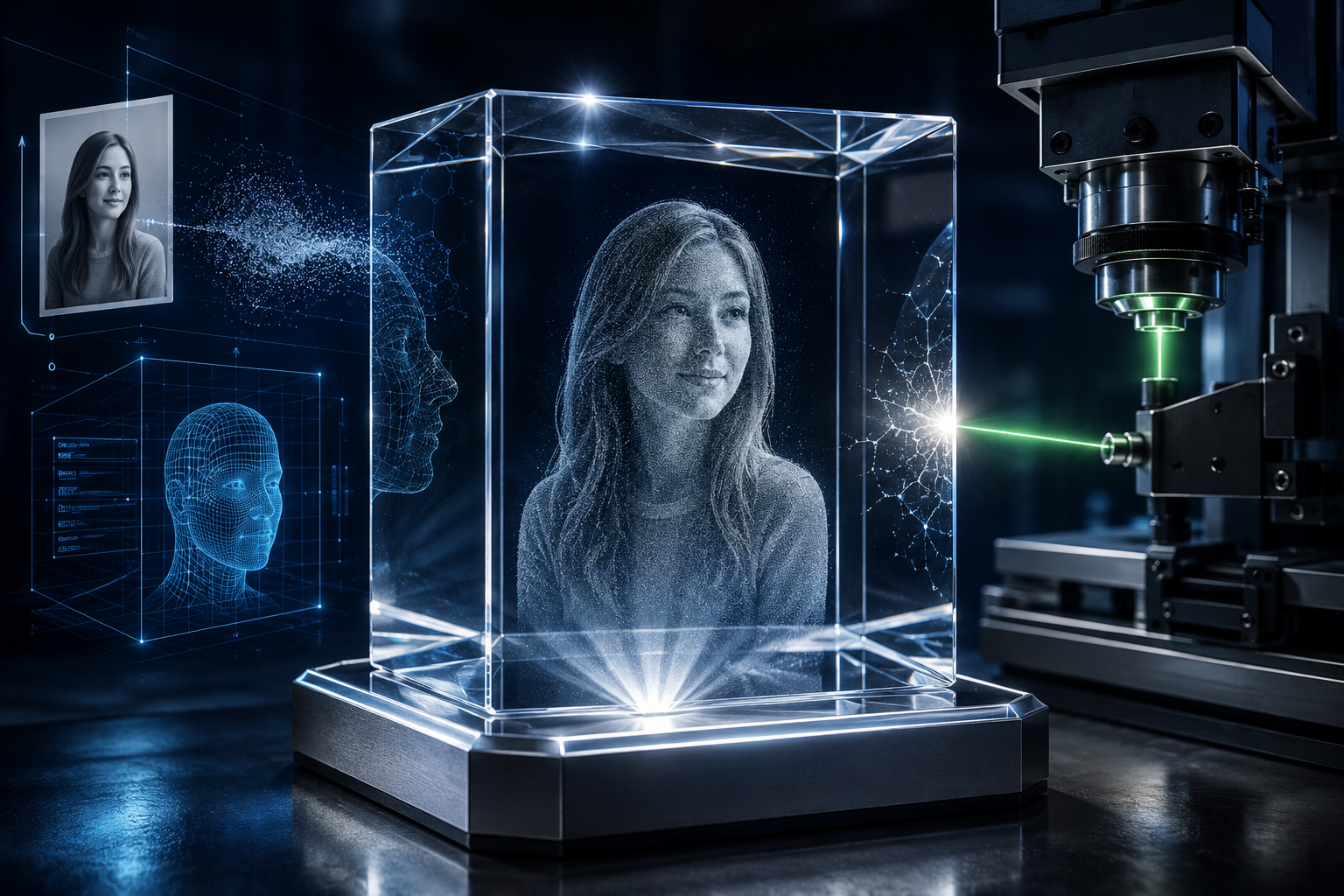
In the world of personalized art, custom home decor, and commemorative keepsakes, the ability to preserve a memory with physical permanence is highly valued. While traditional paper photographs can fade or yellow over time, and surface etchings can wear away under physical friction, a unique medium has emerged as a modern alternative: three-dimensional laser-etched glass. Commonly known as 3D crystals, these objects showcase lifelike, volumetric portraits or complex geometric designs floating completely untouched inside a solid block of transparent material.
Understanding how a flat, two-dimensional digital file transitions into a detailed internal structural design requires an exploration of optical materials science, specialized computer-aided design modeling, and sub-surface laser engineering. This comprehensive guide breaks down the physical components, manufacturing processes, and display methods that define the modern 3D crystal industry.
The Structural Foundation: Optical-Grade K9 Crystal
To achieve a flawless internal laser engraving, the baseline material must meet incredibly rigid clarity standards. The premium standard for 3D photo crystals relies on a specialized material known as K9 borosilicate glass, commonly referred to as K9 crystal.
While natural quartz crystals contain mineral inclusions, internal fractures, and chemical impurities that would crack or shatter under high-intensity thermal stress, K9 glass is engineered in highly controlled environments to guarantee maximum purity. It is formulated with high concentrations of boron trioxide and silica, allowing it to achieve a high refractive index and exceptional optical transmission properties.
Because this material is lead-free, it remains completely stable over long periods. It will not fog, cloud, or discolor when exposed to direct sunlight or ambient room moisture. This perfect transparency ensures that light can pass cleanly through the block, reflecting off the internal design without hitting structural distortion.
The Manufacturing Pipeline: From 2D File to 3D Map
The transformation of a digital image into a floating three-dimensional object inside a solid glass cube involves a multi-stage software and hardware workflow.
Step 1: Point-Cloud Transformation
A standard laser cannot simply draw continuous fluid lines inside a solid piece of glass. Instead, the engraving software must break the source file down into an organized web of coordinates known as a point cloud.
For standard portraits, specialized conversion software maps out the natural contours of the human face, determining the depth of the nose, the curvature of the jawline, and the orientation of facial features. Every individual detail is converted into an independent coordinate along the X, Y, and Z axes. A typical medium-sized crystal will consist of hundreds of thousands, or even millions, of these distinct spatial data points.
Step 2: Sub-Surface Laser Engraving (SSLE)
Once the digital point-cloud map is finalized, the crystal block is positioned inside a specialized sub-surface laser engraving (SSLE) machine. These systems typically utilize high-powered Nd:YAG (neodymium-doped yttrium aluminum garnet) lasers or green light laser arrays because they can pass through transparent substrates cleanly without affecting the surface layer.
The core magic of the process relies on the physics of focal points. The laser head emits ultra-short, high-energy pulses of light that move smoothly through the exterior of the K9 crystal without altering the glass. However, when the beam hits its precise internal target coordinates, the concentrated optical energy becomes intense enough to create a localized thermal shockwave. This micro-explosion generates a tiny, controlled fracture, resulting in a microscopic white dot. The exterior surface remains perfectly smooth, flawless, and untouched.
|
Production Stage |
Primary Process Involved |
Physical Result |
|---|---|---|
|
Image Acquisition |
Digital photograph optimization and background masking. |
High-contrast 2D source file. |
|
Mathematical Modeling |
Depth mapping via specialized 3D conversion software. |
Volumetric coordinate file (X, Y, Z axes). |
|
Laser Execution |
Sub-surface focal tracking via Nd:YAG or Green laser arrays. |
Creation of internal point-cloud micro-fractures. |
|
Final Inspection |
Microfiber clearing and optical refraction testing. |
Flawless, light-scattering 3D internal sculpture. |
Optical Effects: The "Following" Illusion
One of the most engaging characteristics of a completed 3D crystal is an optical phenomenon known as the "following effect." When viewing a high-quality 3D portrait inside the glass block from the front, you see a static, three-dimensional representation of the subject.
However, due to the concave nature of the laser mapping along the back half of the point cloud, if you turn the crystal around and look through the rear surface, an optical illusion causes the face to appear to turn and track your movements as you walk across the room. This interplay of depth, shadow, and glass refraction turns a static photo display into a dynamic sculpture that changes based on your viewing position.
Commercial Execution: The Modern Gifting Landscape
Today, the technology has reached a point where retail consumers can easily order custom 3D photo crystals online for anniversaries, retirement awards, and family memorials. Companies like Artpix3D have built extensive digital platforms designed to manage this complex pipeline at scale.
By using automated software to preview designs before production, they help bridge the gap between complex industrial laser engraving and direct consumer access. The availability of diverse geometries, such as hearts, towers, diamonds, and jagged icebergs, shows how flexible K9 crystal can be when integrated into modern home decoration and memory preservation.
Optimizing the Display: The Role of Illumination
Because the internal image inside a 3D crystal is composed entirely of microscopic fractures, its visibility relies heavily on how light interacts with the glass. In a dimly lit room, an unlit crystal can lose its definition, as the ambient light is not strong enough to refract off the internal points.
To counteract this, these keepsakes are frequently paired with dedicated LED light bases. These bases use high-intensity light emitting diodes that fire straight up through the bottom surface of the crystal block. When the upward light hits the micro-fractures, the points scatter the rays, causing the floating image to glow brightly while the surrounding untouched glass remains dark. Choosing a cool white LED highlights fine details with crisp, modern resolution, while warm white or candle-style LEDs provide a softer, more traditional glow suited for living room mantels and quiet memorial corners.
Original Article
(Disclaimer – This post is auto-fetched from publicly available RSS feeds. Original source: Startuptalky. All rights belong to the respective publisher.)