Most conversations about AI infrastructure end up in the same place: the cloud. More compute, more cost, more distance between the developer and the work.
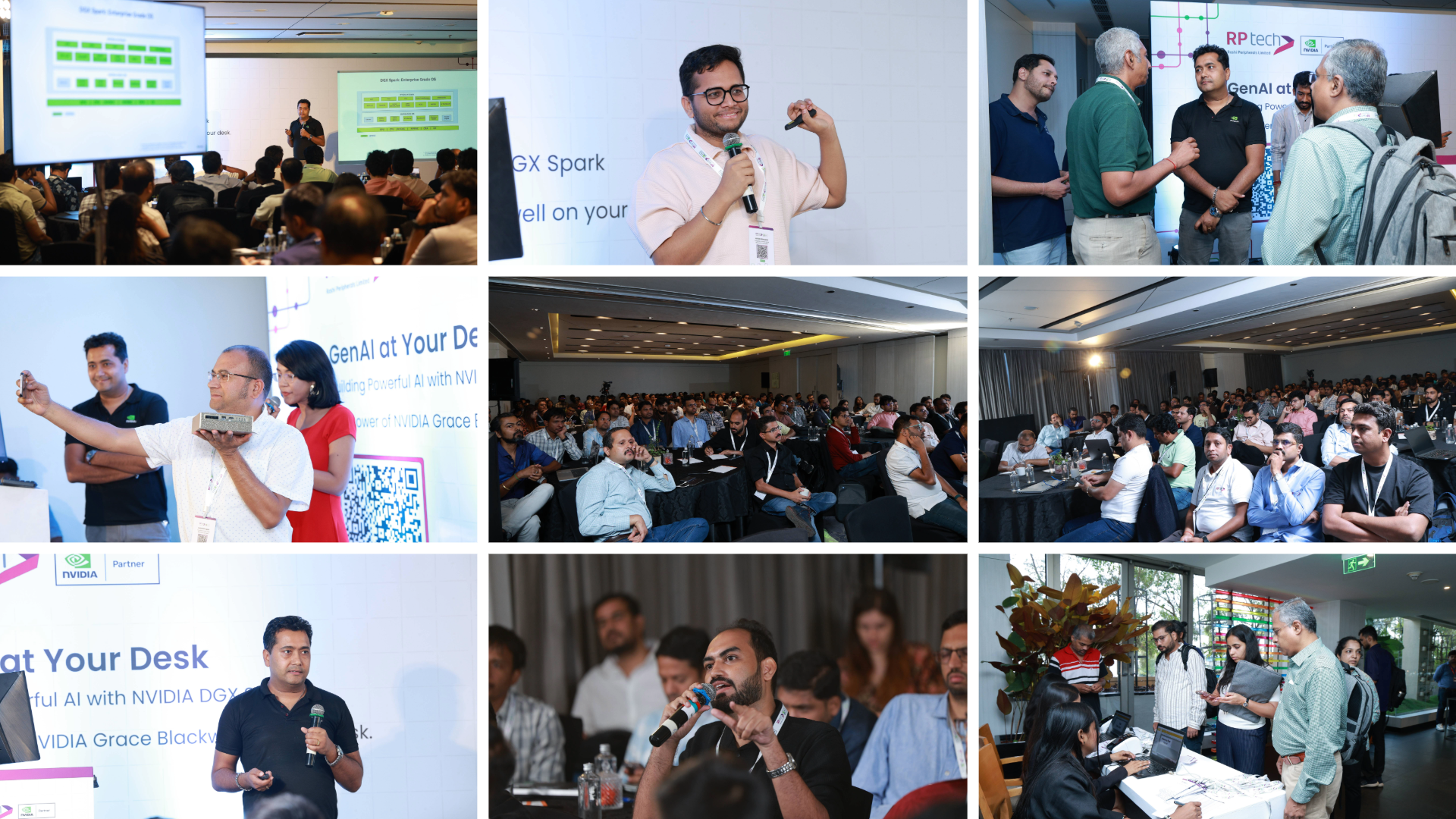
On April 11, 2026, RP Tech, an NVIDIA Partner, in collaboration with YourStory, hosted a different conversation at Hyatt Centric, Bengaluru. Over a 100 experienced developers gathered to spend an evening with a machine that weighed 1.2 kg and fit comfortably on a tabletop.
The theme was direct: Your Desk Is Now a Gen AI Lab. The device was the NVIDIA DGX Spark.
Why local AI development is a developer problem
Before the demo began, Arsh Goyal, an AI and engineering content creator, set the technical foundation. He walked the room through the vocabulary the session would need: parameters, inference, fine-tuning, unified memory, CUDA, TensorRT, RAPIDS, NeMo, NIM. Not as a glossary exercise, but because the gap between knowing these terms and understanding what they cost to run is exactly where most developers hit a wall.
The wall is familiar. Personal laptops top out at around 24 GB of RAM. Cloud environments solve the compute problem but hand you a new one: repeated setup, unpredictable billing, and the persistent question of where your data actually goes when it leaves your machine.
"The future of AI development should be local first," Goyal told the room.
He also put the NVIDIA DGX Spark in historical context. The original DGX station, launched in 2016, weighed 60-70 kg. Now, it weighs 1.2 kg. Same lineage, 10 years apart.
What the NVIDIA DGX Spark actually does
Amit Kumar, Manager for Solutions Architecture and Engineering at NVIDIA, ran the main technical session. He made one deliberate choice before starting: instead of connecting to the device over SSH from a laptop, he plugged the NVIDIA DGX Spark directly into the room display. He wanted the audience to see the actual desktop, not a remote terminal.
The spec he kept returning to was the 128 GB of unified memory. In a standard system, the CPU and GPU connect through a PCI bus, which becomes the bottleneck. On the NVIDIA DGX Spark, the Grace CPU and Blackwell GPU sit side by side, connected via NVLink, sharing the same memory pool at approximately 300 Gbps. The result is that both chips access the same 128 GB simultaneously.
"128 GB is unified memory. That is the breakthrough," Kumar said.
To show what that means in practice, Kumar had already loaded the Nemotron 3 120-billion-parameter model onto the device before the session. A model that size would require 240 GB of storage in FP16 precision. Using Ollama's quantized format, it sits at 86 GB and fits entirely within the device's unified memory. The room watched the dashboard live as the model loaded: memory utilization climbed, GPU utilization went from zero to 95%, and then, once inference was complete, dropped back to zero. The model stayed in memory. The GPU simply had nothing more to do.
Kumar was straightforward about the tradeoffs. The NVIDIA DGX Spark uses LPDDR memory rather than the HBM found in data center GPUs. It runs at 150 watts. It is not a replacement for a data center rack. But for a team of 20 developers who want to run a private, local inference environment, or an organization running 20-25 requests per second, the economics are different. And for anyone who wants to go further, two NVIDIA DGX Spark units can be linked via a QSFP cable to form a 256 GB unified memory system. Four units require a switch.
NemoClaw and the case for enterprise-grade agents
A large part of the session focused on NemoClaw, NVIDIA's enterprise version of the open-source Open Claw agent. Kumar's explanation of why the distinction matters was concrete. Open Claw is a personal AI assistant that can interact with software on your machine on your behalf. The problem is that without hard guardrails, it operates on prompts and probability. "If you tell it to send a WhatsApp message to somebody in your organization," Kumar said, "but by mistake, with a similar name, it can send it to your boss." No hard boundary stops it.
NemoClaw addresses this by running the agent inside a sandbox created by Open Shell, a runtime that enforces policies defined in a YAML configuration file. The rules are deterministic. If the configuration says the agent cannot access a specific application or send data to an external endpoint, that boundary holds regardless of what the prompt says. It functions similarly to how Kubernetes enforces pod policies.
Kumar demonstrated the full installation live from GitHub: configuring Docker to communicate with the GPU through NVIDIA's container runtime, loading the Nemotron 3 model through Ollama, setting sandbox policies, and connecting the sandbox to a Telegram bot. He named the bot "Amit bot" because, he said, his name is Amit. When he sent a message from Telegram, the room watched the GPU utilization spike on the dashboard, and the response returned entirely from the NVIDIA DGX Spark on the table. "Your data is just going here and coming back nowhere else," he said.
He also covered fine-tuning scope on the device: LoRA fine-tuning is workable on models up to 70 billion parameters; full fine-tuning up to approximately 13 billion parameters.
From proof of concept to production: the NVIDIA agent toolkit
The session closed with the NVIDIA NeMo Agent Toolkit, which Kumar positioned not as a competing framework to LangGraph or Google ADK, but as a production layer that sits above them. The specific problem it solves is what happens when a multi-agent system leaves the proof-of-concept stage and encounters real workloads. Memory grows across sessions. Token consumption across multiple LLM calls is hard to track. And without hard limits, agents can enter loops that run unchecked.
The toolkit handles memory management, provides telemetry on token consumption per model and per call, and lets developers set the hard boundaries that prevent those loops.
The Q&A session covered external GPU support and NVIDIA Run: AI compatibility, inference backend selection between vLLM, TensorRT-LLM, and SGLang, and NVIDIA Dynamo's role in managing pre-fill and decode at scale.
What the session demonstrated, across the walkthrough, the Q&A, and the networking dinner, is that the gap between local experimentation and enterprise-grade deployment is narrowing. The NVIDIA DGX Spark and the NVIDIA software stack that RP Tech, an NVIDIA Partner, brought to Bangalore's developer community, make a straightforward case: the most capable GPU in your AI workflow might be the one sitting on your desk.
Click here to know more
Original Article
(Disclaimer – This post is auto-fetched from publicly available RSS feeds. Original source: Yourstory. All rights belong to the respective publisher.)