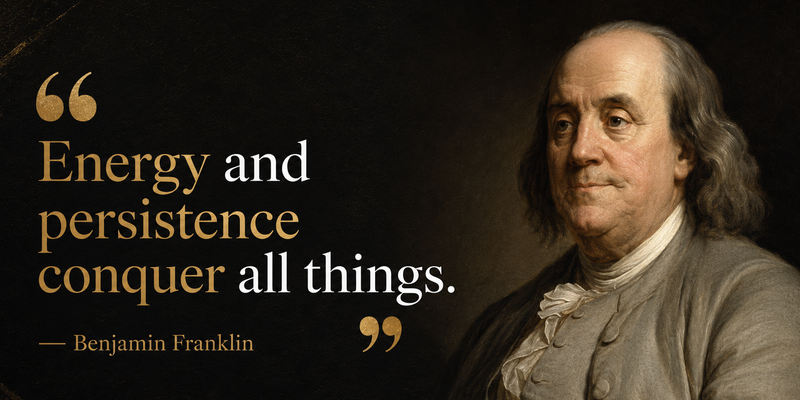
We live amid infinite tabs, rapid cycles, and an economy that prizes speed. Against this backdrop, Benjamin Franklin’s line, “Energy and persistence conquer all things,” feels surprisingly modern. Franklin (1706–1790) was a printer, inventor, diplomat, and a key founder of the United States—someone who turned practical routines into outsized impact. His maxim is less a pep talk and more a method: direct your effort, then keep returning to it.
Decoding “energy” and “persistence” without the hype
In Franklin’s framing, energy is not frantic hustle; it is purposeful attention supported by sleep, nutrition, and clear priorities. Persistence is not stubbornness; it is disciplined repetition in the face of slow, messy progress. Together they outperform raw talent and short bursts of inspiration because they compound. The idea is simple: choose a direction, then keep showing up, even when results lag.
From motion to momentum
Busyness creates motion; consistent practice creates momentum. A helpful filter is to ask, “What moves the core metric?” and “Can I repeat this tomorrow?” If the answer to both is yes, you are converting energy into persistence and persistence into results.
- Replace scattered tasks with a daily block for the highest-leverage work.
- Track inputs you control (minutes of deep work, repetitions) rather than outcomes you do not (likes, quick wins).
Where the maxim pays off: work, learning, and relationships
- Career and productivity: A manager who protects a 90-minute focus window each morning ships more valuable work than one reacting all day. Energy is the clear window; persistence is defending it daily.
- Learning: Twenty minutes of spaced practice, five days a week, beats a weekend cram. Vocabulary, coding patterns, or musical scales grow through small, repeated exposures.
- Leadership: Teams follow consistency. A leader who holds brief weekly reviews, closes loops, and documents decisions builds trust—and velocity.
- Relationships: Thoughtful check-ins, keeping promises, and repairing after conflict are quiet, persistent acts that strengthen bonds over time.
Making setbacks part of the plan
Persistence shines when momentum stalls. Treat obstacles as data, not drama. Tighten the loop between effort and feedback: shorten projects, test assumptions earlier, and iterate openly. This way, energy fuels honest experiments and persistence keeps the experiments going until evidence points the way.
- Pause to define the smallest next step you can complete today.
- Reduce scope by half, then ship to learn.
- Log what worked, what failed, and what you will try next—briefly, every day.
One practical move to start today
Pick one meaningful objective and assign it a daily 30-minute slot you can realistically protect. For the next 30 days, track two things only: minutes of focused work and number of attempts. Let the scoreboard reflect inputs, not luck. Over weeks, you will notice the quiet compounding Franklin trusted: energy applied with patience becomes progress—and progress, sustained, becomes impact.
Original Article
(Disclaimer – This post is auto-fetched from publicly available RSS feeds. Original source: Yourstory. All rights belong to the respective publisher.)