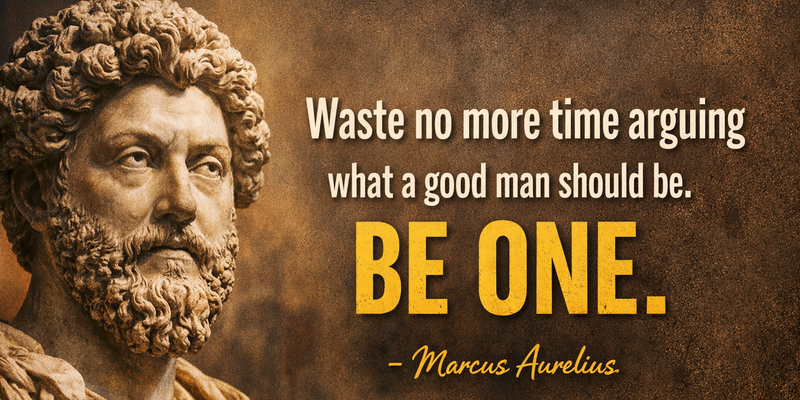
What a good man should be. Be one
At some point, every generation finds itself caught in the same loop. Debating values. Defining morality. Arguing endlessly about what makes a “good person.” The conversations evolve, the platforms change, but the pattern remains. In the middle of this noise, a quiet yet powerful line from Marcus Aurelius cuts through with unusual clarity: “Waste no more time arguing what a good man should be. Be one.”
It is a sentence that feels almost uncomfortable in its simplicity. Because it shifts responsibility. It removes the luxury of abstraction and places the weight of action directly on the individual.
The modern world is built for discussion. Social media rewards opinions. Public discourse thrives on disagreement. Entire careers are built on analysing behaviour, critiquing systems, and debating ethics. But while conversation has its place, it often becomes a substitute for action. We begin to believe that
understanding goodness is the same as practising it. Aurelius challenges that illusion.
His philosophy, rooted in Stoicism, is not concerned with what others should do. It is deeply personal. It asks a far more difficult question: What are you doing? Not what you believe. Not what you support. But how you behave when no one is watching, when there is no applause, and when it is inconvenient.
Being a good person, in this sense, is not performative. It is not about grand gestures or public validation. It is about consistency. Showing integrity in small decisions. Choosing honesty when it costs you. Being patient when it is easier to react. Acting with fairness even when you are not required to. This is where most people struggle.
Because defining goodness is easy. Living it is not. It demands discipline. It requires self-awareness. It often involves doing the right thing without immediate reward. In a culture that prioritises visibility and instant results, this kind of quiet, sustained effort can feel invisible.
But that is precisely the point.
Aurelius understood that character is built privately and revealed over time. It is not shaped in moments of debate, but in moments of decision. Each action either reinforces or weakens the person you are becoming.
There is also a deeper layer to his statement. By asking individuals to focus on being rather than arguing, he redirects attention away from others. It is easy to critique the world. It is much harder to correct oneself. Yet meaningful change, whether personal or societal, begins at that level.
When individuals take responsibility for their own conduct, the collective improves. Not through enforcement or persuasion, but through example.
In practical terms, this philosophy is less about perfection and more about alignment. Are your actions consistent with your values? Do your daily choices reflect the kind of person you claim to be? These are not abstract questions. They are lived, moment to moment.
The relevance of Aurelius’s words today lies in their refusal to complicate what is fundamentally simple. Not easy, but simple.
You do not need another framework to define goodness. You need the willingness to practise it.
And perhaps that is the real challenge. Not the lack of clarity, but the lack of action.
Because in the end, the question is not what a good person should be.
It is whether you are willing to be one.
Original Article
(Disclaimer – This post is auto-fetched from publicly available RSS feeds. Original source: Yourstory. All rights belong to the respective publisher.)