As artificial intelligence systems grow more capable, one question continues to dominate conversations across the technology industry: will AI replace human developers?
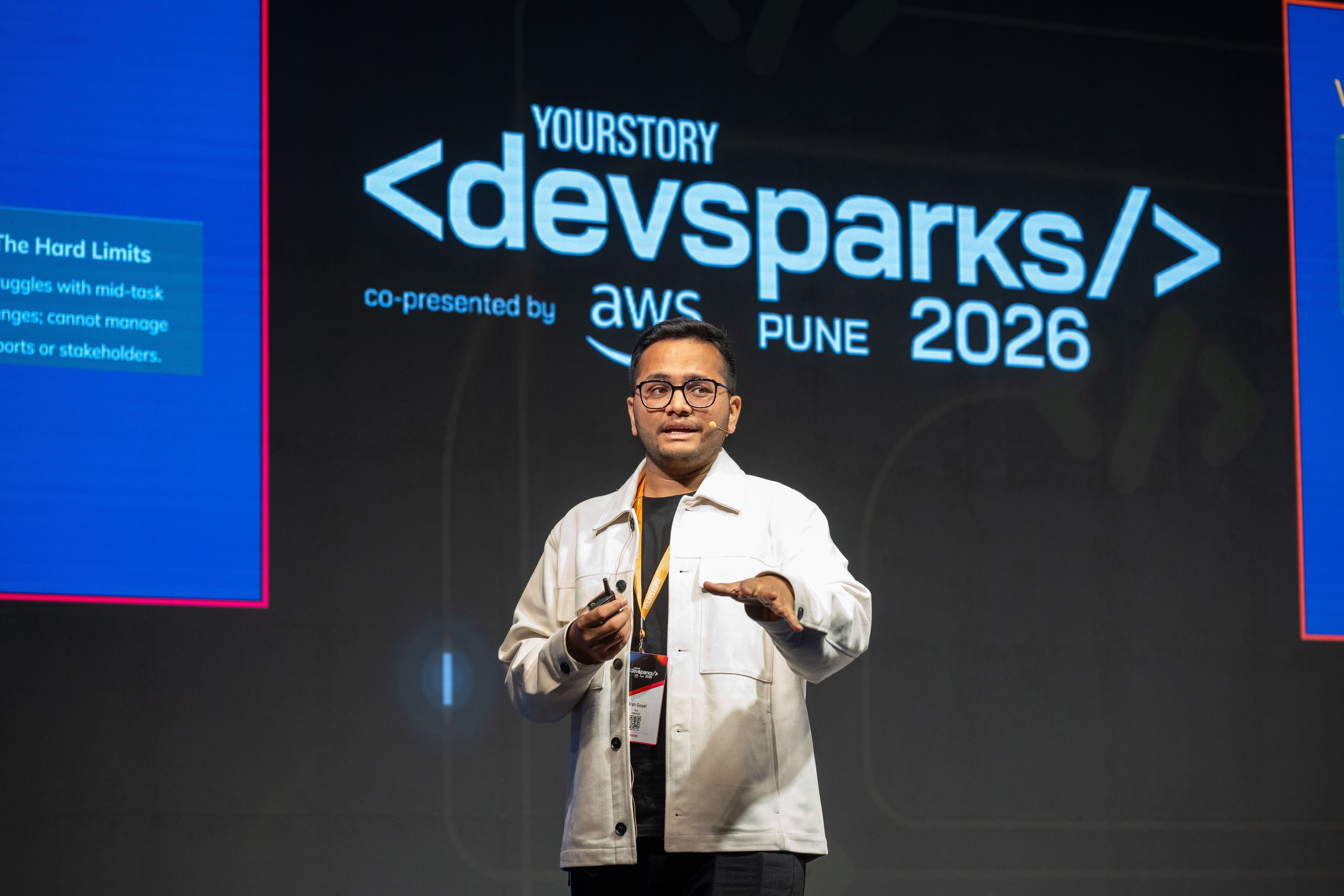
At DevSparks Pune 2026, that question was front and center for many attendees who gathered for a lightning talk by AI and engineering influencer Arsh Goyal. His session tackled developer anxieties head-on, exploring how AI is evolving and what engineers must do to remain relevant in an increasingly automated world.
Goyal’s message was clear: while AI may commoditise certain parts of coding, the deeper craft of engineering, thinking through systems, architecture, and real-world complexity, remains firmly human.
The ‘Days of Devin’
Goyal began by addressing the sense of panic that has spread through developer communities as AI tools advance at unprecedented speed.
“The change that AI has produced did not happen within a decade or a year, but within weeks. We see a development today, and then that same development gets killed by something else a few weeks later,” he said to a room full of coders.
To understand how developers should navigate this moment, he pointed to a key turning point in March 2024, when the then relatively unknown company Cognition AI released Devin AI, described as the world’s first AI software engineer.
“Cognition released a three-minute-long demo video where that AI software engineer was picking a freelance task from Upwork and was doing it entirely by itself. That made the entire market panic. People were questioning whether software engineering was dead and if they should switch domains,” he said.
Also Read Rethinking GenAI development with NVIDIA DGX Spark at DevSparks 2026
Two years later, the technology has matured significantly. Goyal noted that Cognition claims Devin can now understand problems at roughly the same level as a senior developer, although its execution still resembles that of a junior engineer.
He cited an example from Goldman Sachs, which reportedly used a swarm of Devin agents to migrate ETL pipelines.
“The Devin agents managed to do that in three hours, which would have otherwise taken humans 30 long hours to complete. With a clear prompt, it can complete a task in 1/10th the time. However, it can’t improvise if an error happens. If you’re working on something and you notice a problem, you can think on your feet and fix it. Devin can’t do that,” he explained.
What makes Agentic AI different
The rise of more autonomous AI systems is changing how developers think about their own value. While some workers fear automation, others are finding their expertise becoming more valuable. “There’s someone whose job is getting eaten and also someone whose job is getting 10x more valuable,” Goyal said.
To explain the current moment, he traced the evolution of AI coding tools. In 2021, the industry entered the era of autocompletion with the launch of GitHub Copilot, which automatically completed unfinished lines of code.
The landscape shifted again in November 2022 when ChatGPT introduced conversational AI programming assistants. Developers could now interact with AI tools like Claude or Cursor, asking them to generate and refine code through dialogue.
But the next wave is even more transformative. “Agentic AI can do the entire project for you. That’s how it differs from conversational pair programmers. It can plan, execute across files, run the required tests, iterate and submit autonomously,” Goyal said.
How the job market is changing
Despite the promise of productivity gains, the impact of AI on developer workflows is complex.
Citing a survey conducted by a US company, Goyal noted that some engineers report that AI tools can actually slow them down.
“The basic idea behind the study was that whether AI is making your work faster or slower is completely dependent on how you choose to use it. There are so many options, you need to decide which AI tool to use for which specific task. You need to be aware of what’s happening in the market,” he said.
At the same time, the broader job market is shifting. Technology leaders, including Dario Amodei, CEO of Anthropic, have warned about the disruptive potential of AI.
Referring again to Devin’s capabilities, Goyal said reports suggest it may already be affecting hiring patterns in the United States.
“Since Devin could understand like a senior and execute like a junior, the study showed that the US market saw the number of junior-level jobs dropping from 25% to 23%. Someone who is just out of college is struggling to get a job,” he said.
Companies are also becoming more selective in how they build teams.
Goyal highlighted the rise of precision hiring, where organizations maintain smaller engineering teams but expect higher levels of expertise from each developer. At the same time, the idea of one-person companies, startups run largely by individuals supported by AI tools, is gaining attention.
Yet the AI revolution is also creating entirely new roles.
“AI engineers are the next big thing. I was recently interviewing Rajiv Kumar, Managing Director and President at Microsoft India Development Centre, and we spoke a lot about the ‘forward-deployed engineer’. So that’s a new role. MLOps engineer is another one,” he said.
What developers can do to stay ahead
If AI can increasingly write code, should developers trust it? According to Goyal, not entirely; at least not yet.
Referring to another study involving around 50,000 engineers, he noted that while AI adoption is widespread, confidence in the technology remains limited. “They said the problem is that the code that an AI will produce looks perfect. The code quality is very good. But it doesn’t work. It’s almost right but not quite right,” he said.
As AI continues to evolve, some traditional programming tasks are likely to disappear. Writing boilerplate code or memorizing syntax, for example, will become less valuable.
Also Read DevSparks Pune 2026: Here’s everything in store at the developer-only summit
Instead, the future of engineering will emphasize skills that machines still struggle with: designing complex systems, understanding architecture, and orchestrating AI tools effectively.
“Pick an AI tool and go deep into it. There are so many different things in architecture, orchestration and even communication, which AI can’t yet do right,” he said.
Goyal pointed to an example from Anthropic, which recently published a difficult problem statement and invited developers to attempt to outperform its model Claude Opus. Those who succeed may even be considered for hiring.
For developers looking to stay relevant, Goyal’s advice was simple: experiment with AI rather than fear it.
“Build things with AI and analyze if it has messed up somewhere. If you understand where AI is messing up, you will maintain the edge over it,” he signed off.
Edited by Teja Lele
Original Article
(Disclaimer – This post is auto-fetched from publicly available RSS feeds. Original source: Yourstory. All rights belong to the respective publisher.)