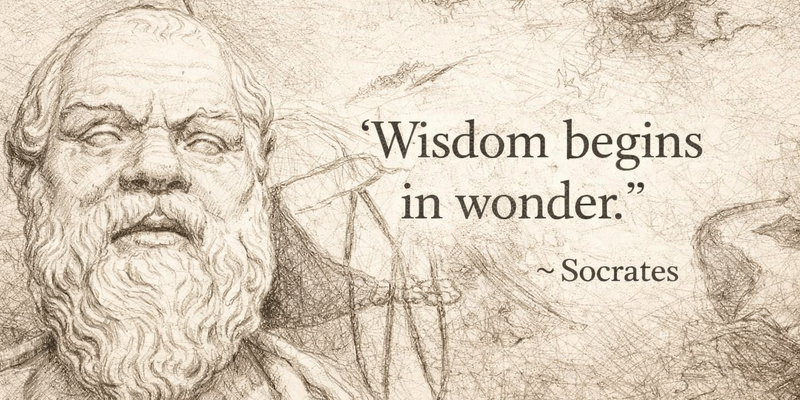
In a world that prizes quick answers and confident opinions, the idea that wisdom begins in wonder feels quietly radical. Yet this observation by Socrates continues to hold its ground centuries later. It suggests that the pursuit of knowledge does not start with certainty, but with a pause—with a question, a moment of curiosity, or even a sense of confusion.
Wonder, in this sense, is more than curiosity. It is a mindset. It is the willingness to look at something familiar and still ask why it exists the way it does. It is the courage to admit that one does not fully understand, and the desire to explore that gap. For Socrates, this was not a limitation but the very foundation of wisdom.
His philosophy revolved around questioning. Rather than offering direct answers, he encouraged dialogue—probing deeper into ideas, challenging assumptions, and uncovering contradictions. This method, now known as the Socratic method, begins with wonder. It starts with a question and unfolds into a process of thinking that is layered, reflective, and often uncomfortable. But it is precisely this discomfort that leads to clarity.
In today’s information-rich environment, this idea feels more relevant than ever. Answers are readily available at the click of a button, but understanding is not. There is a growing difference between knowing something and truly comprehending it. Wonder bridges that gap. It slows down the impulse to accept information at face value and instead invites us to engage with it more deeply.
What is often overlooked is that wonder is not limited to philosophy or academia. It plays a crucial role in everyday life. It shapes how we approach problems, how we interpret experiences, and how we interact with others. When we allow ourselves to question rather than assume, we become more thoughtful in our decisions and more open in our perspectives.
There is also a certain humility embedded in wonder. It requires acknowledging that our current knowledge is incomplete. In professional settings, this humility can lead to better innovation, as it encourages individuals to explore alternatives rather than settle for established norms. In personal contexts, it fosters empathy, as questioning one’s own assumptions often leads to a better understanding of others.
However, modern systems do not always reward this approach. Speed is often prioritised over depth, and certainty over curiosity. In such an environment, wonder can feel inefficient or even unnecessary. Yet wisdom has never been about speed. It has always been about depth, about taking the time to reflect, question, and understand.
The challenge, then, is not in recognising the value of wonder but in practising it. It requires a conscious effort to resist the urge for immediate answers and instead sit with questions a little longer. It involves looking at everyday situations with fresh eyes and allowing curiosity to guide thought rather than conclusions.
Socrates’ insight endures because it captures a simple truth: every meaningful understanding begins with a question. Before there is knowledge, there is curiosity. Before there is certainty, there is doubt. And within that space of not knowing lies the beginning of wisdom.
To choose wonder is to choose growth. It is to remain open, to remain curious, and to accept that learning is not a destination but an ongoing process. In that sense, wisdom is not something we arrive at—it is something we continuously move towards, one question at a time.
Original Article
(Disclaimer – This post is auto-fetched from publicly available RSS feeds. Original source: Yourstory. All rights belong to the respective publisher.)