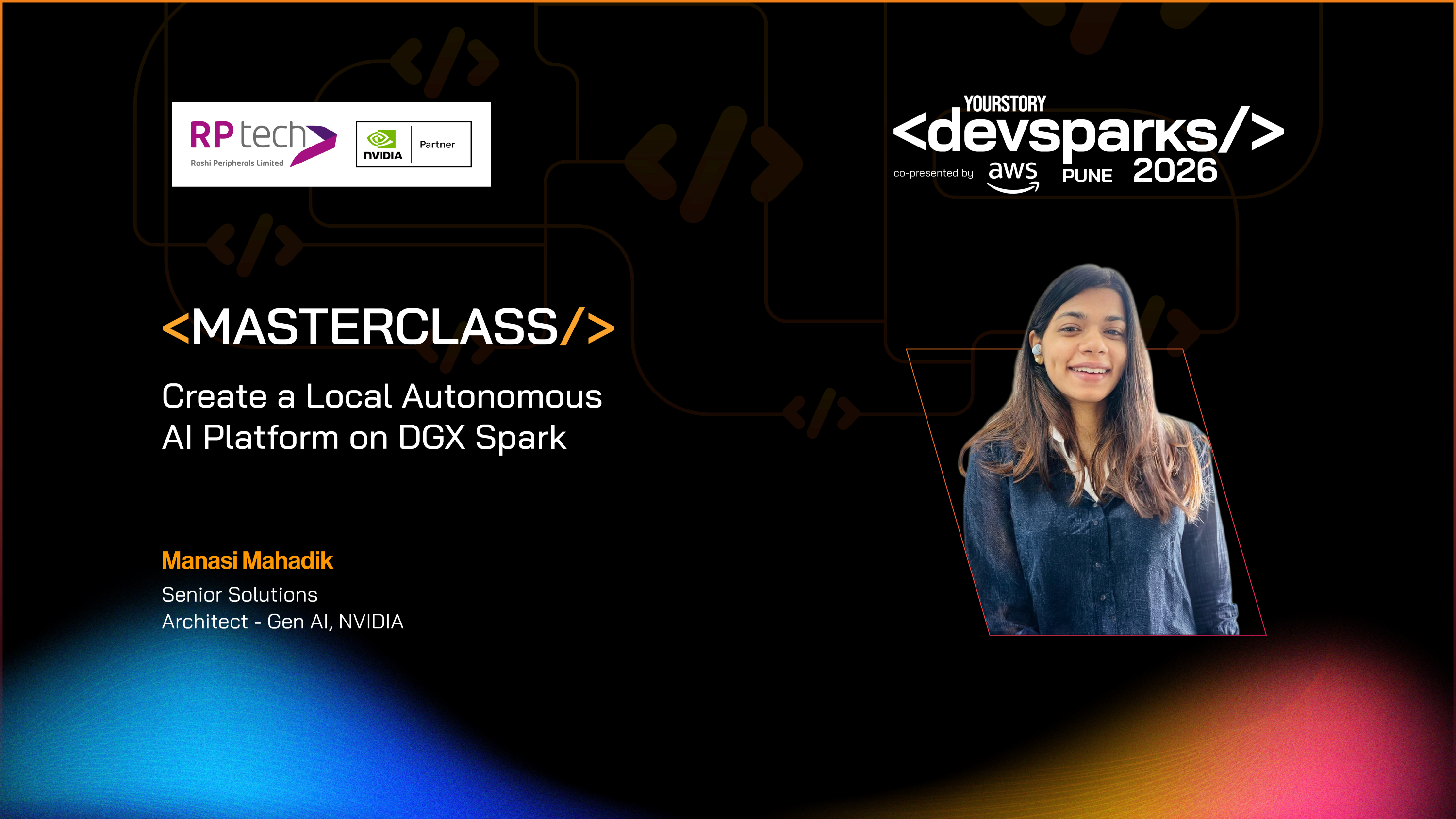
India's developer ecosystem is evolving rapidly, but the more meaningful shift lies in where AI workloads are actually being run. At DevSparks Pune 2026, YourStory Media’s flagship developer summit, NVIDIA, along with RP Tech, an NVIDIA partner, hosted a masterclass titled Building a Fully Autonomous AI Workstation on NVIDIA DGX Spark, led by Manasi Mahadik, Senior Solutions Architect for Gen AI at NVIDIA.
Rather than framing local AI as a distant possibility, the session showed how developers can move their entire AI workflow off the cloud, keep it private, and run it from a device small enough to carry in a bag.
Designed as a technical demonstration, the masterclass introduced DGX Spark, NVIDIA's desktop-class AI compute system built on the Blackwell architecture, and showed how a single locally hosted model can power multiple everyday AI applications, from browser agents and coding assistants to document search and chat interfaces, without any data leaving the device.
Rethinking where AI actually runs
Serious AI workloads have long been tied to cloud infrastructure and data centers. While effective, that model comes with trade-offs in cost, latency, constant connectivity, and growing concerns around data privacy. This is where the session focused, particularly for developers and smaller teams trying to balance capability with control.
As Mahadik explained, “Local systems don't provide enough memory, and they don't provide the software stack.” These two limitations have made local AI difficult to work with. NVIDIA DGX Spark addresses both, combining 128 GB of unified memory with full support for NVIDIA’s CUDA-based ecosystem, bringing data center–level capability into a compact, desk-ready system.
A new category between laptops and data centers
A key part of the masterclass was understanding where NVIDIA DGX Spark fits within NVIDIA's broader hardware stack. On one end are data centers handling trillion-parameter models. On the other hand, developer machines struggle with even moderately sized workloads. NVIDIA DGX Spark sits in between, built for developers and researchers who want to run models independently without the cost or complexity of large-scale infrastructure.
Powered by the Blackwell architecture, NVIDIA Spark supports FP4 quantization, allowing models to be compressed without major performance loss. This makes it possible to handle models of up to around 200 billion parameters. Two Spark units can be connected to scale further, while the unified GB10 chip, combining CPU and GPU, reduces communication overhead and improves efficiency. The trade-off is fixed memory, which requires planning based on use case.
One System, Multiple AI Workflows
The most compelling part of the session was a live demonstration of what Mahadik had set up before the session, with Mahadik hosting a GPT-OSS 120B parameter open-source model locally on the NVIDIA DGX Spark and using it to power multiple applications at once. These included a browser agent connected through Browser OS, a coding agent via a VS Code extension, a knowledge graph for complex document search, and a chat interface similar to what most people use daily.
What stood out wasn’t just the number of applications, but the fact that all of them ran off a single model on the device, replacing tools that developers typically access through separate subscriptions and APIs.
Mahadik described it in simple terms: “Everything that I use AI for, everything that I pay a lot of money for, in terms of subscriptions, in terms of APIs, I could just host it using my one very powerful model,” capturing how tools like browser automation, code assistance, document search, and conversational interfaces can all run off a single model on the device..
The software layer and privacy advantage
The masterclass also covered the NVIDIA software stack that runs on the DGX Spark, including TensorRT-LLM for inference, NCCL for multi-GPU communication, RAPIDS for accelerated data science workloads, and AI Workbench, NVIDIA's low-code platform for getting started quickly. For developers who have dealt with compatibility issues on non-CUDA systems, NVIDIA DGX Spark’s full CUDA support removes a major friction point.
The privacy angle ran throughout the session. Every application demonstrated ran entirely on-device. No external servers, no subscriptions, no data sharing. For teams working with sensitive data, that distinction matters.
What this means for developers
Local AI isn’t theoretical anymore. The hardware, software, and ecosystem are already in place, making it possible to build and run advanced AI systems on a device that fits on a desk.
As Mahadik noted, “You can essentially take it into your own hands, a lot of what you subscribe to for different AI features, you can actually host it yourself,” pointing to a shift where developers are no longer dependent on external services to access the AI capabilities they use every day.
Attendees left with a clearer understanding of how this approach can be applied across real-world use cases, from building intelligent applications to automating workflows and creating private AI environments. The shift is clear: AI is moving closer to the developer, giving them more control over performance, cost, and data.
Original Article
(Disclaimer – This post is auto-fetched from publicly available RSS feeds. Original source: Yourstory. All rights belong to the respective publisher.)