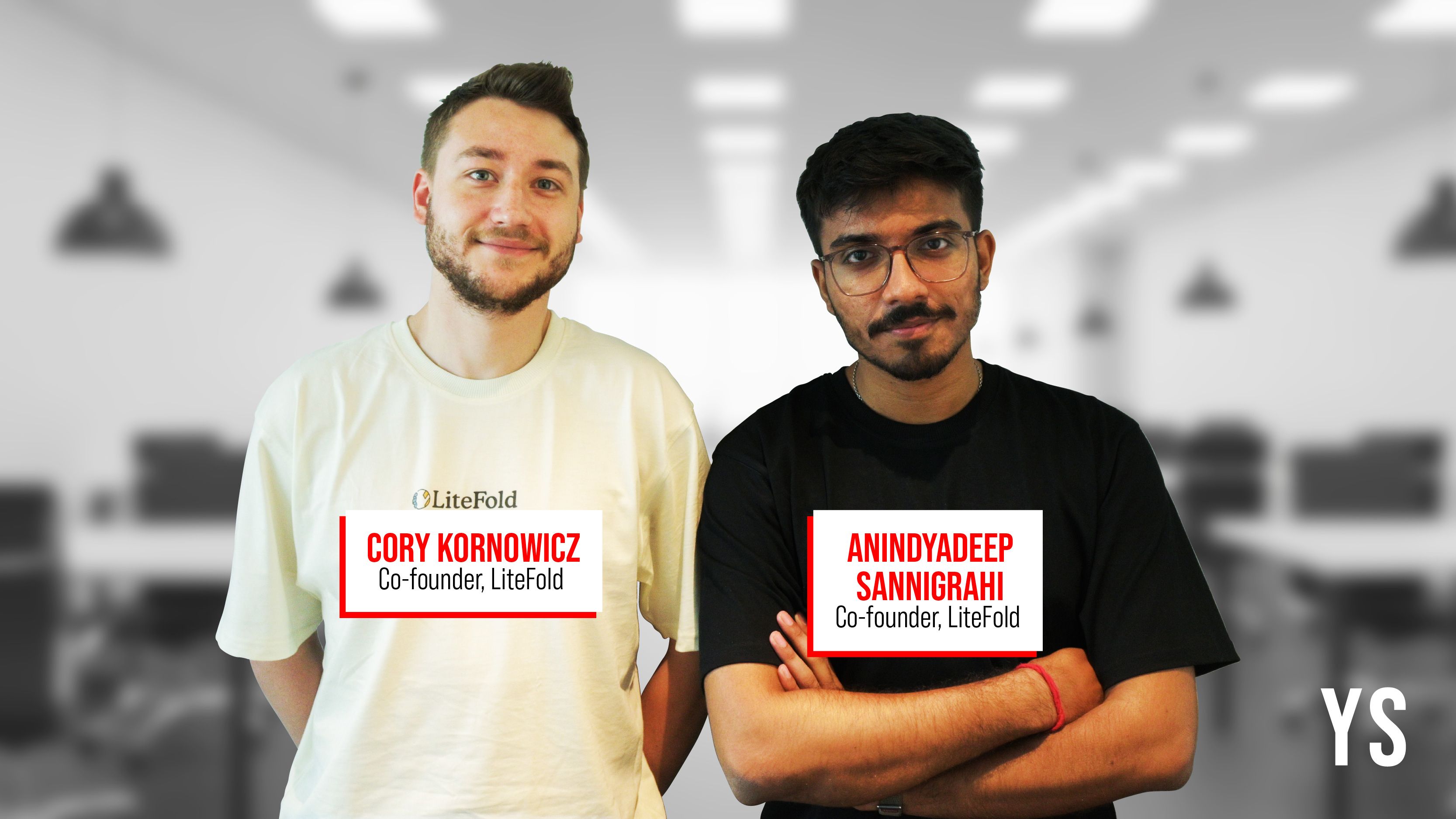
Anindyadeep Sannigrahi is a machine learning (ML) engineer by training, but biology had long held his interest. So, when he joined the AI residency programme at the Bengaluru-based Lossfunk (a research lab which works on several AI problems at the forefront of academia) in 2025, he quickly turned his attention to protein folding—a biological process that makes protein functional for the body.
At first glance, an ML engineer moving into biology may seem like an unusual pivot, but the timing was right. Just a year ago, the Nobel Prize in chemistry had recognised breakthroughs in computational protein design—the very field Sannigrahi was exploring.
But he ran into a practical hurdle when he began working on the problem.
“A software developer now can easily start working on a project as the required tools already exist. That’s not the case for a computational biologist—someone who uses data and computers to understand how living things work. Many of them have to actually build the software before they even get to work on the biology problem,” he says.
“So, just like there is an Integrated Development Environment (IDE), a software suite for computer scientists, I decided to build an IDE for computational biologists.”
While building the technology, Sannigrahi started posting about it on the social media platform X. His posts caught the attention of Cory Kornowicz, an American computational biologist and ML engineer. The two began collaborating, and soon Kornowicz joined Sannigrahi's LiteFold, a biotech AI-native platform designed to accelerate computational biology workflows.
“We’re building the only platform a computational biologist will ever need to be able to execute on any hypothesis they could fathom. Today, we are focused on therapeutic design and tomorrow we will grow into biological engineering,” says Kornowicz.
Founded in 2025, the five-member startup now operates out of Bengaluru and Delaware in the US.
Also Read Biotech startups Tzar Labs, Epigeneres Biotechnology claim breakthrough in cancer detection using novel blood test
Building an AI co-scientist
LiteFold is developing what it calls an AI co-scientist. Sannigrahi says the platform can significantly speed up the work of computational biologists and biotechnologists.
He says biological research work, especially in therapeutics and drug development, usually requires large multidisciplinary teams: AI specialists, infrastructure experts, software engineers, legal professionals, and more. After that comes wet lab testing, often the most resource-intensive stage.
Litefold aims to streamline this process. Through Rosalind, its AI co-scientist, the company says it can bring together several stages, from AI workflows to legal processes, on one platform, excluding the wet lab.
“At the end of the day, biological work requires a lot of hidden trials, a lot of educated guesses. Our platform lets you increase the number of educated guesses by running hundreds of hypotheses in parallel. This naturally increases the probability of achieving success in the wet lab while saving cost,” explains Sannigrahi, adding that the startup can expedite results that traditionally take about nine months to just a few days.
From open source to proprietary AI
LiteFold’s AI began as an open-source project. Sannigrahi later shifted it into a proprietary platform after recognising the commercial potential of the technology.
Rosalind was trained on open-source data, he says.
“The end goal is to make proprietary engines, which would be able to consistently compress four days of work into just a day. We are also building in-house training platforms for AI models. So, biotech companies that won't share their data can use our platform to fine-tune their models,” he says.
LiteFold has also introduced a feature called De Novo that generates new molecules designed to fit into small cavities, called pockets, on proteins.
As Sannigrahi explains, proteins are three-dimensional structures with curves and holes known as pockets. Drugs can bind to these pockets and change how the protein behaves or functions.
“We create new molecules and see if it targets any pockets of the protein. Once we see such cases, we backtrack and try to find existing molecules similar to our generated one. This helps us accelerate the drug discovery process. If we manage to synthesise that novel molecule, the market for it goes up to upwards of a billion dollars,” he says.
The co-founder says LiteFold charges an undisclosed amount for services over a period of six months to a year.
Also Read Vgenomics is using AI to diagnose rare genetic diseases
The industry at large
Sannigrahi says LiteFold has been drawing interest from several parts of the biotech ecosystem. Startups, in particular, are looking for ways to reduce timelines and costs. Some larger pharmaceutical companies, he says, are also exploring LiteFold’s tools, though many remain cautious.
“The scepticism is very normal. In fact, pharmaceutical companies are usually reluctant to use such tools. Not because they are slow but because IT security is vital for them,” he says. “We are very hopeful as LiteFold is a very early player in this market. The moment one of our novel molecules gets validated in the wet lab, we will start seeing interest from big pharma.”
LiteFold is currently not charging B2C customers using the platform for academic research as Sannigrahi believes computational protein design is still a nascent field.
Berk Uluçay, a student studying molecular biology and genetics at Uskudar University in Istanbul, believes LiteFold is critical for his “academic research productivity”.
“It significantly accelerates my hypothesis testing, enabling rapid structural iteration and comparative modelling workflows that were previously computationally prohibitive,” he says.
On a similar vein, Manuel Rivas, professor of Biomedical Data Science at Stanford University also expressed great interest in LiteFold.
"I work on genetics of human diseases. I intend to use LiteFold for running drug discovery campaigns such as protein structure prediction and protein design, among others. I believe it would provide great value by expiditing small molecule discovery for 'genetically validated targets'," he shares.
The AI drug discovery market was valued at $2.35 billion in 2025 and is projected to $13.77 billion by 2033. The startup recently raised an undisclosed amount in a private funding round led by Offscript VC. It has also secured about $23,000 in grants from Emergent Ventures, Dr Aniruddha Malpani’s 3F VC, and also an undisclosed friends and family round from the Boston-based OffScript VC.
LiteFold competes with startups such as San Francisco-based Phylo and FutureHouse. Sannigrahi believes the startup stands apart due to its scale and AI training platform.
“The training platform is something we are betting on. We hope pharmaceutical companies use it to create their own in-house models. With how new the industry is, it’s all dependent on research and I believe our research speaks for itself,” Sannigrahi signs off.
(The copy was updated with additional details.)
Original Article
(Disclaimer – This post is auto-fetched from publicly available RSS feeds. Original source: Yourstory. All rights belong to the respective publisher.)