There is a growing conversation in the AI world about where your data goes when you use cloud-based AI tools. Cost, privacy, and control are becoming just as important as the models themselves. That shift is exactly what the NVIDIA DGX Spark is designed to address.
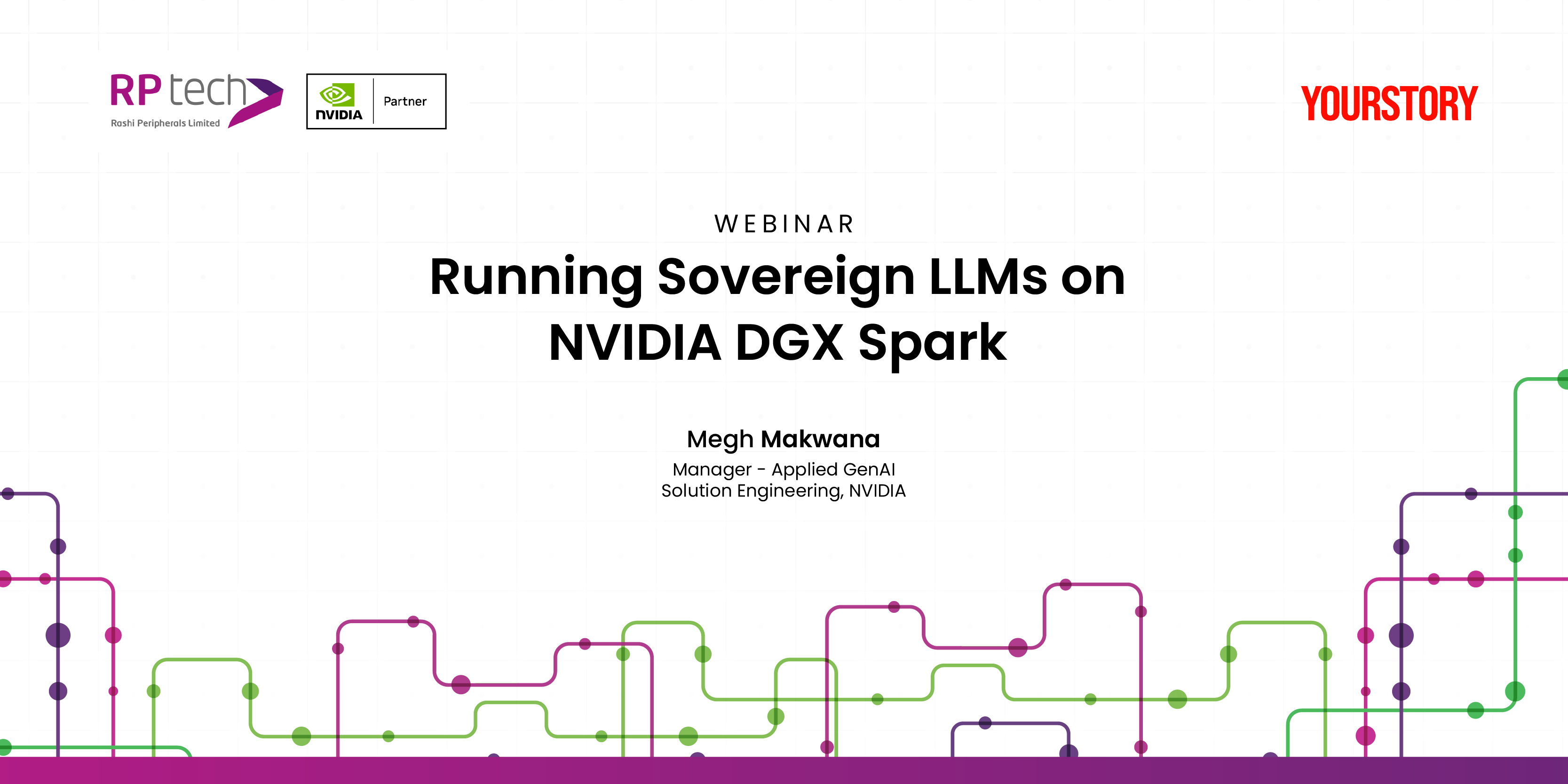
At a recent webinar hosted byRP Tech, an NVIDIA partner, in collaboration with YourStory, Megh Makwana, Manager of Applied GenAI Solutions Engineering at NVIDIA, demonstrated how the NVIDIA DGX Spark works and what it makes possible.
The NVIDIA DGX Spark is a small, portable device powered by the Grace Blackwell superchip. Despite its compact size, it comes with 128 GB of memory, which means it can run some of the largest publicly available AI models without needing a cloud connection or a server room.
Why model size alone is not enough
Makwana explains that simply downloading a large AI model and running it is not always straightforward, and how a technique called quantization helps solve that problem.
In simple terms, quantization is about compressing a model so it takes up less memory without losing too much accuracy. A 70 billion parameter model in its standard format takes up around 140 GB of memory, which is more than the NVIDIA DGX Spark has. By compressing it to a format called FP8, it drops to around 70 GB. Compressing it further to NVFp4, a format that runs natively on the Blackwell chip, brings it down to 35-40 GB.
The difference in real-world performance was demonstrated live. The standard version of the model produced around 13 tokens per second, with a response start time of about 150-170 milliseconds. After switching to the NVFp4 version, the response start time dropped to around 60-65 milliseconds, and the overall speed of token generation more than doubled.
"If you quantize these models into low precision, you can now run multiple models," Makwana said, pointing out that a compressed language model leaves enough room on the same device to also run a speech recognition model and a text-to-speech model at the same time, which is exactly what is needed for a voice agent.
Voice agents, sovereign LLMs, and what comes next
Makwana spent considerable time on voice agents, which combine three components: a speech-to-text model that converts what you say into words, a language model that generates a response, and a text-to-speech model that reads the response out loud.
He explained two ways to build this. The first is a pipeline approach, where each component is separate and can be swapped out or customized. This gives developers more control, including the ability to give the model specific instructions and connect it to external tools like web search or messaging apps. The second approach uses Nemotron 3 Voice Chat, a single model that handles the entire conversation from audio input to audio output. It is faster and simpler, but does not allow for the same level of customization.
The session also covered OpenClaw, an open-source agent framework that can run on the NVIDIA DGX Spark. Think of it as a personal assistant that does not just answer questions but can also carry out tasks on your behalf, like monitoring topics you care about, summarizing content from across the web, or automating repetitive workflows. NVIDIA has added its own layer on top called OpenShell, which brings in privacy controls, a sandboxed environment for safer execution, and a policy engine to define what the agent can and cannot do.
For Indian language support, the DGX currently supports speech recognition for Hindi, Bengali, Tamil, and Telugu, with more languages planned. For teams that need broader language coverage right now, Makwana recommended looking at open-source initiatives like AI for Bharat. For Hindi text-to-speech specifically, the Magpie TTS model is available.
The webinar also featured a live demo of a voice agent built using Parakeet for speech recognition, the Nemotron Nano language model, and Magpie TTS, running as a full voice conversation in near real time.
The one investment that matters most
The session ended with a question that many organizations building their own AI models are wrestling with: if you had to choose between spending money on a bigger model or better quality data, which would you pick?
Makwana's answer was clear. "Any day, data. Model sizes and architectures are democratized. If you have really high-quality data, you can still build really great small language models."
It was a practical note to close on. The tools to run capable AI locally now exist and are within reach. What determines whether those systems actually work well, it turns out, has less to do with the hardware and more to do with what you feed into it.
Original Article
(Disclaimer – This post is auto-fetched from publicly available RSS feeds. Original source: Yourstory. All rights belong to the respective publisher.)