A few years ago, KK Senthil Kumar found himself navigating every parent’s nightmare. His daughter had been admitted to hospital in critical condition, but doctors had to wait for over 24 hours for her antibiotic sensitivity test to determine the right course of treatment.
By the time she recovered, the experience had left a lasting impact on Kumar, a research scientist and professor.
Kumar recalls that nightmarish moment in the hospital. “Watching my daughter struggling and not being able to do anything about it was one of the most painful experiences of my life. That experience later ignited something deeper within me. I felt a weighted responsibility to find a real and lasting solution, so that children like her do not have to endure such suffering.”
He began to question why something as critical as identifying the right antibiotic still took days.
That question eventually became the foundation of Attox Research Lab.
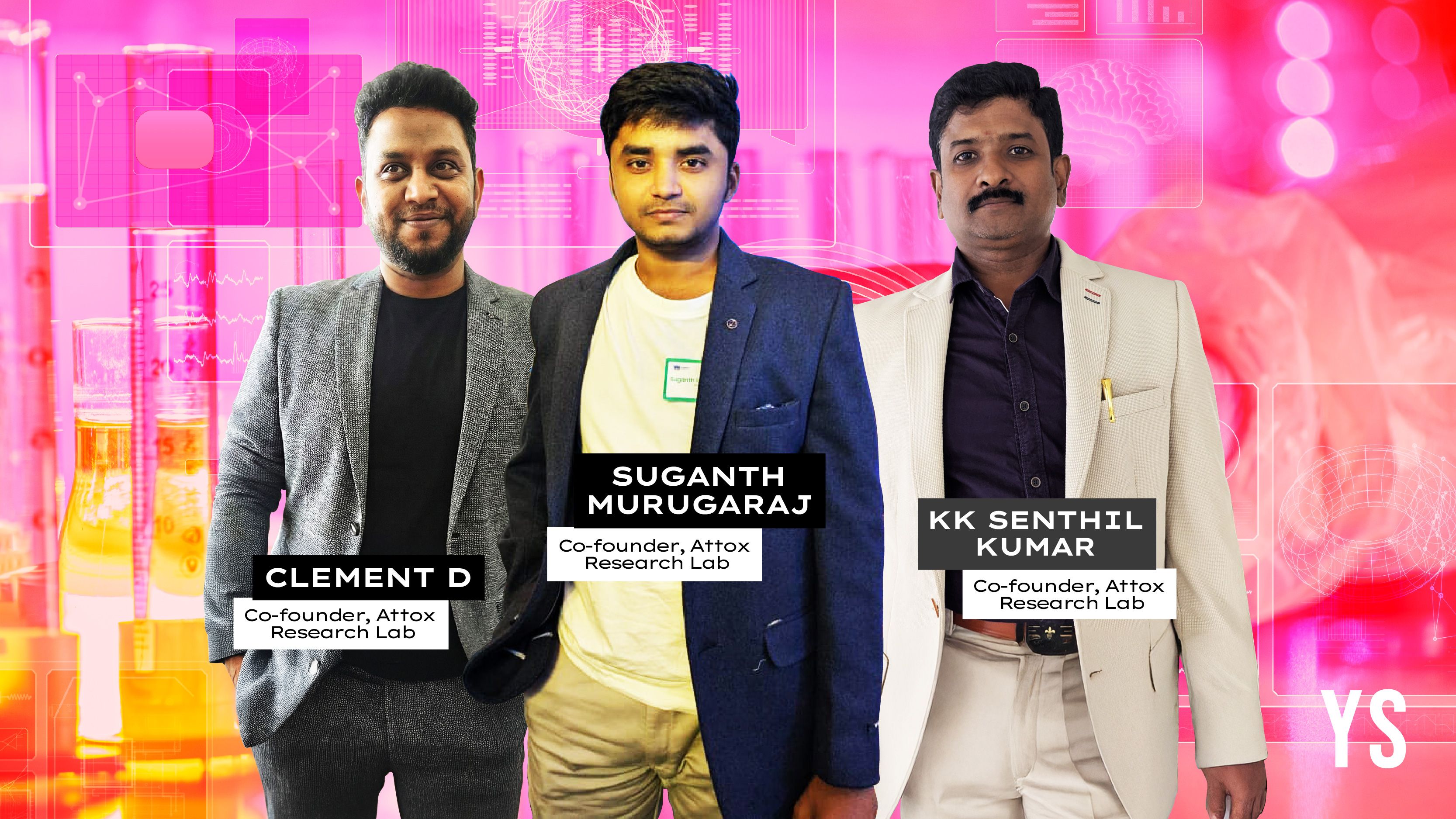
In 2023, Kumar teamed up with his former student Suganth Murugaraj and entrepreneur Clement D to co-found a healthtech startup to build AI‑powered electrochemical tools for efficient medical diagnoses and to tackle the growing global crisis of antimicrobial resistance.
According to a report by the Institute for Health Metrics and Evaluation, a public health research institute of the University of Washington, in 2021 alone, about 1.5 million people lost their lives either directly or indirectly due to antimicrobial resistance (AMR).
“What began as a research collaboration slowly evolved into a market-ready organisation focused on a real and urgent healthcare problem,” says Clement.
Attox has a seven-member team based in Chennai and operates a laboratory in Erode, Tamil Nadu—Murugaraj’s hometown. The startup is also incubated at KonguTBI, Karpagam Innovation & Incubation Council and NSRCEL-IIM Bangalore.
Solving the AMR crisis
Attox’s flagship product, the Bactolizer, is a rapid antibiotic sensitivity analysis device designed to determine which antibiotic will effectively kill a specific bacteria in a patient’s sample.
Compared to the traditional time-frame of 24-78 hours, Attox’s device shares results in two hours. To understand how that works, it is important to understand how the plug-and-play device is designed.
Attox’s hardware has two units: a signal processing device and a disposable electrochemical cartridge. Once the patient sample is collected, it is put into the cartridge. Then the cartridge is loaded onto the Bactolizer.
“We get initial results in 30 minutes and final results in 120 minutes,” explains Murugaraj.
The test is priced between Rs 500 and 600, which is paid by hospitals. The Bactolizer is priced at about Rs 40,000 (subjected to change as the product develops), and it can analyse 23 antibiotics.
Also Read Bugworks raises $9M Series A funding to develop antibiotics to fight superbugs
Clement believes the startup has been able to achieve such quick results by going against the traditional method of culturing, which requires a technician to place bacteria samples on various antibiotics and let them rest for 48 hours before checking under a microscope to see if the bacteria survived.
“With our electrochemical cartridge system, our specialised algorithm compares the initial and final results until it determines which antibiotic will effectively kill the bacterium. It works like a sugar test,” he says.
With the product working, the team has filed for a patent and is currently awaiting ISO certification. Next on the roadmap are regulatory approvals and clinical trials with 1,000 patients, to be conducted at the Karpaga Vinayaga Institute of Medical Sciences and Research Center in Tamil Nadu.
For doctors, the implications are significant.
Dr Deepak Raghavan, a urologist who also works as a consultant for Attox, says the device could fundamentally change how infections are treated. “Their rapid antimicrobial sensitivity device closes the dangerous empirical gap, transforming a two-day wait into actionable results within hours. This is not just an improvement; it is a vital shield for global health,” he says.
What lies ahead
Attox was recently among the finalists at IIT Bombay’s accelerator programme ATMAN 3.0.
Clement hopes to have IIT-B’s Technology Innovation Hub (TIH) as a launchpad for mentorship, regulatory guidance, and fabrication support to reduce Bactolizer’s testing time further, potentially down to only an hour.
Kiran Shesh, CEO of TIH IITB, says Attox is working on a much-needed solution to tackle AMR, which he deems is an area of “growing importance for public health”.
“What stands out is the clarity of the problem it is solving, the uniqueness of its approach, and the early validation of its technology. The team has demonstrated strong capability and a good understanding of how to translate this innovation into real-world impact,” he emphasises.
Attox was started with an initial investment of around Rs 30 lakh. While it remains bootstrapped, the founders have tentative plans to raise over Rs 1 crore soon in an external funding round.
Also Read Healthtech is yet to scale; there’s scope for more, says Ramesh Kannan of PE firm Somerset Indus
The startup competes with both global and Indian players including Switzerland-based Roche Diagnostics and homegrown Ourlife Biolytic Solutions.
Clement believes Attox is distinct in its operational simplicity.
“We don’t have a direct competitor because time is our primary advantage right now. Traditional lab-based methods are still our closest competition; in terms of technology, we don’t have anyone close to us. Our device being a simple plug-and-play unit also provides us with a significant operational edge,” he says.
If watching his daughter hospitalised with a severe infection was agonising, waiting for nearly two days for the culture results was frustrating.
“As a researcher, I saw a systemic failure; as a father, I saw a ticking clock. Today, we are eliminating that delay. Our breakthrough sensitivity detection kit delivers precise results in just 120 minutes, moving us from empirical treatment to targeted care in a fraction of the time. We are ensuring that the uncertainty my family faces becomes a relic of the past," he says.
Edited by Swetha Kannan
Original Article
(Disclaimer – This post is auto-fetched from publicly available RSS feeds. Original source: Yourstory. All rights belong to the respective publisher.)