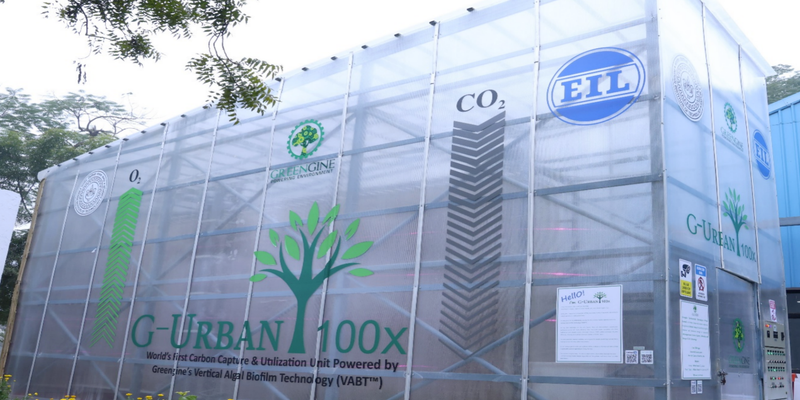
The world nowadays, is limited by space and not by emissions and Kanpur-based climate tech startup Greengine Environmental Technologies adopted a different approach by deploying artificial tree, G-Urban Tree 100x at the Engineers India Limited (EIL) office complex in Gurugram.
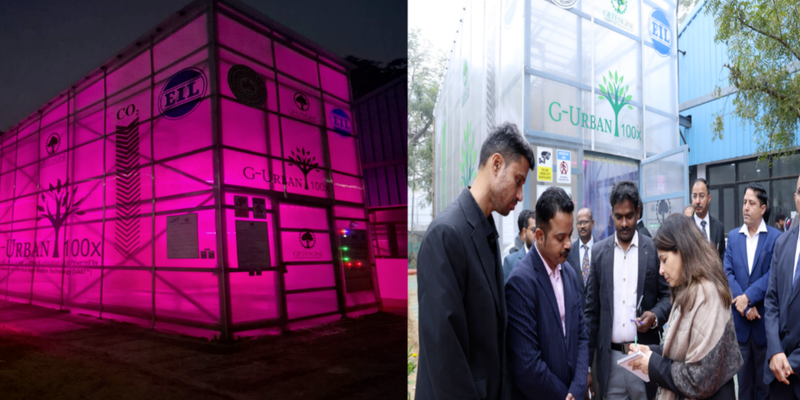
The unit, branded as G-Urban Tree 100x, was inaugurated by Smt. Vartika Shukla, Chairman & Managing Director of EIL, marking a significant milestone in India’s pursuit of scalable, nature-inspired climate solutions.
The Science Behind the G-Urban Tree 100x
At the heart of the system lies Greengine’s patented Vertical Algal Biofilm Technology (VABT™), a platform that harnesses the photosynthetic capabilities of microalgae to capture carbon dioxide directly from ambient air and release oxygen in return.
Think of it as a high-performance artificial tree, engineered for the constraints of urban and institutional environments where planting 100 actual trees is simply not feasible. Each G-Urban Tree 100x unit captures approximately 2.25 tonnes of CO₂ annually and releases nearly 2 tonnes of oxygen, delivering the environmental impact of 100 mature trees in a fraction of the physical footprint.
Built for Cities: Compact, Solar-Powered, and Resource Efficient
The G-Urban Tree 100x has been designed with urban deployment squarely in mind. The unit is solar-powered, eliminating dependence on grid electricity. It is compact and modular, allowing it to be installed across a range of sites, from corporate campuses and government buildings to public spaces and transport hubs (airports, metro stations, railway stations etc).
Greengine has also incorporated sustainability into the hardware itself: the unit is built using upcycled steel and supports remote monitoring and automated operation, reducing manual intervention and maintenance costs.
Critically, the captured carbon does not simply disappear. It is stored within the microalgal biomass generated by the system, which is subsequently utilised in sustainable material applications, effectively closing the carbon loop and ensuring zero waste.
In addition, the unit offers a large exterior surface (approximately 600–800 sq. ft.) that can be leveraged for sustainability-led storytelling and brand promotion, enabling organizations to adopt an innovative form of brand communication.
Complementing Trees, Not Replacing Them
Greengine is clear-eyed about the role of its technology: The G-Urban Tree 100x is not positioned as a substitute for natural green cover. Rather, it is designed to augment traditional tree-planting efforts in areas where cities face acute constraints, limited land availability, high pollution levels, and challenging climatic conditions.
The installation at EIL’s Gurugram campus serves as a demonstration of how advanced biological carbon capture can work alongside conventional green infrastructure, contributing towards India’s Net-Zero commitments.
Beyond Cities: A Pathway for Industrial Decarbonisation
While the G-Urban Tree 100x targets urban environments, Greengine’s underlying technology platform has far broader implications. The same VABT™ system can be scaled and integrated with industrial exhaust streams and flue gases, enabling carbon capture from refineries, power plants, cement factories, steel mills, and other hard-to-abate sectors.
This positions Greengine at the intersection of two high-priority climate agendas: sustainable cities and industrial decarbonisation both of which are central to India’s sustainability and Carbon Capture, Utilisation, and Storage (CCUS) goals.
Why This Matters
India’s climate ambitions require a portfolio of solutions, from renewable energy and electric mobility to nature-based and engineered carbon removal. The deployment of the G-Urban Tree 100x represents a tangible, indigenous innovation that addresses the carbon capture gap in dense urban environments where conventional approaches fall short.
The collaboration between EIL, a Navratna public sector enterprise, and Greengine, a startup emerging from India’s heartland, also underscores a broader trend: established institutions increasingly partnering with deep-tech startups to pilot and scale frontier climate technologies.
Original Article
(Disclaimer – This post is auto-fetched from publicly available RSS feeds. Original source: Yourstory. All rights belong to the respective publisher.)