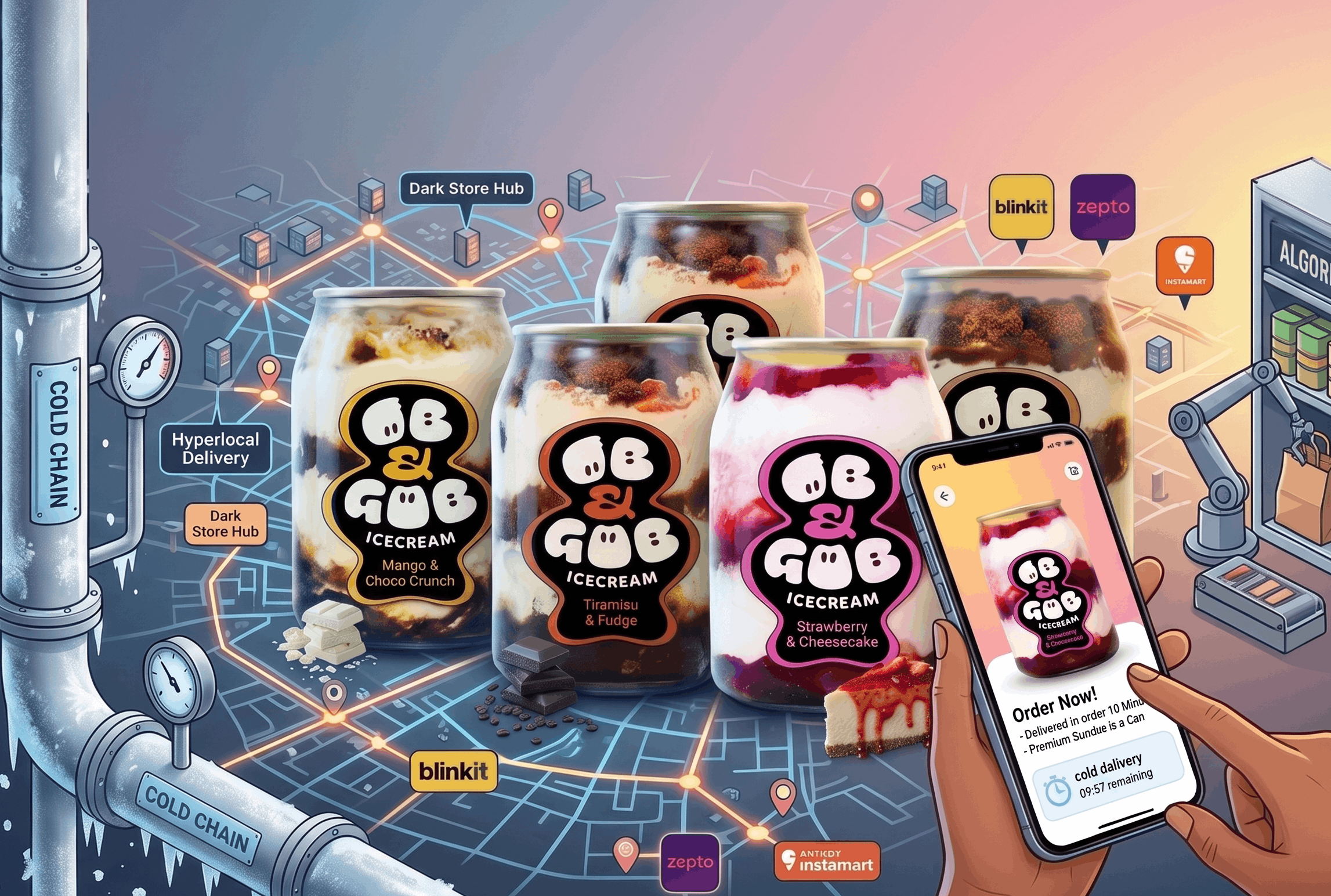
On a warm evening in Bengaluru, ordering a premium sundae no longer requires a trip to an ice cream parlour. It takes less than ten minutes, and arrives in a can.
That shift in consumer behaviour is at the heart of Dairy Day's latest bet: Ob & Gob, a quick-commerce-first ice cream brand designed not for freezers in retail stores, but for the algorithmic shelves of platforms like Blinkit, Zepto, and Swiggy Instamart.
The launch signals something larger than a new product format. It shows how quick commerce, once seen as a convenience layer for groceries, is beginning to reshape entire categories—including one of India's most logistically complex: ice cream.
For years, ice cream in India has largely been a destination purchase. Consumers either visited parlours such as Amul outlets or premium chains like Naturals Ice Cream, or bought family packs during supermarket runs.
The constraints were structural. Ice cream requires an unbroken cold chain, suffers from high last-mile spoilage risk, and depends heavily on physical visibility in freezers. Distribution was capital-intensive, and scaling meant investing in refrigeration, dealer networks, and retail relationships.
Quick commerce has upended that model.
Dark stores, small, hyperlocal warehouses, now act as micro-distribution hubs, enabling brands to bypass traditional retail and reach consumers directly within minutes. The result: ice cream is shifting from a planned purchase to an impulse-driven indulgence, often ordered alongside snacks, beverages, or late-night meals. Tellingly, impulse ice cream now dominates the category, accounting for nearly 60% of the Indian market in 2025.
"Spontaneity is the new driver," said Saurabh Kasat, Director & CFO at Dairy Day, in the company's announcement. "Consumers want indulgence on demand."
The rise of QCom-first brands
Ob & Gob is among a growing cohort of brands being built specifically for this new channel. Unlike legacy products adapted for delivery, these brands are designed with quick commerce constraints in mind, packaging that travels well, formats optimised for single-serve consumption, and visuals that stand out on a smartphone screen rather than a retail shelf.
This shift mirrors what has already played out in categories like beverages and snacks, where digital-first brands have leveraged platforms such as Flipkart Minutes and Amazon Now to scale rapidly without relying on traditional distribution networks.
In ice cream, the shift is particularly pronounced, and increasingly well-funded.Indian ice cream startups raised a record $26.5 million in 2024, accounting for 74% of all sector funding over the prior five years. The names leading this wave are telling: Go Zero, a guilt-free, zero-sugar brand that derives 70% of its revenue from quick commerce; NOTO, a low-calorie Mumbai-based brand whose revenue grew from Rs 8 crore in FY22 to Rs 55 crore in FY24, according to data by Tracxn.
Even established players like Havmor Ice Cream and Kwality Wall's have expanded their presence on quick commerce platforms, experimenting with smaller SKUs and exclusive launches. Kwality Wall's recently rolled out The Dairy Factory, a slow-churned premium tub range built explicitly to cater to at-home indulgence via quick commerce and modern retail.
Packaging meets platform
Ob & Gob's "ice cream in a can" format reflects another emerging trend: designing products for digital discovery.
In a physical store, a brand competes for freezer space. On quick commerce apps, it competes for thumbnail attention.
Transparent cans showcasing layered sundaes, ice cream, cake, toppings, and syrup, are meant to do what traditional tubs cannot: communicate indulgence instantly on a small screen.
This is part of what marketers call "channel-first thinking," where product design, branding, and even portion sizes are tailored to how consumers encounter the product.
"It's not just about taste anymore," said Arvind Ramachandran, Dairy Day's VP of Marketing. "It's about how the product travels, how it looks on the app, and how quickly it converts."
A structural shift in the industry
The implications for the broader ice cream industry are significant.
Quick commerce reduces dependence on distributors and retailers, lowers entry barriers for new brands, and compresses the feedback loop between product launch and consumer response. A new flavour can be tested, iterated, or withdrawn in weeks rather than seasons.
At the same time, it is changing demand patterns. Late-night ordering, smaller pack sizes, and premium indulgence formats are seeing disproportionate growth.
By mid-2025, quick commerce platforms estimate approximately 33 million monthly transacting users across more than 150 cities, well beyond the top metros where the trend first took hold. Tier II and Tier III cities are increasingly part of the story, as brands like Hocco extend their reach into Rajasthan, Maharashtra, and Delhi-NCR via QCom networks rather than ground-up physical distribution,
For Dairy Day, which recently crossed Rs 1,000 crore in revenue, quick commerce already contributes around 7% of sales, a figure expected to double in the coming years.
The company said its QCom business has more than doubled in the past year. Hindustan Unilever, operating at a far larger scale, reported that quick commerce already accounts for over 10% of its ice cream business.
The trade-offs
The model is not without challenges.
Margins on quick commerce can be thinner due to platform commissions and the need for aggressive promotions. Brands also become dependent on platform algorithms for visibility, much like sellers on ecommerce marketplaces. And as more brands flood the same digital shelves, standing out becomes harder—and more expensive.
There is also a structural question about geography. The long-term viability of the QCom model beyond top-tier cities remains uncertain, as lower order density and spend per order could strain unit economics at scale.
Yet, for many, the trade-off is worth it.
Before quick commerce, scaling an ice cream brand nationally could take years of building cold-chain infrastructure. Today, a startup can reach multiple metros in months by plugging into existing networks.
The new ice cream economy
The result is a category in transition.
India's ice cream market, valued at approximately Rs 31,000 crore in 2025, is projected to nearly quadruple to Rs 1.19 lakh crore by 2034. Quick commerce won't be solely responsible for that trajectory, but it is increasingly the accelerant.
Ice cream is no longer just a summer staple or a family dessert. It is becoming an on-demand, digitally discovered, single-serve indulgence, ordered as casually as a soft drink.
For consumers, that means more choice and faster gratification. For brands, it means rethinking everything, from how ice cream is made and packaged to how it is marketed and delivered.
And for companies like Dairy Day, the message is clear: in the age of quick commerce, even a century-old category can be reinvented, one delivery at a time.
Edited by Megha Reddy
Original Article
(Disclaimer – This post is auto-fetched from publicly available RSS feeds. Original source: Yourstory. All rights belong to the respective publisher.)