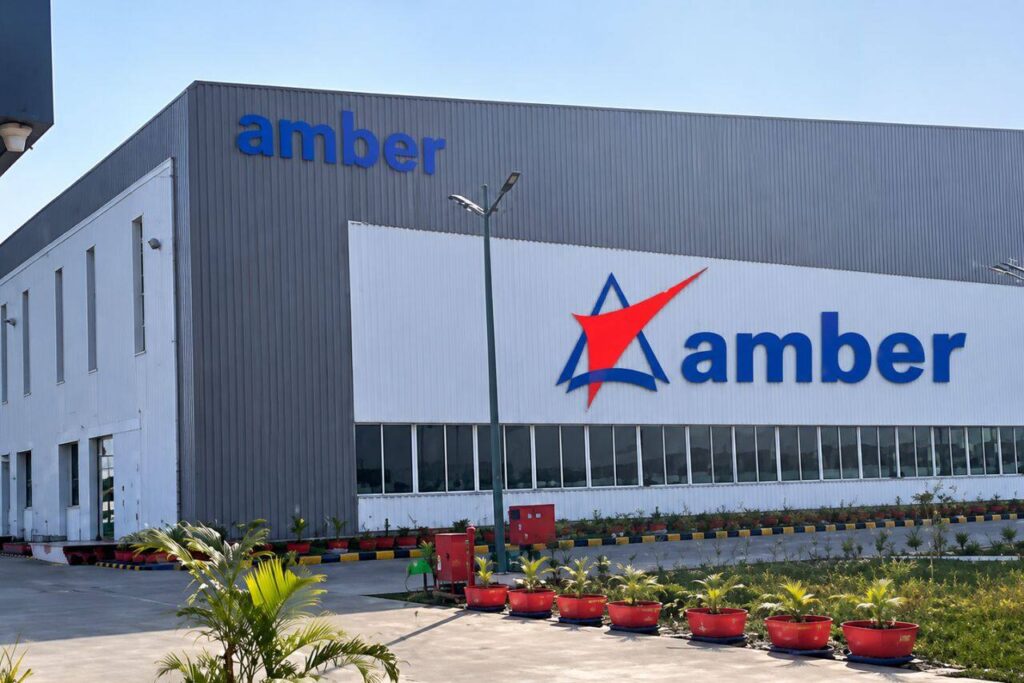
Synopsis: Amber Enterprises has entered India’s smartphone manufacturing industry through a strategic collaboration with Oppo, covering Oppo, OnePlus and Realme. While the business starts with assembly, management’s long-term roadmap focuses on increasing local value addition through component manufacturing. Can this become Amber’s next multi-year growth engine beyond air conditioners and electronics?
Amber Enterprises has steadily transformed itself from an air-conditioner contract manufacturer into a diversified electronics manufacturing player. Its latest manufacturing collaboration with Oppo, covering Oppo, OnePlus and Realme smartphones, marks its entry into one of the world’s largest consumer electronics segments.
While the partnership initially focuses on assembly, management’s long-term strategy of increasing local value addition and expanding into component manufacturing could potentially create a new multi-year growth engine for the company.
With a market cap of Rs 26,700 crore, the shares of Amber Enterprises India Ltd are trading at Rs 7,567 and are trading at a PE of 135 compared to their industry’s PE of 47. The shares have given a return of more than 150% in the last 5 years.
Financials
Despite a challenging operating environment, the company delivered a resilient FY26 performance. Revenue increased from Rs 9,973 crore in FY25 to Rs 12,186 crore, while EBITDA rose from Rs 736 crore to Rs 862 crore, maintaining a stable 7% EBITDA margin. Profit after tax declined from Rs 251 crore in FY25 to Rs 226 crore in FY26.
However, the March 2026 quarter was relatively softer sequentially, with revenue recovering to Rs 4,148 crore in Q4 FY26 from Rs 2,943 crore in Q3 FY26. Overall, the company ended FY26 with stronger revenue but a drop in profitability.
Amber’s Biggest Diversification Yet
Amber Enterprises has been working for more than two decades in building itself up from a mere air conditioner contract manufacturer to become one of the biggest EMS firms in India. During this period, the firm has diversified into areas like consumer electronics, wearables, PCBs, railway electronics, and components.
Nevertheless, its latest partnership with Oppo Mobiles India could become one of the most important events in the firm’s history. The firm has signed a manufacturing collaboration deal with Oppo India covering three big smartphone brands, such as Oppo, OnePlus and Realme.
As per the management, this partnership marks the official entrance of the firm into the Indian mobile phone manufacturing sector, which is one of the largest electronics manufacturing sectors in the world. This collaboration will serve the long-term vision of the firm, where it aims to strike a balance between high-value-added operations and volume manufacturing.
Why the Oppo, OnePlus & Realme Partnership Matters
The management considers the partnership a result of faith shown by a top global brand of smartphones in the manufacturing prowess of Amber. Rather than developing a manufacturing unit from scratch, Amber will be involved in the manufacturing of smartphones through its own manufacturing unit on a sublease basis from Oppo India.
With the partnership, Amber will be able to enter the market without making substantial initial investments. The deal encompasses all the brands associated with the partnership, which include Oppo, OnePlus, and Realme, thus providing Amber with an immediate manufacturing opportunity in the field of smartphones.
It is expected that trial production will be started in the fourth quarter of FY27, whereas commercial production is planned to be started in the first quarter of FY28. The management estimates production volumes of approximately 8 million smartphones in the first year and 13-15 million smartphones in the second year.
An Asset-Light Entry Into India’s Smartphone Manufacturing Opportunity
One of the most significant elements of the collaboration is the fact that the company stresses its asset-light model of operation. In contrast to many manufacturing businesses that have large greenfield investments, Amber would need a negligible amount of capital investment because there is already an existing manufacturing plant within Oppo India’s infrastructure.
As per the management, the company needs an initial investment of less than Rs 50 crore because assembly and surface-mount technology processes can all be done from the existing factory itself.
This greatly reduces execution risks for the company while ensuring that it remains efficient in its operations without needing much capital investment. The company also points out that the working capital requirement for the business is expected to be very low, with net working capital usually between four and ten days.
From Assembly Today to Component Manufacturing Tomorrow
While the collaboration starts with assembly and SMT, it was very clearly pointed out by management that this is just the beginning of a larger journey. The strategy of the company would be to systematically increase the domestic value addition in the coming 5-6 years through mobile phone components with higher value addition.
The next step would be the introduction of High-Density Interconnect (HDI) printed circuit boards, following which the company aims to keep adding more components in the company’s ecosystem for manufacturing. It has been explained by the management that while the Indian smartphone industry has been operating with merely 10-12% domestic value addition, the ultimate goal of Amber is to take it to 35-40% in the coming 5-6 years through systematic addition of more components.
Instead of taking on the responsibility of immediate localisation of all components, the company aims to adopt the same process-orientated and gradual path which helped it build a large presence in its air-conditioner business. Here, through systematic addition of components one at a time over a period of several years, the company has achieved near-total value addition of close to 70%.
Leveraging Existing Manufacturing Expertise
Despite being a novel type of product, management ensured that mass-scale manufacturing of electronic products was something that Amber was familiar with through IL JIN Electronics, which currently manufactures almost 9-10 million smartwatches per year, produces approximately 15 million printed circuit board assemblies in various applications, and produces over 5.5 million room air conditioners each year.
Given the current level of manufacturing experience at Amber, management feels that the learning curve for assembling smartphones should be fairly easy. It is expected that the first three months of trial manufacturing would help in bringing stability before the actual manufacturing starts in FY28. Moreover, as manufacturing will begin in an existing facility of Oppo, Amber expects to leverage the existing manufacturing environment and develop its own experience.
Why Mobile Manufacturing Could Become a High-ROCE Business
Another aspect related to the manufacture of smartphones is the lower operating margin achieved through assembly operations. The management admitted that the typical industry EBITDA margin for assembling companies is from 1.5% to 2%, depending on the product mix. But the company believes that it would be inappropriate to consider the opportunity only on the basis of EBITDA margins because the firm is highly capital efficient.
As per the management, due to the extremely low capital outlay and working capital required, the firm could potentially achieve ROCE of 30-35% on its own. With increased localisation and entry into higher-margin component manufacturing, the profitability of the firm would further increase. Typical EBITDA margins for the component firms, such as PCBS, are about 15-16%, where the value added is the factor influencing the earnings growth.
Beyond Smartphones: Building a Larger Electronics Ecosystem
It was made clear by the management that this opportunity is not limited to just producing mobile phones. This is more about becoming a supplier of components for smartphones in India’s growing ecosystem. The more localisation that takes place, the more suppliers Amber can introduce into India and produce more components locally over time.
The acquisition of Ascent along with Shogini has already enabled Amber to become one of the largest producers of PCB in India. According to the management, this existing capability would fit into Amber’s ambitions of making smartphones while giving it chances to supply components not just for Oppo but for the entire ecosystem in the future. Although currently the deal is limited to Oppo, OnePlus, and Realme, management said that at this point in time they want to concentrate only on implementing this deal first.
Can Amber Unlock a Multi-Year Mobile Manufacturing Opportunity?
In terms of entering the smartphone manufacturing business, Amber Enterprises seems to be doing more than just entering into an agreement for contract manufacturing. Rather, it is clearly taking the phased approach of beginning with light asset assembly, gaining competency, adding more value locally, and gradually moving into higher-margin component manufacturing.
This follows the path that helped Amber emerge as a major manufacturer of air-conditioning component manufacturing in India over the last 20 years. Whether this strategy succeeds will depend entirely on execution.
The company needs to scale up its production from 8 million units in year one to 13-15 million units in year two, increase localisation, introduce HDI PCBs and other components, and raise margins through increasing domestic value addition.
In such a case, this partnership can become far more than a mere customer relationship. It can turn Amber into a key player in the dynamic field of smartphone manufacturing in India, along with the existing electronics manufacturing business.
Disclaimer: The views and investment tips expressed by investment experts/broking houses/rating agencies on tradebrains.in are their own, and not that of the website or its management. Investing in equities poses a risk of financial losses. Investors must therefore exercise due caution while investing or trading in stocks. Trade Brains Technologies Private Limited or the author are not liable for any losses caused as a result of the decision based on this article. Please consult your investment advisor before investing.
The post Oppo, OnePlus & Realme Deal: Can Amber Enterprises Unlock a Multi-Year Mobile Manufacturing Opportunity? appeared first on Trade Brains.
Original Article
(Disclaimer – This post is auto-fetched from publicly available RSS feeds. Original source: Tradebrains. All rights belong to the respective publisher.)