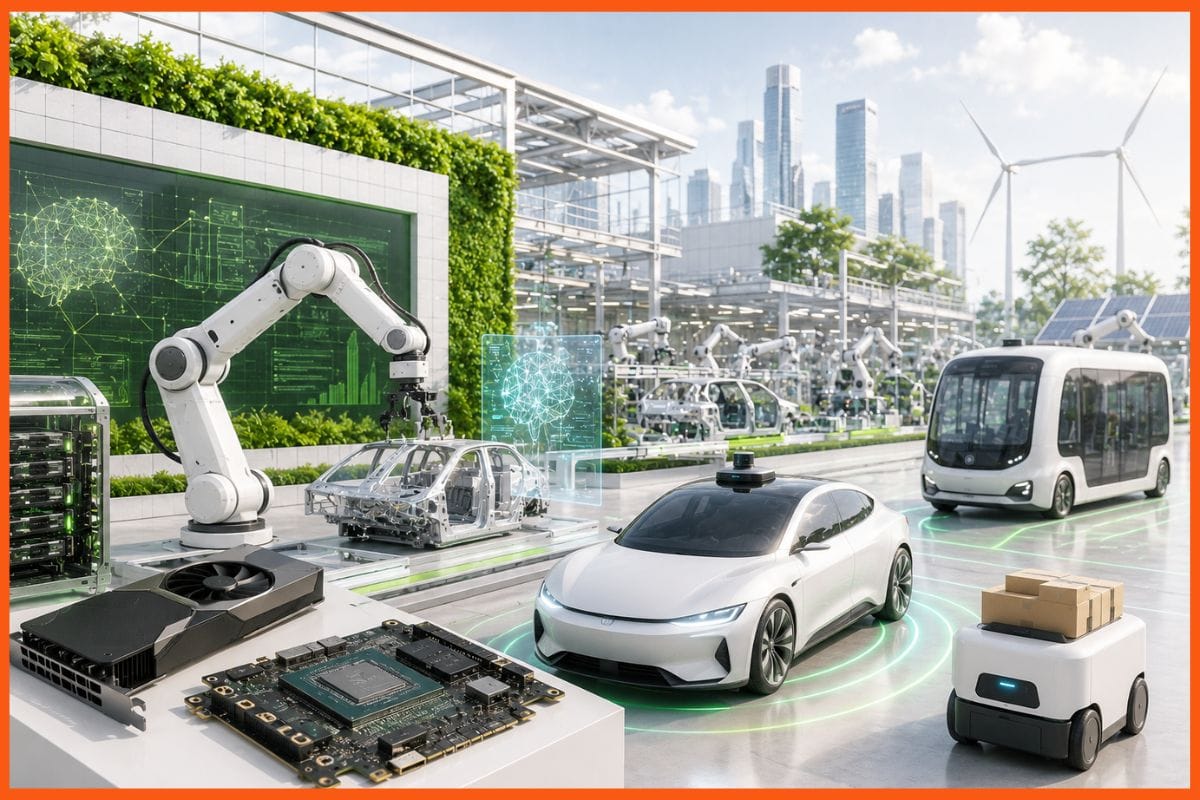
To speed up LG Group's upcoming AI-driven economic wave, NVIDIA and LG Group are constructing an AI factory. This is a huge step forward for LG as they expand into new areas, including graphics processing unit (GPU) cloud services, data center technologies, autonomous driving, and robots. Through the AI factory, LG Group will have access to faster computer resources, allowing it to develop, test, and roll out AI-based apps to its most important divisions.
Together, the two companies' AI manufacturing platforms integrate NVIDIA's full-stack capabilities. This is complemented by the fact that LG Group is a world leader in data center technologies, smart spaces, robotics, mobility components, and consumer electronics. A uniform pipeline for constructing physical AI systems is being connected by the firms involved. This workflow will include physical AI data production, robot simulation and training, edge deployment, and factory-scale digital twins.
NVIDIA to Help LG Electronics' Future Robots
To aid with a variety of interior household chores, LG Electronics is creating home-based robots such as CLoiD. Moreover, these robots will be raising living standards and making routine tasks easier. Before releasing these home cobots to the public, LG may test them in realistic virtual environments by including the open robotics frameworks from NVIDIA, Isaac Sim and NVIDIA Isaac Lab into their development processes.
For its residential robots and modular robotics systems, the business is looking at the possibility of utilising the NVIDIA Isaac GR00T open reasoning vision action language paradigm. Thanks to the GR00T model, LG robots will be able to reason like humans and do complicated jobs. Along with working together on reference robots, NVIDIA and LG Electronics intend to integrate LG's robots into the NVIDIA Isaac GR00T ecosystem. In an effort to speed up physical AI initiatives for both Korean and international enterprises, LG Electronics is building a data factory to help with robotic training data.
By transforming computation into data, LG will supply top-notch training data for AI projects in industry and robotics. This data will be generated and enhanced utilising models from NVIDIA's Cosmos World Foundation. Utilising its renowned optical expertise, LG Innotek intends to supply cutting-edge robotics parts, including sensing technologies, tailored to NVIDIA's development environments and GPU architecture.
|
Some Interesting Facts of the Story |
|
1.The partnership spans multiple sectors 2.The AI Factory could accelerate 3.The initiative may help bring smarter |
LG-NVIDIA Partnership to Further Enhance AI in Mobility
Using the NVIDIA DRIVE platform, LG Electronics aligns its in-vehicle AI technologies and advanced driver-assistance systems (ADAS) with NVIDIA in the mobility sector. Supporting LG Electronics' plan for autonomous driving, ADAS, and software-defined vehicles, the partnership will centre on aligning sensor, compute, and software architectures with the NVIDIA DRIVE Hyperion framework.
AI-powered cockpits and edge AI processing are only two of the future mobility applications that LG Electronics intends to employ using NVIDIA DRIVE AGX accelerated compute. The goal of this project is to help global manufacturers build AI-driven mobility solutions more quickly and to enhance LG Electronics' automotive electronics portfolio. By using its cutting-edge sensing, communication, and illumination technologies, LG Innotek is quickly solidifying its position as the industry leader in autonomous driving. LG Innotek and NVIDIA will work together on next-gen components designed for NVIDIA architecture.
|
Quick Shots |
|
•NVIDIA and LG Group are building an AI •The initiative combines NVIDIA’s •The AI Factory will support the •The collaboration aims to create a unified |
Original Article
(Disclaimer – This post is auto-fetched from publicly available RSS feeds. Original source: Startuptalky. All rights belong to the respective publisher.)