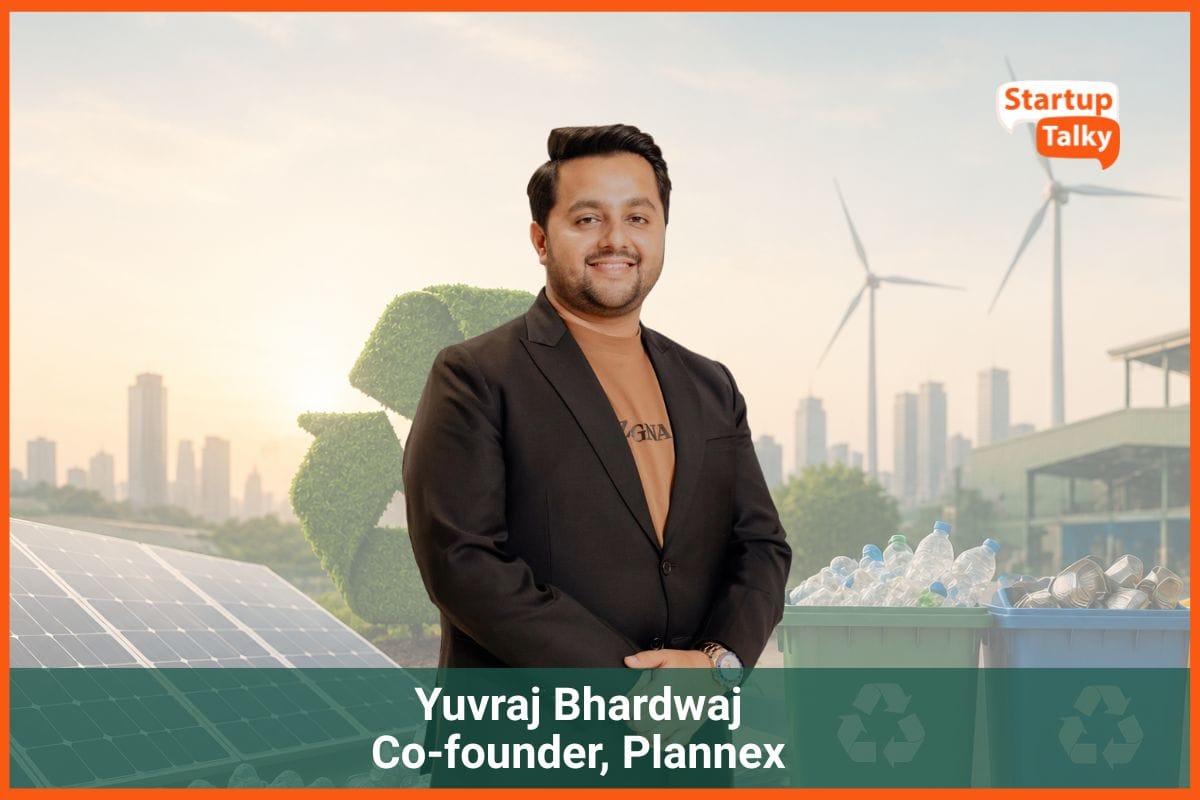
India's recycling and circular economy sector is gaining momentum as the country grapples with rising waste generation from renewable energy, electric vehicles, plastics, batteries, and electronic devices. The global recycling market is projected to grow at a CAGR of around 6-8% through 2030, while India’s waste management and recycling industry is expected to expand at aCAGR of over 10%, driven by Extended Producer Responsibility (EPR) regulations, sustainability commitments, and increasing investments in resource recovery infrastructure.
In this interview, Yuvraj Bhardwaj, Co-founder of Plannex, discusses the future of solar panel recycling, AI-powered waste processing, EPR compliance, informal waste worker integration, and the circular economy infrastructure India needs to build for the next decade.
Building India's Solar Panel Recycling Infrastructure Before the Waste Wave Arrives
StartupTalky: India’s solar capacity is growing at a rapid pace, but solar panel lifespans of 20–25 years mean that a significant wave of decommissioned modules is now beginning to arrive. What does the current state of solar panel recycling infrastructure in India look like, and what needs to be built before this becomes a crisis rather than an opportunity?
Yuvraj Bhardwaj: India has scaled solar deployment faster than almost any country in the world, but end-of-life planning has simply not kept pace. Right now, large-scale solar panel recycling infrastructure is almost non-existent in any meaningful form. There are no standardized collection frameworks, no national-level processing capacity, and no clear commercial pathway for recovered materials. The industry has understandably been focused on installation targets, but that window is closing.
The incoming wave of decommissioned panels is no longer a future problem. The panels deployed during India’s early solar expansion are already approaching end-of-life. Each module contains recoverable value, including glass, aluminium, silicon, silver contacts, and in some thin-film variants, cadmium and tellurium. Without organized systems to capture that value, it ends up in landfills. That is both an environmental failure and an economic one.
What needs to be built urgently is not complicated, but it requires coordinated action. India needs policy clarity from the Ministry of Environment, Forest and Climate Change on panel-specific EPR obligations, standardized material recovery benchmarks, commercial incentives for recyclers to invest in processing capacity, and robust traceability systems so panels can be tracked from installation through decommissioning. At Plannex, we are already building within this space. The question for the country is whether the ecosystem develops fast enough to turn this into a supply chain asset rather than a landfill liability.
Managing the Full Lifecycle Cost of India's Energy Transition
StartupTalky: The Iran conflict has pushed India to accelerate domestic energy production, including mining of critical minerals for batteries and solar. But that acceleration creates its own waste and environmental burden. How should India think about the full lifecycle cost of its energy transition, from raw material extraction to end-of-life recycling?
Yuvraj Bhardwaj: The energy transition narrative in India has been dominated by deployment metrics, gigawatts installed, targets set, and capacity added. What it has consistently underweighted is the environmental and material cost of building that capacity in the first place. Critical mineral extraction, battery manufacturing, and large-scale renewable infrastructure all carry significant upstream environmental burdens. Treating those as someone else’s problem is not a strategy.
Lifecycle cost accounting must become central to how India plans its energy transition, not an afterthought. That means responsible domestic mining practices, material efficiency standards in manufacturing, design-for-disassembly requirements on new energy products, and end-of-life recovery systems built before volumes become unmanageable.
The real risk is that India replaces one form of environmental dependency with another, importing fewer hydrocarbons while exporting its mining and recycling burden. Circularity is not a downstream consideration in the energy transition. It is structurally embedded within it. Every kilogram of lithium, cobalt, or silicon recovered from end-of-life batteries or panels is a kilogram that does not need to be extracted again. India has the industrial base and policy momentum to get this right, but it requires treating recycling infrastructure as critical national infrastructure rather than a secondary commercial activity.
Strengthening EPR Compliance Through Better Traceability and Enforcement
StartupTalky: Plannex operates EPR-compliant recycling across batteries, plastics, tyres, e-waste, and solar panels. India’s Extended Producer Responsibility framework is still relatively young. What is working well in how brands and manufacturers are engaging with EPR, and where are the most persistent gaps in compliance and traceability?
Yuvraj Bhardwaj: The biggest positive is that EPR has shifted the conversation inside boardrooms. Three years ago, most producers treated compliance as a box-ticking exercise managed primarily by legal teams. Today, sustainability and procurement leaders are actively involved, and brands are increasingly linking EPR performance to broader ESG commitments and investor expectations. That shift in ownership within organisations is meaningful.
However, the gaps remain significant. The most fundamental issue is traceability. Waste changes hands multiple times between generation and processing, and documentation often breaks down along the way. This creates a system where compliance credits can sometimes be claimed without corresponding physical recovery actually taking place. Until digital tracking is embedded at the collection level and not just at the recycler level, verification will remain unreliable.
The second challenge is fragmentation. Informal collection channels continue to dominate waste movement across India, yet they largely operate outside formal compliance systems. At Plannex, we have invested heavily in integrating these networks into auditable supply chains because credible EPR compliance cannot be built on an undocumented foundation.
The third challenge is enforcement consistency. The framework exists, but implementation varies significantly by geography and category. Strengthening enforcement uniformity is arguably as important as any new policy addition.
How AI Is Transforming Material Recovery and Waste Processing Economics
StartupTalky: Your AI-driven material recovery system segregates complex plastic waste at scale. How does AI change the economics and throughput of waste processing compared to manual or basic mechanical sorting, and what categories of waste are still too difficult or uneconomical to recover even with AI assistance?
Yuvraj Bhardwaj: The fundamental change AI brings is not speed, it is precision at scale. Manual sorting is inconsistent, physically limiting, and cannot differentiate material composition beyond what the human eye can detect. Mechanical systems improve throughput but remain largely binary in classification. AI vision systems can simultaneously evaluate colour, density, surface texture, contamination levels, and material type across fast-moving processing lines, with accuracy that improves as models learn from larger datasets.
In practical terms, this results in higher-purity recovered materials, lower contamination rates, and better downstream market value for recycled outputs. Within our tyre recycling operations, AI-driven evaluation enables us to route each tyre to the optimal stream, whether reuse, retreading, or full recycling, based on wear patterns, material quality, and structural integrity. We also deploy X-ray detection systems to identify hidden hazards such as embedded lithium batteries or metal components that could damage equipment or create safety risks.
That said, certain categories remain difficult even with AI assistance. Multi-layered flexible packaging used in food sachets and snack wrappers is the clearest example. The economics of recovering material worth INR 5 per kilogram when processing costs are INR 20 per kilogram simply do not work. The limiting factor is not technology, but the lack of viable downstream markets and poor product design. Design-for-recyclability standards are ultimately the most sustainable solution.
Scaling Waste-to-Product Manufacturing Through Circular Economy Models
StartupTalky: Plannex upcycles low-value plastic into eco-pavers and infrastructure materials. For this kind of waste-to-product business to scale, you need both reliable waste supply and consistent product demand. Which side of that equation is harder to manage in India, and what market conditions would make upcycling economics genuinely attractive for a wider range of materials?
Yuvraj Bhardwaj: Supply remains the more challenging side of the equation. Demand for sustainable infrastructure products such as eco-pavers is growing, and institutional buyers including municipalities, real estate developers, and large corporates increasingly want to demonstrate circular procurement. That side of the market is improving.
The challenge lies in aggregating consistent, quality-controlled waste feedstock at the scale required to run upcycling operations efficiently. India’s waste collection ecosystem is highly fragmented across geographies, collection formats, and quality standards. The plastic reaching a recycler from one district often looks very different from material arriving from another. Managing this variability requires strong aggregator networks, quality controls, and incentives for better segregation upstream.
What would make upcycling economics more attractive is a combination of green procurement mandates, standardized performance frameworks for recycled products, and EPR mechanisms that create financial flows back into the recycling ecosystem. Scale follows economics. If the economics are right, the market will build itself.
Integrating Informal Waste Workers into India's Formal Recycling Ecosystem
StartupTalky: Informal waste workers are a critical part of India’s recycling ecosystem but are largely excluded from the value it generates. Plannex formally integrates waste workers into its supply chain. What does that look like in practice, and how does it affect the economics, traceability, and social legitimacy of your recycling operations?
Yuvraj Bhardwaj: Informal waste workers are not a problem to be designed around. They are the operational backbone of India’s waste collection system, and any serious recycling model must begin with that reality. Attempting to build formal recycling infrastructure while bypassing these networks simply does not work.
At Plannex, integration means structured engagement at the aggregation level through organized collection contracts, documented handoffs, digital or paper-based tracking of material volumes and provenance, and income structures that provide greater visibility and stability. We also focus on safety practices and operational standards because the physical risks associated with informal waste handling are significant and often overlooked.
The impact on traceability is direct and measurable. When collection remains undocumented, compliance claims are difficult to verify. When collection becomes formalized, even partially, it creates an auditable chain of custody that strengthens EPR compliance, reduces fraud exposure, and improves operational planning.
The social legitimacy argument is inseparable from the business case. A circular economy model that generates value while excluding the people who make it function is neither sustainable nor defensible. Getting this right is what separates credible recycling infrastructure from greenwashing.
Creating Circular Economy Solutions for Batteries, Solar Panels, and Emerging Waste Streams
StartupTalky: As India’s energy transition creates entirely new waste streams, from lithium battery packs to decommissioned wind turbine blades, which of these emerging categories do you see as most urgently in need of a circular economy solution, and what would it take to build one?
Yuvraj Bhardwaj: Lithium-ion batteries are the most urgent priority, and the gap between current capacity and future volumes is significant. EV adoption is accelerating, battery storage is expanding across industrial and grid applications, and the batteries being deployed today will begin reaching end-of-life in large numbers within the next five to eight years.
Unlike many waste streams, lithium-ion batteries present both high environmental risk and high resource recovery potential. Lithium, cobalt, nickel, graphite, and manganese are all present in commercially meaningful concentrations. Building a viable circular ecosystem requires safe collection and transport standards, dismantling infrastructure with appropriate safety controls, advanced recycling technologies capable of recovering critical minerals to battery-grade specifications, and producer responsibility frameworks that make collection economically viable.
Solar panels are the second most urgent category for similar reasons. Wind turbine blades represent a longer-term challenge because the composite materials involved remain difficult to recover economically.
The common thread across all of these waste streams is simple. The time to build circular infrastructure is before waste volumes become unmanageable, not after. India has a narrow window to get ahead of the curve. At Plannex, we are already investing in battery and solar recycling solutions. The question for the broader ecosystem is whether policy and capital can move fast enough to match the pace of the energy transition.
 StartupTalky- Business News, Insights and StoriesApoorva Bajj
Original Article
(Disclaimer – This post is auto-fetched from publicly available RSS feeds. Original source: Startuptalky. All rights belong to the respective publisher.)