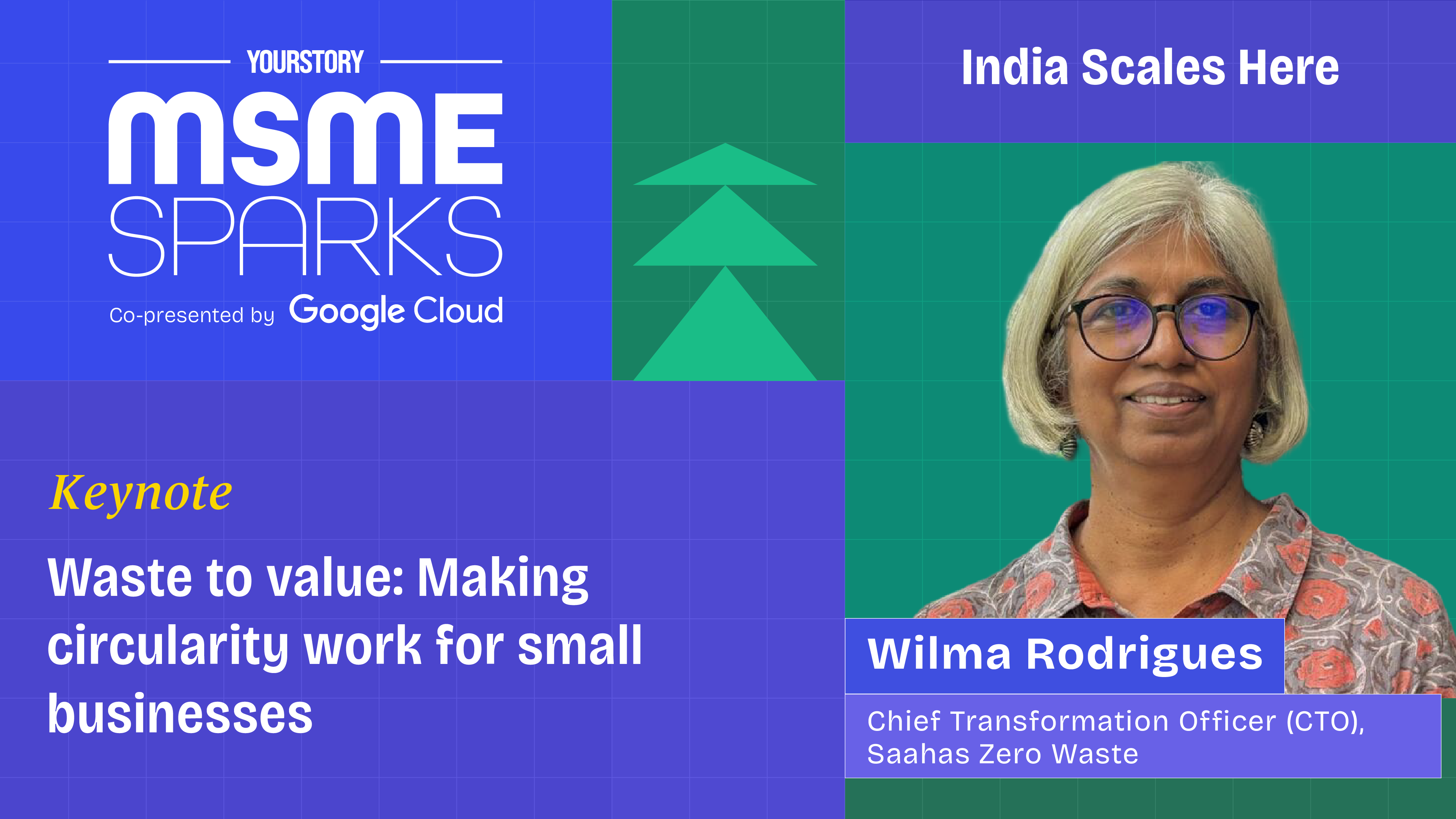
Sustainability is no longer a corporate social responsibility exercise. Wilma Rodrigues, Chief Transformation Officer at Saahas Zero Waste, believes it’s a business opportunity.
At MSME Sparks 2026, a five-day YourStory event spotlighting India’s MSME ecosystem in Bengaluru, Rodrigues delivered the keynote on day three. Speaking on ‘Waste to Value: Making Circularity Work for Small Businesses’, Rodrigues drew on 12 years of running Saahas Zero Waste to argue that circularity is not a fringe pursuit anymore but a mainstream necessity for India's five crore MSMEs.
India generates 62 million tonnes of waste every year, Rodrigues said, and as much as 80% is dumped or burned rather than recovered. Only a fraction is truly recycled, even as the country pushes toward the kind of closed loop systems that developed economies increasingly demand.
"Fifty percent of the global economy comes from nature," she said, pointing to raw materials, food, clothing, and housing as examples. "The exponential growth of the last century took place in a linear system, and we, as MSMEs, now have to be mindful and make the necessary reversal."
Also Read MSME Sparks 2026 puts India’s growth engines in the spotlight
A business built on service fees, not just resale
Saahas Zero Waste operates three verticals: a zero-waste program for bulk generators such as campuses and tech parks, an extended producer responsibility (EPR) vertical covering plastic and electronic waste, and a closed loop retail arm that sells recovered products back to communities.
Contrary to popular narratives around waste to wealth, Rodrigues said the bulk of Saahas' revenue does not come from selling recovered materials. About 40% comes from material sales to recyclers and consumers, while the larger share comes from service fees, since roughly 70% of the waste the company handles has no inherent economic value.
"There is a limited flow of capital into this space, because of a belief that waste management doesn't need fees or investment. That thinking is what holds the sector back,” she said.
The company scaled to a peak revenue of about Rs 86 crore in FY24, before slipping to around Rs 60 crore with marginal losses over the following two years. Rodrigues attributed the dip to churn in EPR regulations, and said Saahas chose to absorb the financial hit rather than dilute its environmental and social commitments.
With over 400 employees, most of them women, the company processes around 100 tonnes of solid waste daily and diverted 40,000 tonnes last year across recycling, composting, biogas and reuse channels, claiming a 96% landfill diversion rate.
"Technology plays a role in helping us close the loop, but we cannot do without people," Rodrigues said. "People have to be part of the system, whether it is collection of segregated waste, aggregation and sorting, or recycling, and that means paying them appropriately."
She linked Saahas’ work to multiple UN Sustainable Development Goals, including those on poverty, decent work, sustainable cities and partnerships.
Also Read Borrow the speed, keep the discipline: Zoho’s startup playbook for MSMEs
What comes next
Saahas has raised only small amounts of capital so far, about Rs 8 crore from what Rodrigues called "aligned investors" willing to be patient. The company is now looking to grow into a Rs 200 crore business over the next five years, and is exploring a shift toward steward ownership, a model she urged the audience to research through the Purpose Foundation.
Responding to audience questions, Rodrigues encouraged entrepreneurs in Tier II and Tier III cities to enter the waste sector through partnerships rather than alone, citing the new Solid Waste Management Rules 2026 as a strong tailwind.
On Bengaluru's persistent waste problem, she noted that nearly 40% of the city's waste originates from tech parks and bulk generators, and urged citizens and businesses to manage waste locally rather than pushing it into public spaces.
"We have to be the change we want to see," she said. "That's the way forward, not just for Bengaluru, but for Chennai, for the NCR…for all of India."
Edited by Teja Lele
Original Article
(Disclaimer – This post is auto-fetched from publicly available RSS feeds. Original source: Yourstory. All rights belong to the respective publisher.)