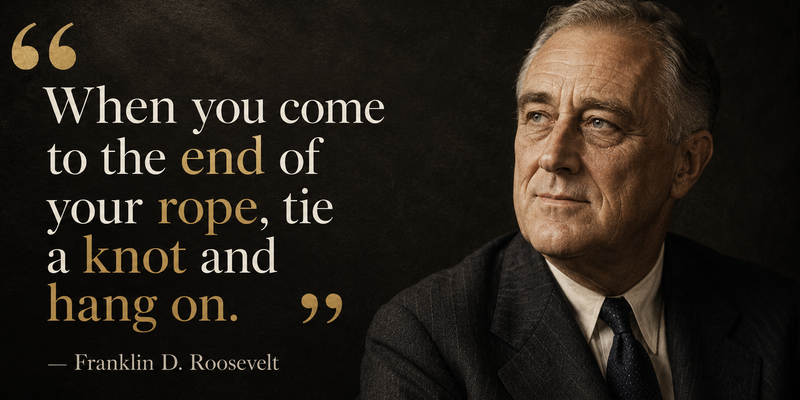
In a world of shifting markets, exam stress, and family pressures, the ground can feel slippery. The line, “When you come to the end of your rope, tie a knot and hang on,” speaks to exactly this moment—when momentum fades and options look thin.
It comes from Franklin D. Roosevelt, the 32nd President of the United States, who led his country through the Great Depression and the Second World War while living with the effects of polio. The source lends the advice weight: it is resilience grounded in governance and hardship, not sentiment.
The idea, in simple terms
There are two moves here. First, “tie a knot”: create a deliberate grip—something small, stable, and within control. Second, “hang on”: commit to sustained effort once that grip exists. The contrast matters. Blind persistence slides; structured persistence holds. The knot is not heroics; it is a practical intervention that prevents further loss and buys time to think.
Applying it at work and in learning
When projects stall or syllabus coverage feels impossible, the knot is a stabiliser that converts overwhelm into a plan you can execute today.
- Define a minimum viable outcome for this day: one page drafted, five problems solved, one client call closed.
- Timebox 25–50 minutes, then review. Treat the review as the knot that stops drift.
- Write a one-page brief before executing. Clarity is grip.
- Templatise repeat tasks status notes, emails, checklists—so decision fatigue reduces.
- Ask for a 10-minute consult from a mentor or colleague to unblock a single question.
Leadership, relationships, and self-care
For leaders and families alike, tying a knot means stabilising the system before scaling solutions. It avoids rash decisions and preserves trust.
- Pause before response: acknowledge constraints, restate the goal, and propose the next observable step.
- Name the stuck point publicly—budget, bandwidth, or skill—and assign one owner.
- Bring in a neutral third party for a time-bound mediation when emotions run high.
- Use a cool-down rule for tough conversations: sleep on it, then decide.
- If safety or dignity is at risk, the knot is a boundary—step back and seek professional help.
What the knot is not
It is not clinging to a lost cause. Hanging on makes sense only after you establish feedback and limits. Persistence without data is wear and tear.
- Run time-bound experiments and review outcomes on a fixed date.
- Track leading indicators (response rates, error counts) rather than vibes.
- Predefine exit criteria: what would make you pivot or stop.
- Protect sleep and nutrition; endurance collapses without maintenance.
A clear takeaway
When you feel at the end of your rope, pick one stabilising action you can complete in the next 15 minutes, set a review time, and only then persist. That small knot clarity plus boundary is what turns hanging on into progress.
Original Article
(Disclaimer – This post is auto-fetched from publicly available RSS feeds. Original source: Yourstory. All rights belong to the respective publisher.)