Artificial intelligence (AI) has arrived as a product problem, according to Ronnie Screwvala, Co-founder and chairperson of upGrad—someone who has built companies, backed founders and watched sectors heat and cool.
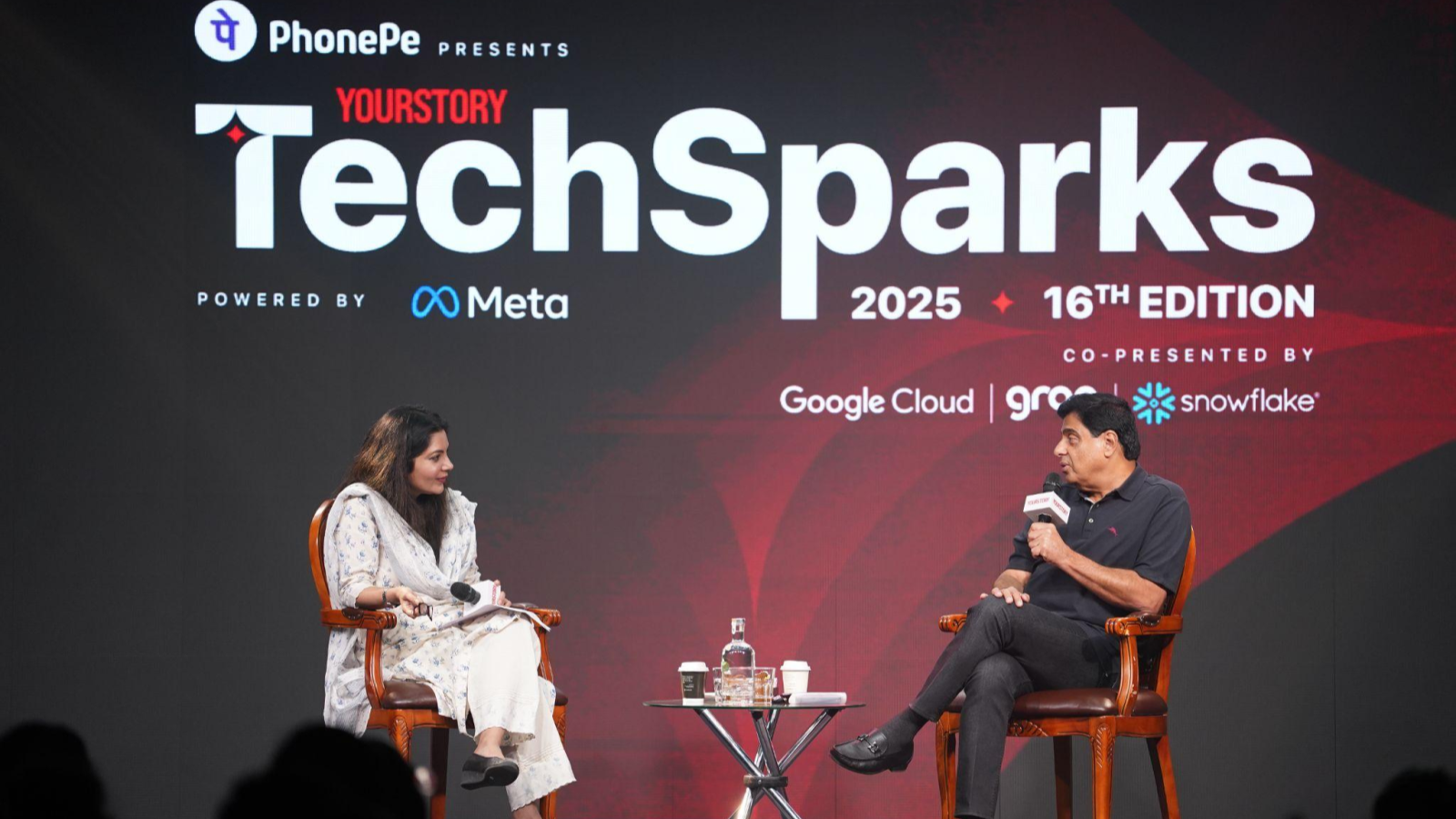
“AI today is still at the product stage…This is not the time to go out and always look at raising money because there is so much that needs to be done in product development,” said Screwvala during a fireside chat at TechSparks 2025 with Shradha Sharma, Founder and CEO of YourStory.
In a conversation that ranged from movies to media to education and investing, Screwvala argued that longevity will be decided by product depth, disciplined focus and a willingness to accept failure as part of a longer game as the hype around AI brings capital and chatter.
The seasoned entrepreneur went further, urging founders to think about survivability.
“If you can actually write the trend on the positivities of AI, the chances of you being there long term are going to be high because the casualties over the next five years on AI are going to be very high,” he said.
Screwvala explained that AI is not an automatic path to scale but a stage in which the work happens quietly inside engineering teams and classrooms. He noted that indiscriminate funding and marketing can create a negative context for genuine advances in skilling and education.
“This is not a sector that needs the capital that it got. Skilling, education, there is an aura around it. If you just throw money at a sector and start marketing it, you create negative context,” the upGrad chairperson remarked.
Investment thesis
Screwvala, who has invested across a range of sectors, also spoke about his involvement in two spacetech companies, a field that is evolving and finding its direction in orbit.
He explained that at one stage, space was always the prerogative of the government and ISRO. But today, because of lower orbit innovation, there are 15,000-16,000 satellites that are no longer government satellites.
“But imagine that each of these has a life of five (years). So you have got companies that are specialising in how to fix and refuel satellites every five years to stay in orbit for another five years,” he noted.
“There are space companies that are innovating today on how to clear debris in lower space because every time a satellite collapses, it can hurt the other 15,000 that will now be 30,000 very soon,” Screwvala added.
Beyond space, he spoke about his broader investment approach, which centres on backing founders and encouraging focus. Screwvala recalled advising Lenskart to shut its accessory lines (Watchkart, Bagskart, Jewelskart), a move he believes helped sharpen the company’s direction. The Peyush Bansal-led startup will soon debut on the stock exchange.
“To their credit, they really thought about it, and in six months, they shut those three ones completely. And I don’t think Lenskart today would be Lenskart if they had Lenskart, Bagskart, Watchkart, (and Jewelskart),” Screwvala remarked.
He also pointed out how important it is for entrepreneurs to bet on themselves and emphasised that his investment decisions are shaped by people rather than sectors.
“You take bets on people,” he said, recalling how he is often asked what sector he would stake money on. His answer, he explained, has remained consistent. “If I had one rupee or one crore rupees, I’d first bet it on myself because either you are betting it on yourself, otherwise you are not betting on a company.” In the case of Lenskart, for instance, he said the conviction lay primarily in the founder team.
Reinvention and resilience
Reinvention is more than a career tactic. Screwvala traced how creative impulses fed media work, which in turn connected to education efforts and not-for-profit ventures. Meanwhile, he repeatedly spoke about the failures as the seedbed for success.
“My ratio of what I would call failures to successes has always been, I would say—and I’ve made a count of them—eight failures to two successes. When you are at that failure, it can be quite cathartic,” he noted.
Screwvala explained that the ratio mattered more than the emotional weight of each setback.
“If there were five failures and five successes, the probability of my five successes being really big would have been lower,” he said. The point, he added, is to be able to recognise when something is not working and move on without getting attached.
“The probability of you losing eight times is minus 8x. But the two successes need to be 20x. And if they’re 20x, that’s plus 40 and minus 8. That’s the formula… that I go by on almost everything that I do,” the seasoned entrepreneur noted.
Frugality and focus
Screwvala also spoke about frugality as a discipline rather than a constraint.
“My theme I wanted was frugality. Because I think I’m obsessed with that. A lot of us, when we get to a certain stage, the sense of entitlement comes, frugality goes out the door,” he said, adding that success tends to follow when entitlement is kept low.
He described taking his team to meet young scholarship recipients from rural communities to remind them of what ambition looks like when resources are limited.
The experience, he said, made clear that “if these people can aspire and be inspired at that level, then all of us are wasting our time” when we operate from entitlement rather than intent.
In his view, frugality does not mean deprivation but clarity. “If you are frugal and you’re smart and you are intelligent, you can do that,” he said.
Screwvala linked the same principle to staying focused on one’s own path. Entrepreneurs, he noted, often begin by pursuing their own vision but start adjusting it as soon as investors and external expectations enter. He cautioned against that drift and emphasised the value of resilience.
“You have got to be able to stay with your own conviction and your own course,” he said. Criticism, he added, is unavoidable, especially when failures are public. “If you are not thick-skinned, you are not going to get anywhere,” he said. Self-belief and resilience, he argued, are the entrepreneur’s primary tools.
“If you are thick-skinned and you have the highest level of self-confidence, that’s your barometer.”
He noted that he is where he is because he held his course during difficult periods, saying that had he allowed external opinions to dictate his decisions, “I wouldn’t be sitting here.”

Edited by Jyoti Narayan
Original Article
(Disclaimer – This post is auto-fetched from publicly available RSS feeds. Original source: Yourstory. All rights belong to the respective publisher.)