For nearly three decades, Kota was a one-word answer. Ask any small-town family in Bihar, Uttar Pradesh or the Northeast where a bright child should go to chase an IIT or AIIMS seat, and the reply came back instantly. Today, that answer no longer arrives so easily.
At least 29 students died by suicide in Kota in 2023, the highest figure in eight years according to data compiled by independent researchers. Student numbers, which had peaked at around 2 to 2.5 lakh, fell to roughly 85,000 to 1 lakh by 2024-25, with industry revenue reportedly halving from Rs 6,500-7,000 crore to about Rs 3,500 crore. The "Kashi of education", as the city is sometimes called, was being asked to look in the mirror.
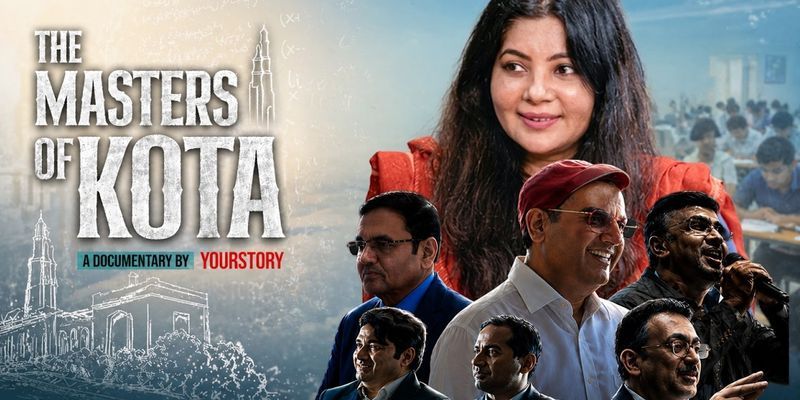
YourStory founder and CEO Shradha Sharma travelled to Kota to talk to coaching institute heads, students, parents and the district administration. The picture that emerges is messier than either side of the debate would like to admit, and more hopeful than the headlines suggest.
How Kota became Kota
The story begins in 1983, when an engineer at JK Synthetics named Vinod Kumar Bansal, diagnosed with muscular dystrophy, started teaching eight neighbourhood children at his dining table. By 1991, he had formalised it as Bansal Classes. By the year 2000, his students were taking AIR 1 and AIR 2 in the IIT-JEE.
What scaled around him was a pedagogy and a language. A problem written on the board every morning, on-the-spot solving, teacher-led discussion, weekly tests with marks displayed for everyone to see. And while big-city coaching institutes ran in English, Kota taught in Hindi. That single decision opened the gates for students from non-metro India.
Around the classroom came the rest of the stack: roughly 35 to 40 active coaching institutes, around 4,000 hostels, over 40,000 paying guest accommodations, and an entire town economy of mess owners, auto drivers and stationers built on a single, tunnel-focused goal.
The crack in the model
Then came the suicides. And inside Kota, the sharpest critique came not from outsiders but from coaching insiders themselves.
One senior teacher argues that the rot started when admission filters were quietly dropped. "Earlier, if the institution felt this student cannot be selected, on day one they were told we will not give you admission," he says. "Today every student is given admission. The faculty knows this child cannot be selected. You will earn Rs 1 lakh, Rs 2 lakh from him, but what will you answer to him after one year?"
The commercial logic is brutal. The top 5% of students are pulled in with full scholarships, often through aggressive faculty poaching wars. The remaining 95% pay full fees, subsidising the toppers and the marketing machine. "Education got lost in it," he admits.
Why grit still pulls students back
Why does Kota still work for the students who survive it? Several voices converge on the same answer: peer competition is the secret no online platform has cracked. "Unless you prepare with four, five, ten friends, inspire each other, challenge each other, your best does not come. It is very difficult to bring that online," one institute head says. In offline batches, dropout rates hover around 20%. In online ones, they climb to 60-70%.
The students themselves are split. "I would not want to live that life again," one admits. Another, in the same breath, says she would absolutely come back, because Kota gave her "maturity" and taught her how to manage failure, loneliness and people. Mental health, several say, is now an open topic among peers. Seniors help juniors. Teachers, they admit, are still a harder conversation.
What does it really take to crack JEE or NEET from Kota
Of the more than two lakh students who once headed to Kota each year, only a sliver crack the top entrance exams. Independent academic studies put the success rate at roughly 2%.
That leaves a vast majority who return home without the rank they came for. One teacher's message to them lands as the heart of the city's case: "It is okay that you were not successful in one exam. But if you learned to work hard, if you learned that dealing with failure is also a very important point in life, that itself is success."
The system fails, the argument goes, not when students don't crack the exam, but when institutes and parents treat that failure as a verdict on the child.
What comes next
The administration has stepped in more visibly than ever. Nodal officers across departments interact directly with students. A flagship Dinner with the Collector initiative has, by official accounts, reached over 25,000 students in a single year. A Kalika Squad protects girl aspirants. Anti-suicide devices on ceiling fans, gate-keeper training for hostel wardens based on WHO norms and SOS helplines are now standard. The administration credits this combination with cutting student suicides to 17 in 2024, a roughly 50% drop from 2023.
The market is correcting too. Industry stakeholders, including the Kota Hostel Association, told the press in early 2026 that admissions for the 2026-27 session were tracking 20-30% higher than the previous year, with parents from across the country, including the Northeast, returning to the city.
One veteran teacher offers the longer view. The age of lakh-student campuses, he predicts, is fading. "Small centres will open all over the country. The era of teachers will come back. Gradually they will combine and get organised again." Kota's playbook, in other words, may be decentralising before it reaggregates.
Whether the city regains its golden era will depend less on its infrastructure and more on whether its classrooms remember why they were built. As one veteran puts it, invoking V.K. Bansal: "If teachers continue to teach with that passion even today, no one can stop Kota."
Original Article
(Disclaimer – This post is auto-fetched from publicly available RSS feeds. Original source: Yourstory. All rights belong to the respective publisher.)