For years, the developer’s role was straightforward: write code, define instructions, and make sure machines executed them correctly. Cloud computing changed that once, abstracting away infrastructure so developers could focus on outcomes instead of operations.
Now, another shift is under way.
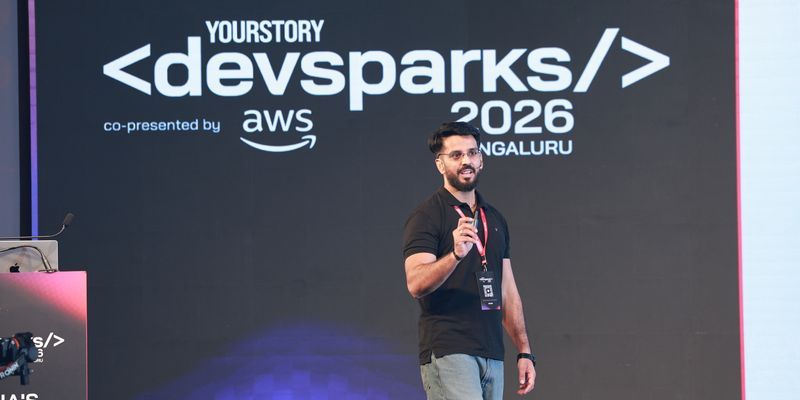
At DevSparks Bengaluru 2026, Praful Bagai, Head of Developer Relations for AWS in India and South Asia, argued that developers are entering an era where the job is less about programming functions and more about leading intelligent systems. In his lightning talk, ‘The agentic shift: From writing code to leading systems’, Bagai drew a sharp line between generative AI applications and true agentic systems — and he used cricket to make the point.
Separating hype from reality
The rise of tools like ChatGPT has blurred the lines. Many developers assume they’re already building agents. Bagai challenged that assumption, arguing that many applications being labeled as agents today are still fundamentally prompt-response systems.
GenAI apps are reactive — a prompt goes in, a response comes out, and the interaction ends. Agents, by contrast, pursue goals over multiple steps, making decisions, adapting to new information, and coordinating actions along the way.
From reactive responses to dynamic decision-making
Bagai likened agents to cricket captains. A captain doesn’t just react to one ball; they read conditions, study opponents, adjust strategies, and make decisions that maximise the team’s chances.
“An agent is like a Dhoni,” Bagai said. “Captains adapt ball by ball across the match conditions and coordinate specialists toward a goal. ”
Agents, similarly, plan, reason, interact with tools, and respond to changing circumstances. Autonomy is the key difference: you don’t tell Dhoni every move; he understands the match and acts. For developers, that means designing systems that can decide, not just execute.
Demo in action
Bagai illustrated the concept with a live demo built on AWS Bedrock and Kiro. Tasked with analyzing Royal Challengers Bengaluru’s IPL season and recommending a strategy for a final, the agent didn’t just spit out text. It created an execution plan, pulled team stats and match-condition data, analysed player form, and delivered actionable recommendations across batting, bowling, and death-over strategies.
One of the biggest misconceptions, Bagai noted, is that agentic AI is just a better chatbot. It isn’t. Agents operate in a continuous cognitive loop: gathering information, assessing outcomes, updating plans, and deciding next steps. Like cricket, every ball offers feedback loops where every action generates new information that influences the next decision. Mirroring the dynamics of cricket, each delivery creates feedback loops where every outcome provides fresh data that informs the subsequent tactical move. Agents thrive in ambiguity, adapting as conditions change.
Designing the next generation of software
Bagai outlined emerging design patterns: single-agent systems where one large language model handles everything, and multi-agent systems where specialised agents collaborate under an orchestrator. He highlighted sequential, parallel, and hierarchical orchestration models, with hierarchical approaches emerging as a powerful pattern for coordinating specialized agents at scale.
Why guardrails matter
With autonomy comes risk. Bagai stressed the need for guardrails — approval workflows, budget limits, compliance checks, and monitoring — to ensure reliability and trust. Without them, even capable systems can go off track.
Bagai closed with a reminder: not every problem needs an agent. Many processes remain predictable and rules-driven, where traditional automation is more efficient. Agents shine in dynamic, multi-step environments.
The future, he argued, will blend both worlds: “The next generation of AI systems will have the reliability of software with the adaptability of intelligence.”
Original Article
(Disclaimer – This post is auto-fetched from publicly available RSS feeds. Original source: Yourstory. All rights belong to the respective publisher.)