Company Details
| Company Overview | |
|---|---|
| Founded | 2025 |
| Headquarters | Bengaluru, Karnataka |
| Sector | DeepTech: Edge AI hardware |
| Business model | B2B |
| Funding stage | Seed |
| Amount raised | Rs 1.39 crore (~$163K) |
| Key investors | Inflection Point Ventures (lead) |
| Institutional support | STPI (NGIS incubation); MeitY Bhashini award |
India builds a great deal of hardware, but rarely uses Indian parts. The single-board computers and compute modules that act as the brains of drones, industrial gateways, electric vehicles and smart-home devices are largely imported, whether Raspberry Pi and Arduino boards or foreign compute modules, leaving Indian startups and manufacturers exposed to long lead times and overseas supply chains they cannot control. Edgehax, founded in Bengaluru in 2025, is trying to remove that dependency by designing and building edge-AI boards in India.
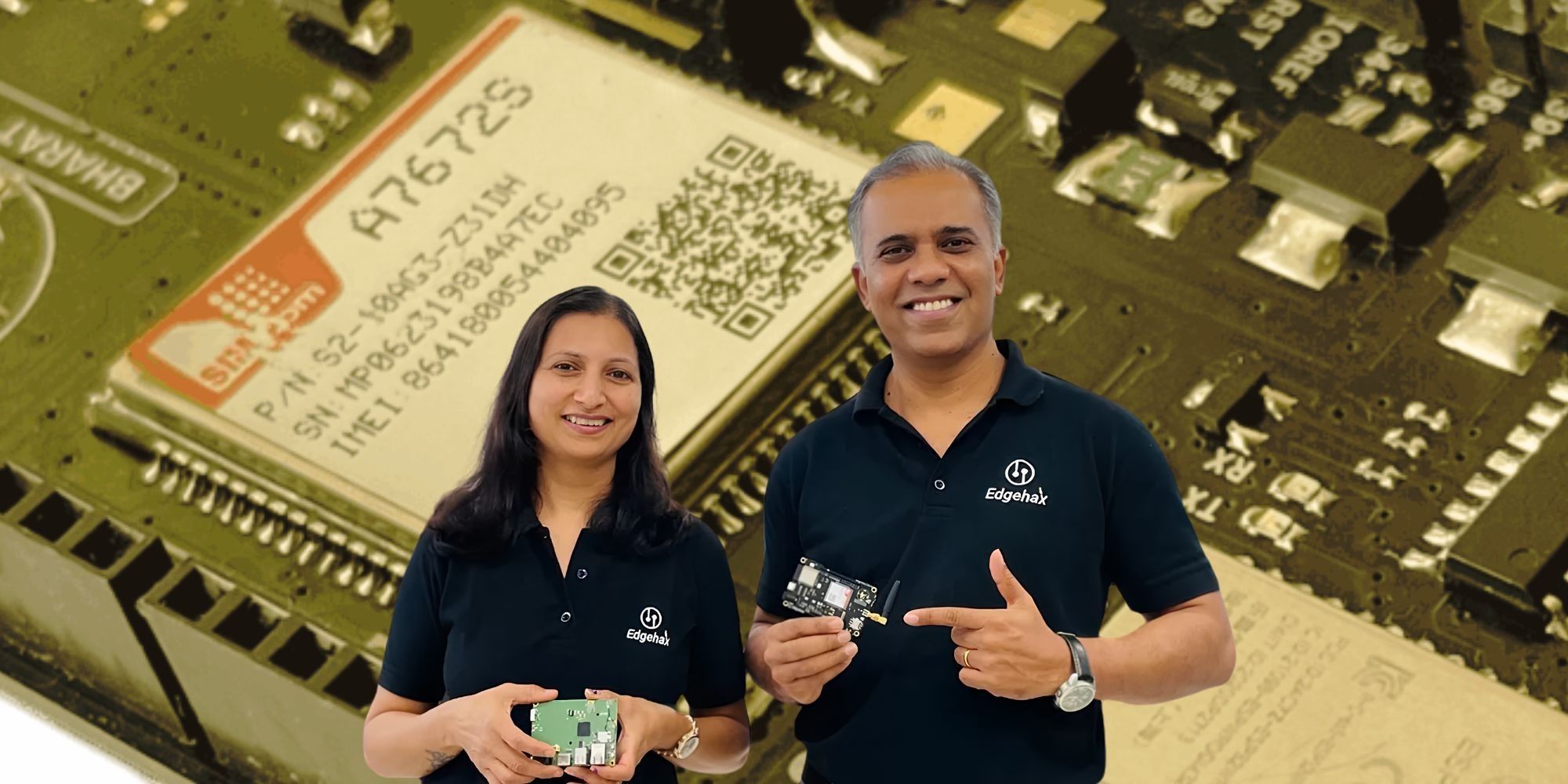
Its founders had already run into the problem from the inside. Prabhu Stavarmath, the CEO, spent more than 15 years in IoT hardware, product development and enterprise sales, and built two hardware ventures before this one, Bharat Pi and Refillbot, which between them served over 100,000 customers.
Savitri Patil, the COO, came from electronics and manufacturing and runs operations, supply chain and logistics. Their conclusion was structural rather than personal: anyone building a hardware product in India had to begin by importing the part that made it think.
One board, many machines
Edgehax builds a single board that packs in compute, connectivity and storage. It carries CPU, GPU and NPU units alongside 4G and 5G, Wi-Fi and LoRa connectivity and built-in storage, and runs the company’s own operating system, DvarOS, built for industrial edge gateways.
The boards can run convolutional neural networks and transformer models on the device itself, with remote software updates and remote deployment, and the company says it designs and prototypes them entirely in India.
The same hardware turns up across very different machines: industrial gateways, humanoid robots, autonomous vehicles, drones, NavIC-based tracking systems for Indian defence, and consumer IoT devices.
What a customer buys is a plug-and-play board with domestic supply and local technical support rather than a stack of imported parts. Its natural reference points are the boards it wants to displace, Raspberry Pi and Arduino, but Edgehax positions its own boards as industrial-grade, locally made, and backed by long-term supply.
Also Read AI is not just for OEMs: How startups are democratising auto intelligence
A hundred thousand students, then customers
Edgehax has put development kits into the hands of more than 100,000 students and faculty across over 30 universities and IITs, a base of early users that spread the product largely by word of mouth and now feeds development, with kits tested and refined by the developers using them.
Commercially, the platform is used by over 150 startups, OEMs (original equipment manufacturers) and enterprises, with more than 5,000 edge gateway boards in production. Institutional backing followed quickly. Edgehax won the NXP Silicon Seeds Startup Program 2025 to build a low-cost compute module on NXP chips, and secured a MeitY Bhashini award to build hardware for the government's voice-AI platform.
It is also a beneficiary of the Next Generation Incubation Scheme run by Software Technology Parks of India, which supports startups from smaller cities with mentoring and funding of up to Rs 25 lakh.
In August 2025, the company raised Rs 1.39 crore in a seed round led by Inflection Point Ventures, to fund scaling manufacturing, product development and an international push into Singapore, the US and Europe, working with NXP.
The timing rides a growing market: global spending on edge hardware is projected to roughly double by 2030, to nearly $59 billion from about $26 billion in 2025.
The founders' stated goal is to become the default design and manufacturing partner for OEMs that want ready-to-use, customisable hardware, and to put Edgehax boards and tools in the hands of 100 million developers across Asia-Pacific, the US and Europe by 2029.
(This story has been researched and compiled using publicly available information.)
Original Article
(Disclaimer – This post is auto-fetched from publicly available RSS feeds. Original source: Yourstory. All rights belong to the respective publisher.)