For a long time, the biggest challenge in business payments was getting the transaction to go through. An entire generation of Indian fintech infrastructure was built around that problem, and the ecosystem solved it at scale.
Data from the Department of Financial Services shows that UPI alone processed 22.64 billion transactions worth Rs 29.53 lakh crore in March 2026. For most businesses today, accepting payments is no longer the problem. Customers can pay through UPI, cards, net banking,, and other digital payment methods with little friction.
The bigger challenge comes after the payment is made. Businesses still need to match payments to invoices, track settlements, manage recurring payments, and reconcile transactions across different systems. As businesses grow, these processes often become harder to manage than the payment itself.
Few companies have seen this shift as closely as Zoho. Through its software products for finance, sales, operations, HR, and customer engagement, the company works with businesses across industries and geographies, giving it a front-row view of the operational challenges that emerge as companies grow. These insights have helped shape products that address not just payment acceptance, but also the processes that follow.
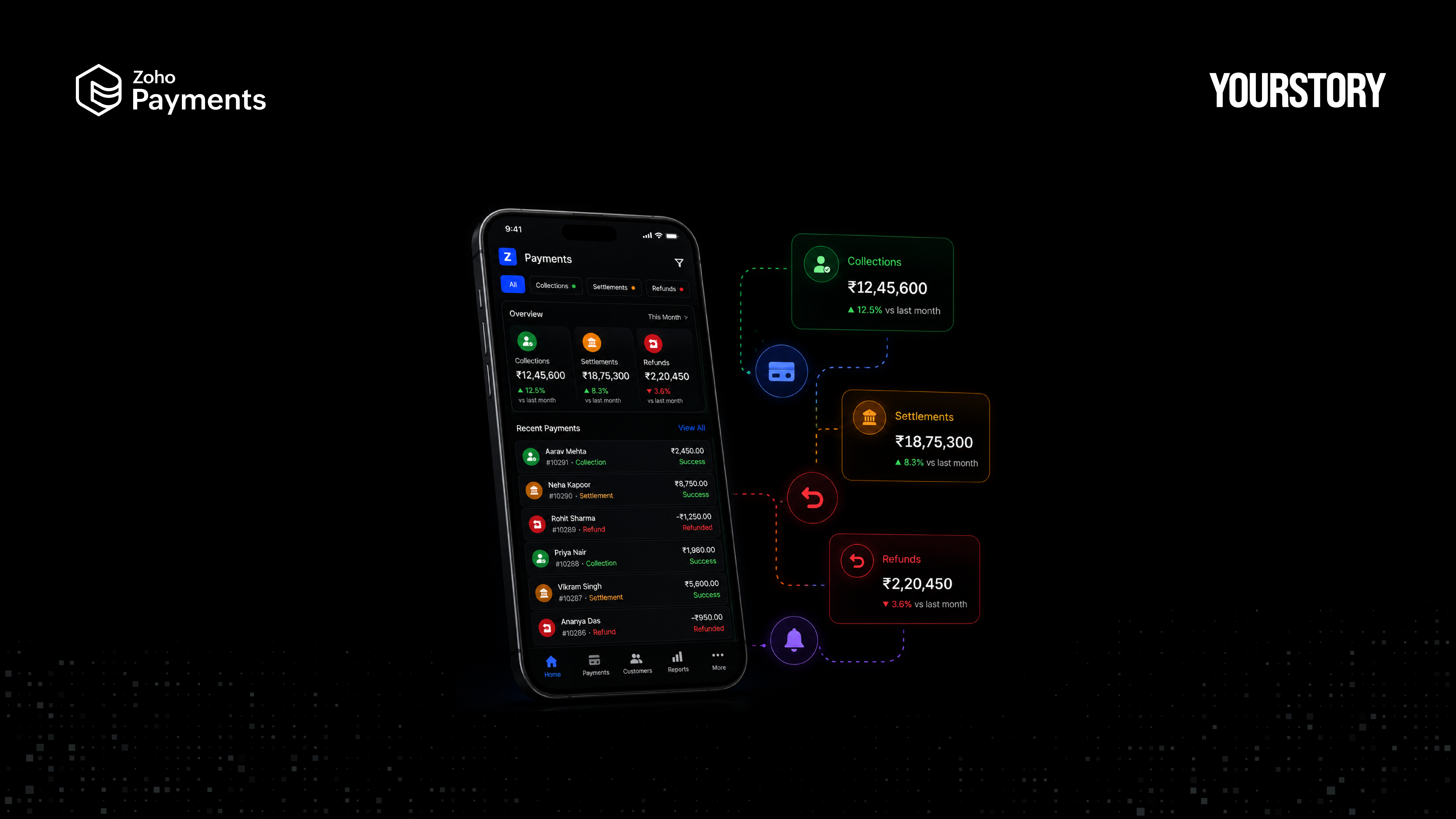
Zoho Payments was launched after the company received its payment aggregator licence from RBI, in February 2024. The platform is designed to help businesses manage collections, settlements, and reconciliation within the same system they use to run their day-to-day operations.
For many businesses today, payment acceptance itself is no longer the hardest problem. Instead, the complexity lies in everything surrounding the transaction, from ensuring invoices are accurately updated and receipts are generated automatically to maintaining visibility into settlements, renewals, and reconciliation processes.
The hidden cost of fragmented payments
Talk to a finance head during admissions season at an education group, or to a finance lead handling month-end renewals, and the conversation moves quickly past checkout. Did the invoice close on its own? Did the receipt go out before the customer called to ask? Did the failed renewals get retried, or quietly slip into churn?
A typical mid-sized Indian business might use one platform for accounting, another for payment processing, a POS system for offline collections, a tool for subscriptions, spreadsheets for reconciliation, and multiple bank portals for settlements. Each serves a purpose, but the information sits across different systems.
While the customer experiences a seamless payment journey, finance teams often have to pull data from multiple sources to reconcile transactions, track settlements, and keep records up to date.
A lot of businesses digitized collections faster than they digitized finance operations. While this approach worked initially, scaling across multiple channels, business functions, and customer touchpoints has exposed the inefficiencies created by fragmented finance systems. These disconnected systems often introduce operational bottlenecks and increase manual workloads.
The cost of fragmented systems often shows up in day-to-day operations. Finance teams spend hours reconciling transactions. Failed recurring payments can go unnoticed. Getting an accurate picture of cash flow may require pulling data from multiple sources at the end of the month. For subscription businesses, the impact can be even more direct.
Industry research estimates that involuntary churn—customers lost because payments fail rather than because they choose to cancel—accounts for 20% to 40% of total churn.
The reason is simple: a successful payment is only one part of the process. Businesses still need to match payments to invoices, track settlements, manage renewals, and keep financial records up to date. When this information sits across different systems, maintaining visibility becomes harder and manual work increases.
What changes when payments stop being a silo
A third-party integration can move transaction data between systems. But a payment is not just an amount and a transaction ID. It carries important business information, including customer details, invoice references, settlement status, and the downstream processes linked to the transact
That context becomes especially important in industries like education, nonprofits, subscriptions, services, and B2B collections, where payments are closely linked to broader operational records. In such environments, the challenge extends beyond transferring payment data between systems; it involves ensuring that payment events are seamlessly connected to the business processes that depend on them.
This is the philosophy behind Zoho Payments. Rather than functioning as a gateway that exchanges data with the rest of the business stack, it is built natively inside the same ecosystem, that runs accounting, billing, subscriptions, and payroll. The payment and the business context live in the same system from the start.
Take an education group during admissions week. Fees are arriving across half a dozen channels at once: online portals, payment links shared over WhatsApp, QR scans at the counter, POS terminals at the front office, and direct bank transfers from parents who prefer the old way. In a fragmented setup, the finance head has three browser tabs open to different gateway dashboards, a spreadsheet from yesterday's reconciliation, and a queue of parents asking whether their payments have been received.
Or take a mid-sized B2B business closing its quarter. Customer collections are landing across NEFT, UPI, and Bharat Connect. Vendor payments are moving through two banking portals. Subscription renewals are processing in a separate billing system. The finance team is matching receipts to invoices by hand because the bank statement and the billing system can't agree on how to identify the same transaction.
Now picture the same week with payments built into the platform that runs the books. Each payment, the moment it succeeds, closes its own invoice. Receipts go out automatically. Refunds and vendor settlements show up in the same view as collections. The finance head is reading a single dashboard that already knows what happened. Work that used to take three days to clean up takes a few hours.
The tailwinds making this possible
Two things have changed to make this shift possible. The first is regulatory maturity. By January 2026, the RBI authorized 19 entities to operate as PA‑CBs. For context, India has minted more unicorns in the last five years than it has licensed payment aggregators in total. A PA licence provides the regulatory framework businesses look for when evaluating payment partners.
The second is the strength of India's digital payments infrastructure. UPI has transformed how consumers pay, while Bharat Connect is helping streamline bill payments and B2B collections. As digital payments become more widespread and reliable, businesses are looking beyond payment acceptance and focusing on how payment information flows into their finance and operational systems.
Not every business needs to consolidate
This is not about one approach replacing another. Different businesses have different requirements, whether they are processing large transaction volumes, managing recurring payments, handling collections across multiple channels, or operating in highly regulated sectors such as healthcare and education.
What is changing is the expectation from a payments platform. Businesses are looking beyond payment acceptance and evaluating how payments connect with accounting, billing, reporting, and day-to-day operations. As these processes become more interconnected, the ability to manage them within a single system becomes increasingly valuable.As businesses grow, payments are becoming more than a checkout function. They are increasingly tied to billing, accounting, collections, and day-to-day operations.
For Indian businesses, the question is no longer just whether a payment can be accepted. It is whether the payment data can move seamlessly across the systems that run the business.
That shift is changing how companies think about payments: from a transaction that needs to be completed to a business process that needs to be managed end to ends.
Original Article
(Disclaimer – This post is auto-fetched from publicly available RSS feeds. Original source: Yourstory. All rights belong to the respective publisher.)