Artificial intelligence (AI) is often framed as a tool that transforms familiar environments. Yet, its most ambitious frontier lies far beyond in space, as it’s becoming central to how companies observe, navigate, and manage activity in orbit.
This shift is driven by a new generation of space entrepreneurs, like Anirudh Sharma, Co-founder and CEO of Digantara; Awais Ahmed, Founder and CEO of Pixxel; and Yashas Karanam, Co-founder and COO of Bellatrix Aerospace, who are building systems that rely on immense volumes of data and rapid decision-making.
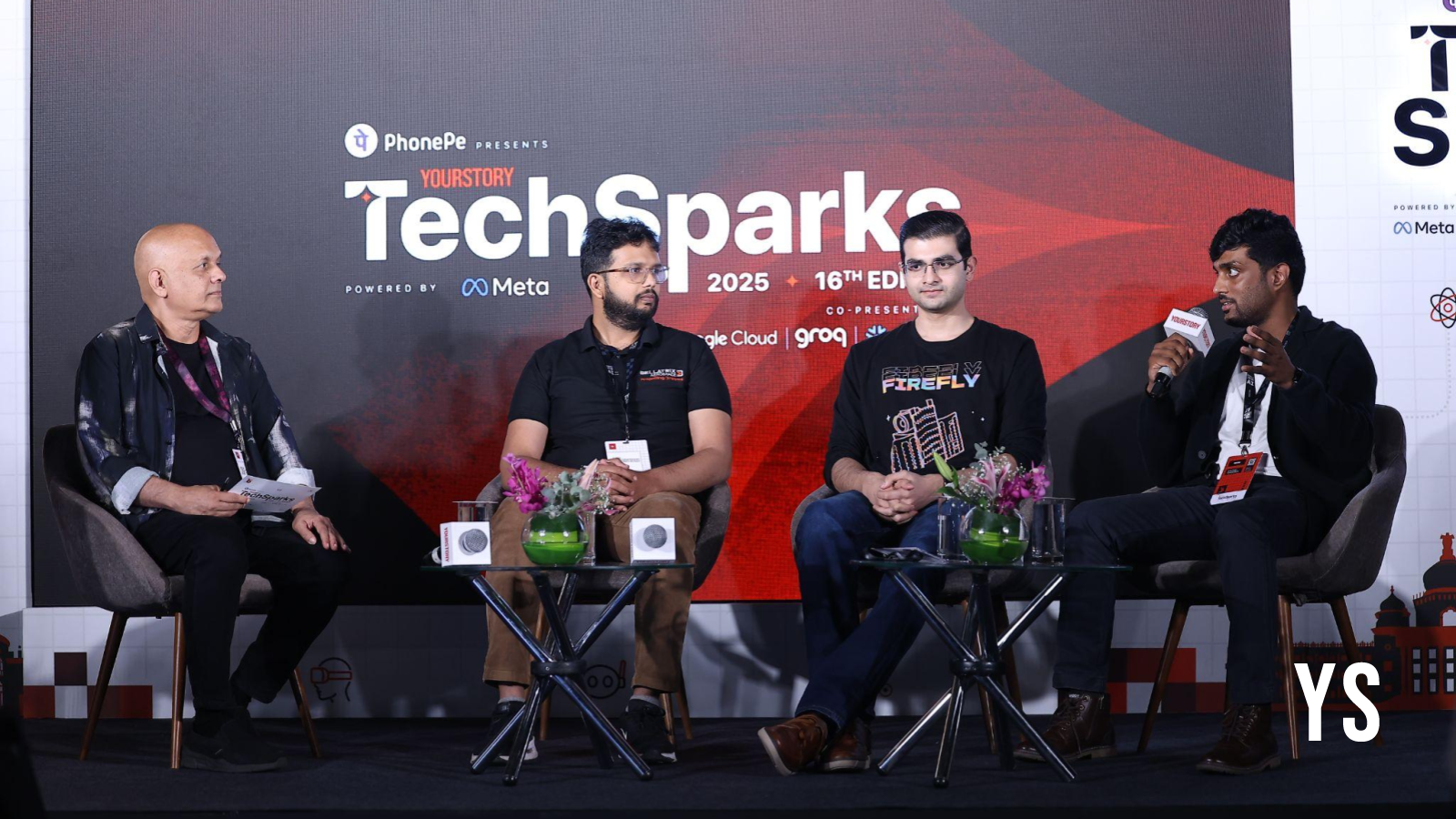
In a hall packed with tech and space enthusiasts at TechSparks 2025, these spacetech founders discussed how AI is quietly reshaping both the practical operations of satellites and the strategic understanding of Earth and beyond.
Sharma, who leads a company focused on space situational awareness, works on the challenge of tracking thousands of fast-moving objects in orbit. Ahmed, whose organisation builds a constellation of hyper-spectral imaging satellites, aims to create what he calls planetary intelligence. Karanam, who runs a propulsion company, works on the future of in-orbit refuelling and precision manoeuvring.
Each of them approaches AI from a different angle, yet their experiences form a coherent picture of how the technology is being applied across the space sector.
AI is starting to augment the physics-heavy world of orbital prediction and real-time monitoring. Sharma described the early stage of this transition with caution and clarity. He explained that his team continues to rely on physics models for accuracy but is beginning to test AI for predictive analytics.
“We track objects moving at 7 to 10 kilometres per second, and the aim is to reach a million tracked objects. With the limited historical data available, we are enhancing physics-based models while exploring where AI can take us,” Sharma noted.
Pixxel’s Ahmed views AI through the lens of satellite imagery. Hyper-spectral images reveal details that the human eye cannot see, such as invisible emissions, subtle vegetation changes, or early signs of stress in natural environments.
The volume of this data is enormous and impossible for humans to analyse manually. AI becomes essential for identifying trends and anomalies across landscapes, borders, and environmental systems.
He explained that this role predates recent advances in large language models. “We were using deep learning long before the LLM boom because no group of humans can study petabytes of imagery every week. When you feed this data into an AI model, it starts to paint a story of what is changing and why it matters.”
Bellatrix focuses on a different application. Karanam’s company is working on orbit refuelling and precise satellite docking. These tasks require autonomous decision-making because signals from Earth cannot guide every step in real time. AI becomes vital when two satellites must approach each other safely at high velocities.
“At velocities above eight kilometres per second, you need intelligence on the go. A satellite must decide in real time if it is safe to dock because nobody on the ground can calculate the exact position quickly enough,” he described.
Space infrastructure
The technical work of these companies reflects a broader expansion of space infrastructure. Sharma’s team builds sensors on the ground and in orbit to map activity in Low Earth Orbit, geostationary orbit, and even the growing cislunar region. This helps prevent collisions and supports future interplanetary navigation.
Ahmed’s team focuses on satellites provide high-frequency global imaging that can capture environmental change in near real time. Karanam’s startup’s propulsion systems support the long-term sustainability of satellites by enabling fuel transfer rather than replacement.
These strands point to a future where space systems are interconnected, data-rich, and increasingly autonomous.
Meanwhile, each founder’s work captures a different aspect of how space infrastructure is evolving. Sharma focuses on measurement and awareness, Ahmed on environmental visibility, and Karanam on in-orbit mobility. They converge on the idea that space is becoming an environment that must be actively managed rather than simply used.
Commercial realities
As these technologies advance, commercial realities remain decisive. Building hardware for space is capital-intensive, slow and dependent on early customers who are willing to pay for new capabilities.
Sharma described how Digantara adapted its focus when it became clear that defence organisations were immediate customers for accurate tracking and monitoring.
“While our long-term goal is interplanetary navigation, we realised that defence is the customer segment ready to pay for solutions today. That revenue helps us sustain the journey,” he explained.
Pixxel’s Ahmed argued that distribution is less of a problem in space than in other industries. The real challenge is whether a product solves a problem significant enough for governments and enterprises. For him, building a useful planetary intelligence system requires both affordability and scientific reliability.
“Distribution is not the issue because the customer base is well defined. The challenge is whether the data is accurate, valuable, and priced in a way that customers will adopt it,” he noted.
Karanam of Bellatrix Aerospace highlighted a different dimension. Space companies must choose their technical focus with care and avoid being carried away by interesting but commercially limited ideas. He emphasised the importance of targeting markets that are both meaningful and large enough to support growth.
“In space, it is easy to get excited by a technology from your PhD, but you have to ask if the market exists. If not, you must diversify before it is too late,” he remarked.

Edited by Suman Singh
Original Article
(Disclaimer – This post is auto-fetched from publicly available RSS feeds. Original source: Yourstory. All rights belong to the respective publisher.)