India’s private space sector has taken another step towards building a homegrown commercial launch capability.
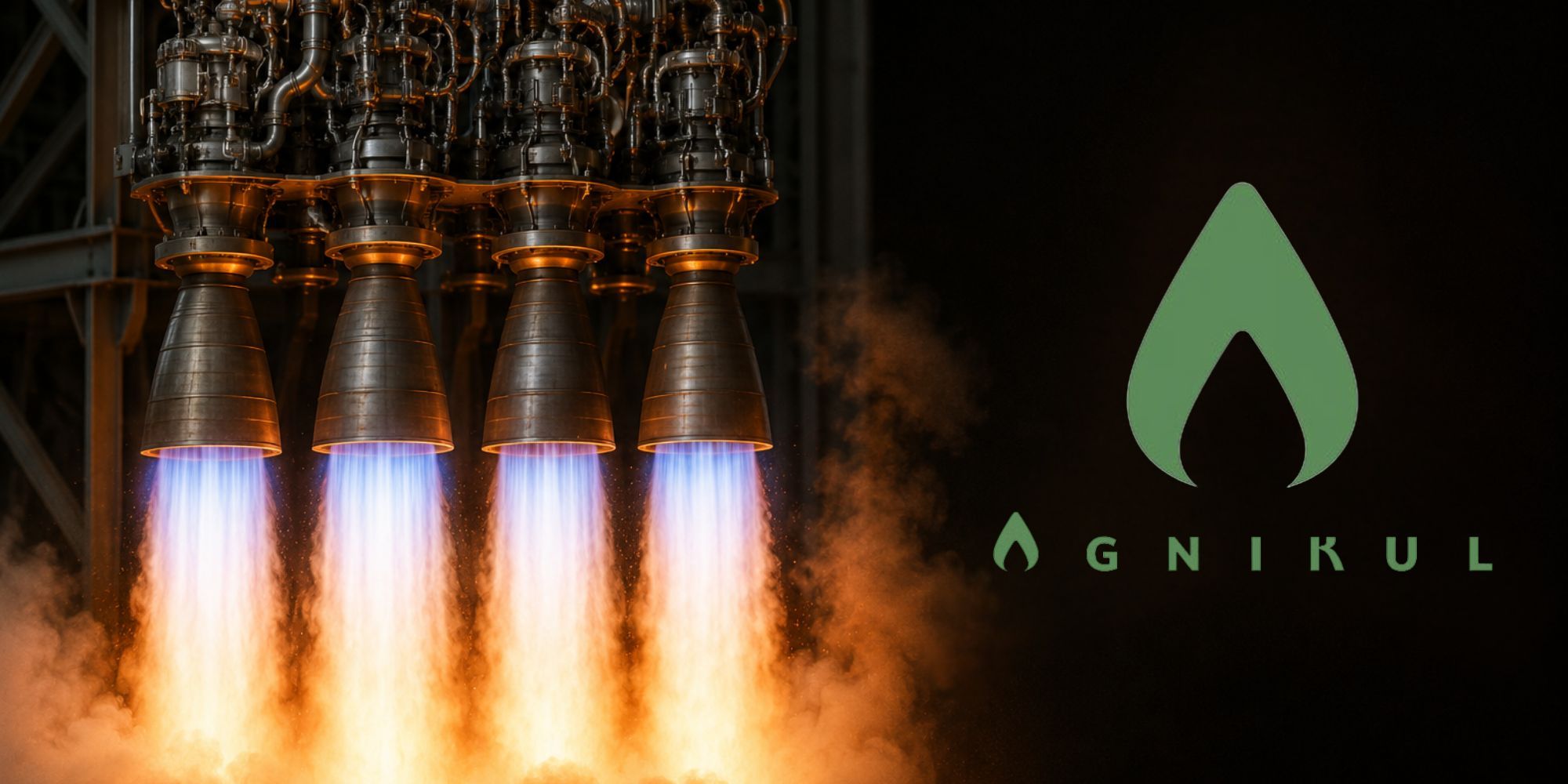
Agnikul Cosmos has successfully test-fired a cluster of four semi-cryogenic rocket engines, marking a major milestone in the development of its small satellite launch vehicle, Agnibaan. The achievement signals progress beyond individual engine validation and towards more integrated launch-ready systems.
While it was not a full flight test, running four engines together is a critical stage in rocket development. Multi-engine systems are significantly more complex than single-engine setups because propulsion units must ignite, throttle and operate in synchronisation under extreme conditions.
Why does the four-engine test matter?
A clustered engine test helps validate several core aspects of launch vehicle performance. The firing demonstrates that the engines can maintain stable combustion, coordinate thrust output and operate under a unified control system.
Even small inconsistencies between engines can create instability during ascent, making clustered testing an important step before full-stage hot fires and eventual orbital launches. This milestone suggests the company is progressing from component-level engineering towards integrated flight systems.
The next phases will likely include longer-duration firings, thrust-vector-control validation, and full-stage testing before Agnibaan attempts future launch missions.
What semi-cryogenic propulsion actually means
Semi-cryogenic engines use a cryogenic oxidiser, usually liquid oxygen, paired with a refined hydrocarbon fuel such as kerosene. This propulsion approach offers a balance between efficiency and operational practicality.
Compared with many traditional storable propellants, semi-cryogenic systems deliver stronger performance while remaining easier to manage than fully cryogenic systems, where both fuel and oxidiser must be maintained at extremely low temperatures.
The technology also allows engine throttling, which gives launch systems finer control during ascent.
That flexibility is particularly valuable for smaller launch vehicles targeting responsive satellite deployment missions into low Earth orbit.
Why clustering engines are strategically useful
Instead of developing one extremely large engine, many modern launch companies rely on clusters of smaller engines. This approach simplifies manufacturing because the same engine design can be repeated multiple times. It also introduces greater operational flexibility.
In certain mission scenarios, individual engines can be throttled or adjusted to manage loads and optimise flight performance. For startups like Agnikul Cosmos, clustering also supports faster iteration and testing cycles compared with building entirely new large-engine architectures from scratch.
The strategy aligns closely with the broader trend in private aerospace, where modular engineering and rapid testing have become central to reducing development timelines.
Agnikul’s engineering philosophy
Agnikul Cosmos has drawn attention for its extensive use of additive manufacturing, commonly known as 3D printing. The company uses 3D-printed rocket engine components to reduce part counts, speed up production and enable more intricate internal designs such as cooling channels and injector systems.
These manufacturing techniques allow engineers to test and refine propulsion systems more quickly. That rapid iteration model has become increasingly important across the global commercial space industry, where companies prioritise frequent testing and incremental progress rather than long development cycles between major milestones.
Also Read In a league of its own: This Ahmedabad space tech startup is working on persistent oceanic surveillance
Why this matters for India’s space ambitions
India’s private space ecosystem has been expanding rapidly since regulatory reforms opened greater participation to startups and commercial launch firms. Successful propulsion milestones like this strengthen domestic expertise in engine development, manufacturing, testing infrastructure and launch operations.
They also help build a larger supplier ecosystem capable of supporting future commercial missions. At the same time, global demand for small satellite launches continues to grow, driven by Earth observation, communications and data services. Reliable, flexible launch providers are becoming increasingly valuable in that market.
A successful four-engine semi-cryogenic test is more than a technical demonstration. It is a sign that India’s private launch industry is steadily moving towards operational maturity. For Agnikul Cosmos, the milestone brings Agnibaan closer to future integrated flight tests and eventually commercial launch services. If upcoming stage-level tests succeed, the company could emerge as an important player in the growing small satellite launch market.
Original Article
(Disclaimer – This post is auto-fetched from publicly available RSS feeds. Original source: Yourstory. All rights belong to the respective publisher.)