
The Paytm Business Model Behind Payments and Loan Distribution
How payments, financial services distribution and marketing fit together at Paytm
Key Takeaways
- Paytm's FY26 revenue from operations was Rs 8,437 crore, up 22% from Rs 6,900 crore in FY25.
- Paytm reported a profit after tax of Rs 552 crore in FY26, its first full year of profit.
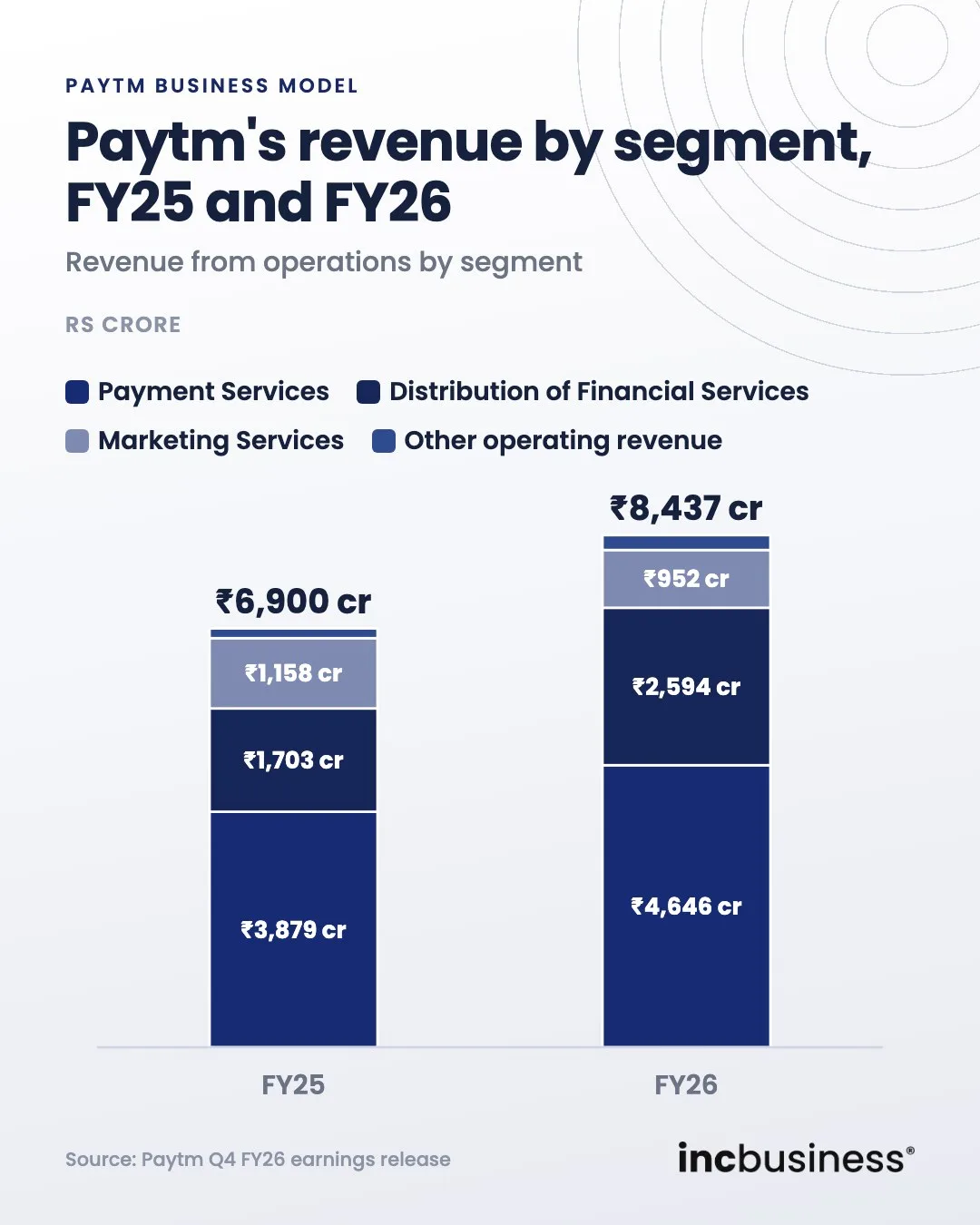
- Payment Services earned Rs 4,646 crore in FY26, about 55% of revenue.
- Distribution of Financial Services grew 52% to Rs 2,594 crore in FY26.
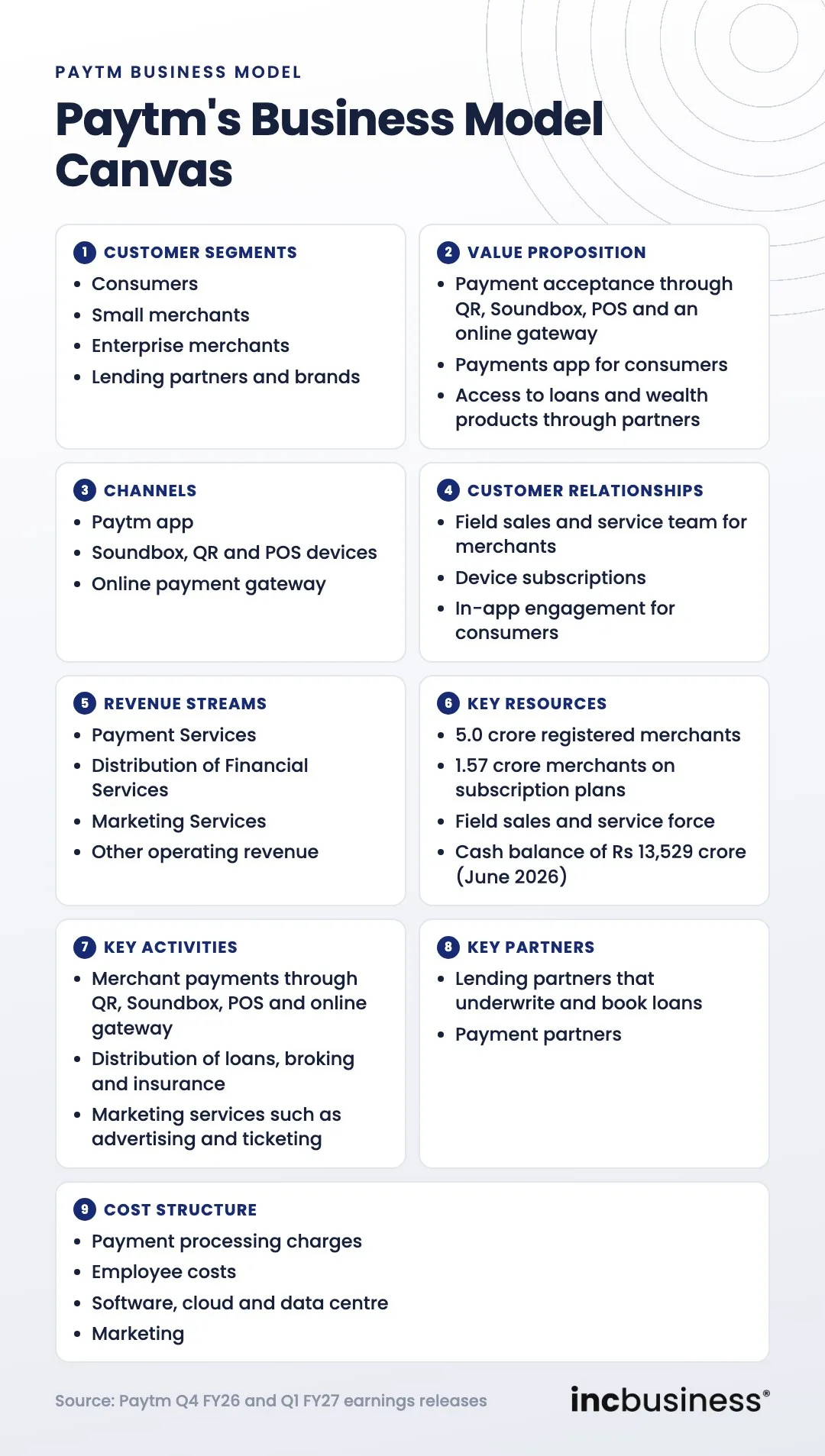
- At the end of June 2026, 5.0 crore merchants were registered and 1.57 crore were on subscription plans.
The Paytm business model starts with payments and adds financial services and marketing on top. Paytm, run by One 97 Communications, earns from the payments that run through its app and its merchant devices, from distributing loans and other financial products for partners, and from advertising and ticketing. In FY26 its revenue from operations was Rs 8,437 crore and its profit after tax was Rs 552 crore, which Paytm described as its first full year of profit.
This is how Paytm makes money, where the money goes, and what its latest quarter shows. The revenue, cost and profit The latest quarter reported at the time of writing is Q1 FY27, the three months to June 2026.
Paytm at a glance
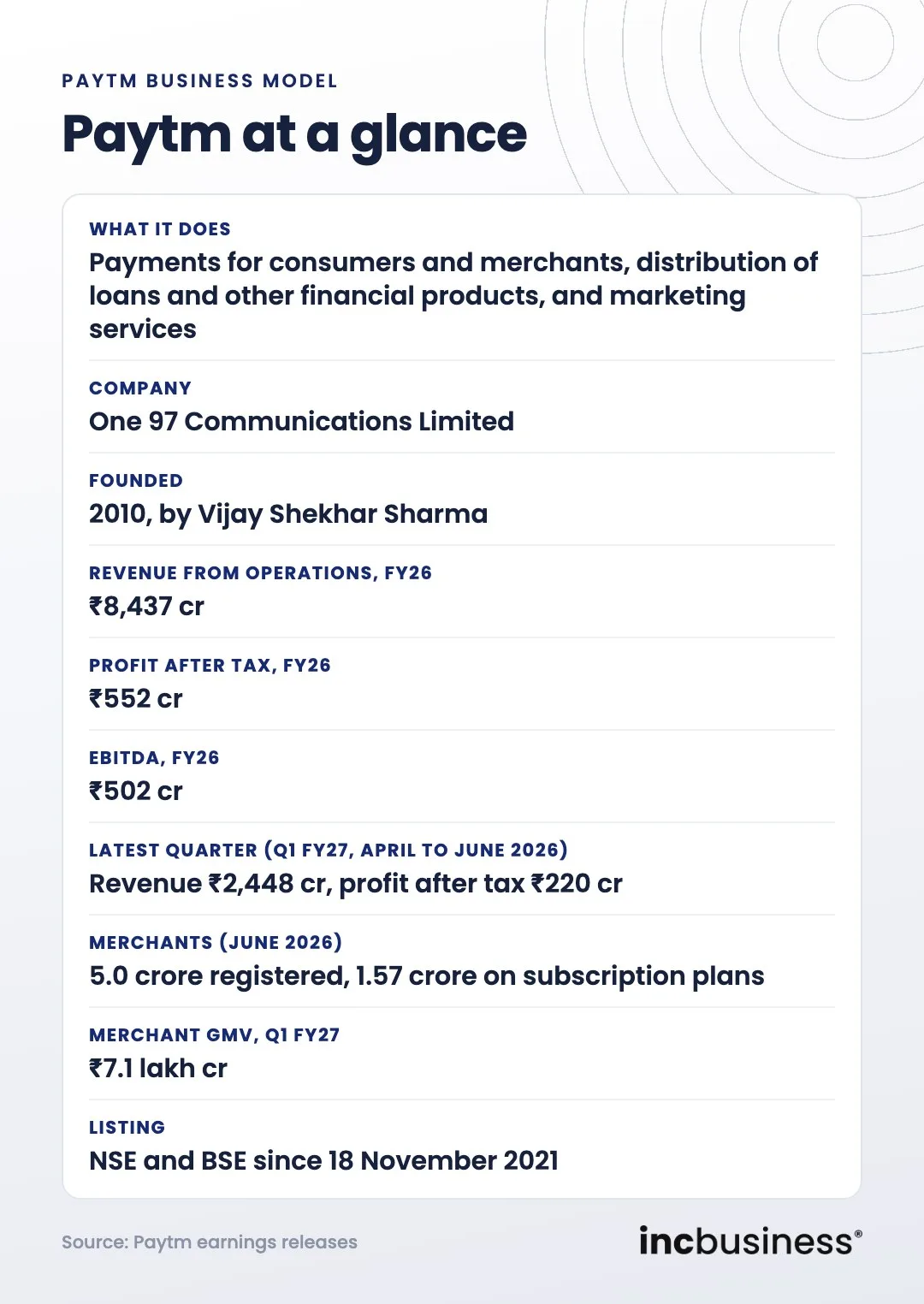
| Detail | Paytm |
|---|---|
| What it does | Payments for consumers and merchants, distribution of loans and other financial products, and marketing services |
| Company | One 97 Communications Limited |
| Founded | 2010, by Vijay Shekhar Sharma |
| Revenue from operations (FY26) | Rs 8,437 crore |
| Profit after tax (FY26) | Rs 552 crore |
| EBITDA (FY26) | Rs 502 crore |
| Latest quarter (Q1 FY27, April to June 2026) | Revenue from operations of Rs 2,448 crore and profit after tax of Rs 220 crore |
| Registered merchants (June 2026) | 5.0 crore |
| Merchants on subscription plans (June 2026) | 1.57 crore |
| Merchant GMV (Q1 FY27) | Rs 7.1 lakh crore |
| Listing | Listed on the NSE and BSE since 18 November 2021 |
What Paytm does
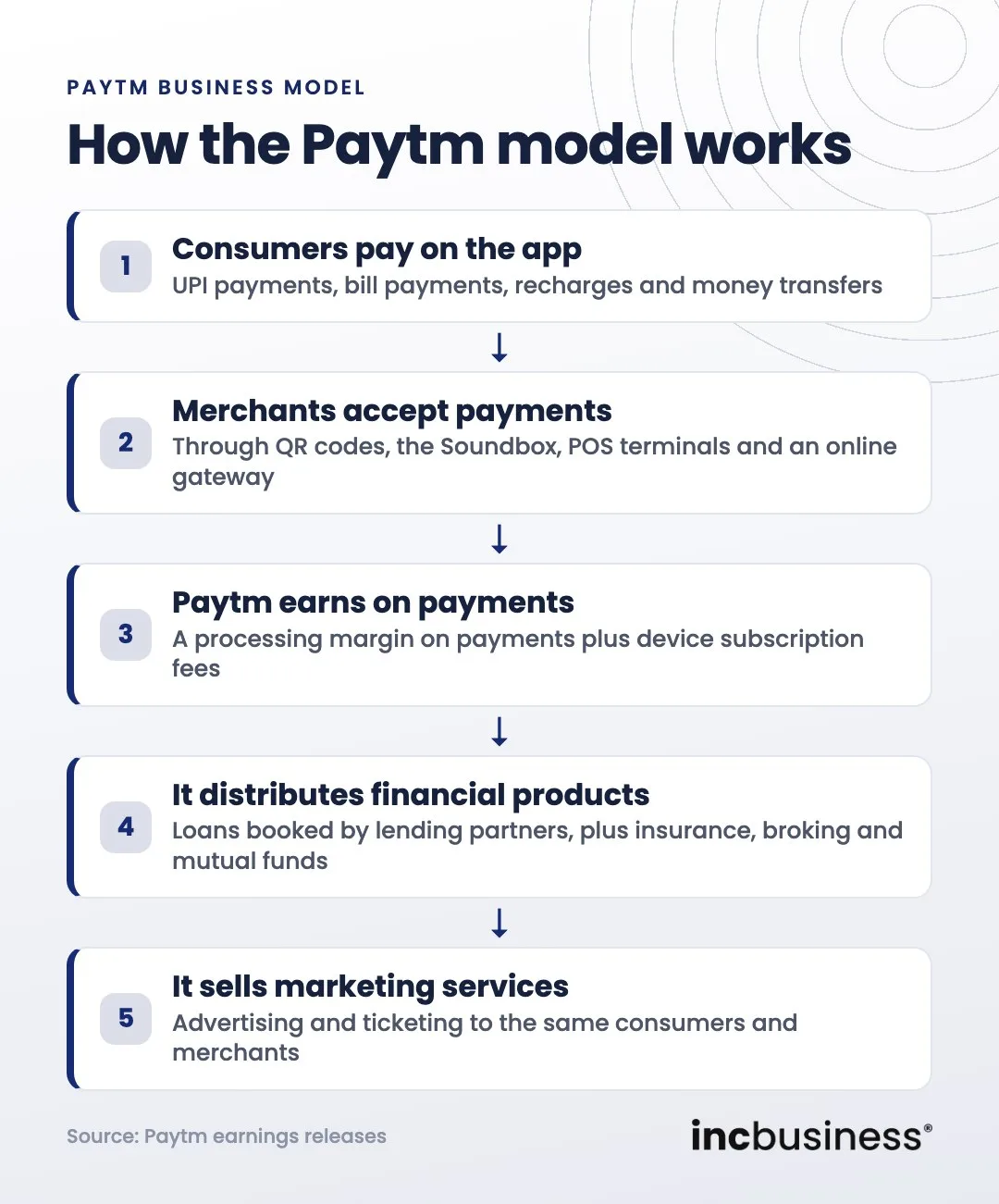
Consumers use the Paytm app for UPI payments, bill payments, recharges and money transfers. Merchants use its acceptance products, which include QR codes, the Soundbox device that announces payments, POS terminals and an online payment gateway. On top of this base, Paytm distributes loans, equity broking, insurance and mutual funds, and sells advertising and ticketing.
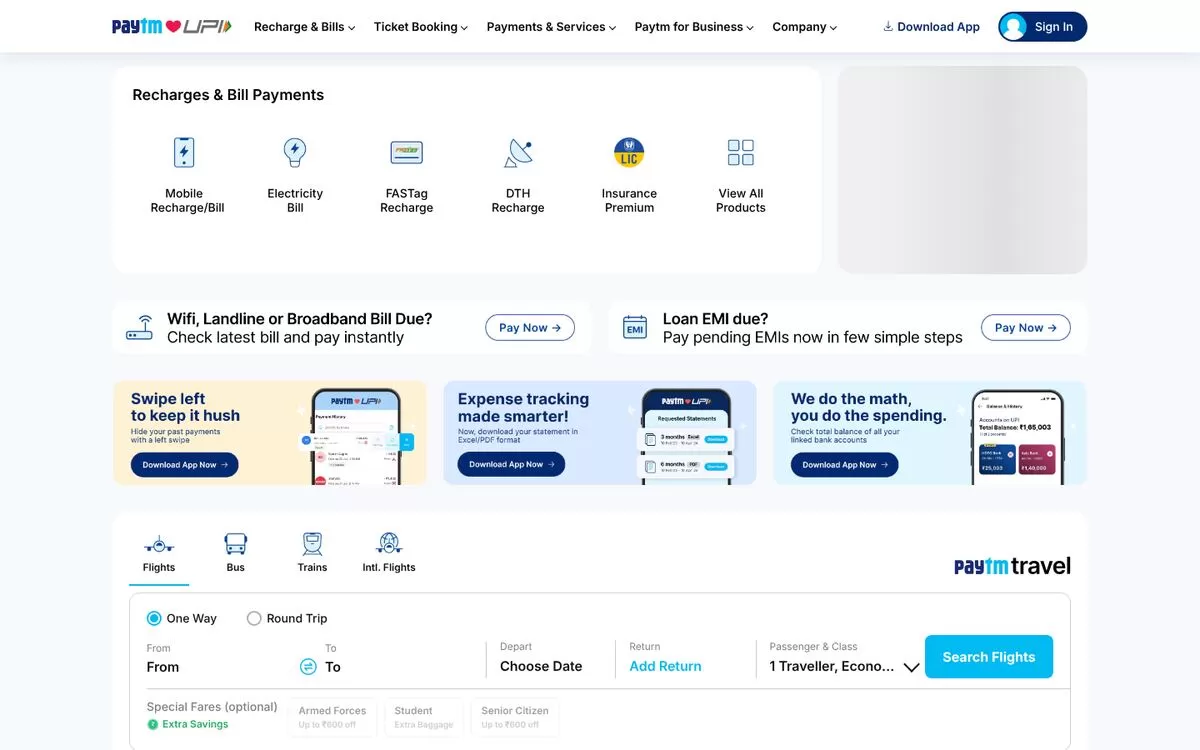
How the Paytm business model makes money from four revenue lines
Paytm's FY26 revenue from operations of Rs 8,437 crore came from four lines. Payment Services was the largest at about 55%, and Distribution of Financial Services was about 31%.
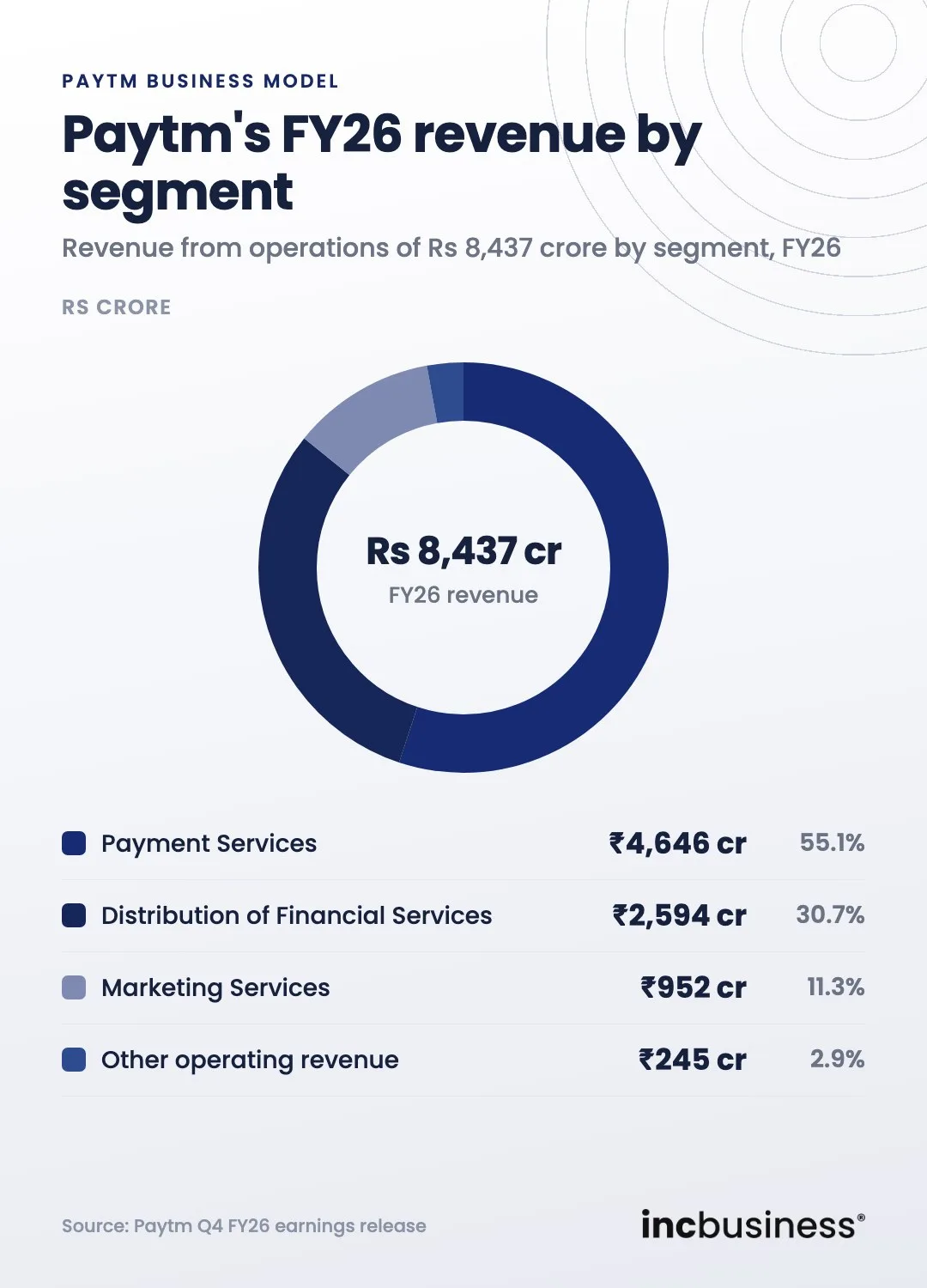
- Payment Services (Rs 4,646 crore). Paytm earns a margin on payments that merchants accept through its devices and gateway, and it earns subscription fees from merchants who use devices such as the Soundbox. Paytm says its payment processing margin is above 4 basis points of GMV. GMV is the total value of payments processed.
- Distribution of Financial Services (Rs 2,594 crore). Paytm connects borrowers with lenders. Loans are underwritten and booked by Paytm's lending partners on their own balance sheets, while Paytm brings merchants and consumers and supports collections. This line also includes insurance distribution, equity broking and mutual funds.
- Marketing Services (Rs 952 crore). This covers marketing services such as advertising and ticketing.
- Other operating revenue (Rs 245 crore). The remainder of revenue from operations.
Distribution of Financial Services revenue in FY26
Between FY25 and FY26, Distribution of Financial Services revenue grew 52%, from Rs 1,703 crore to Rs 2,594 crore. Payment Services grew 20% to Rs 4,646 crore, while Marketing Services fell 18% to Rs 952 crore.
Paytm's Business Model Canvas
The Business Model Canvas puts the model on one page, showing who Paytm serves, what it offers, how it reaches customers, what it needs to run and how money comes in and goes out.
Where Paytm's money goes
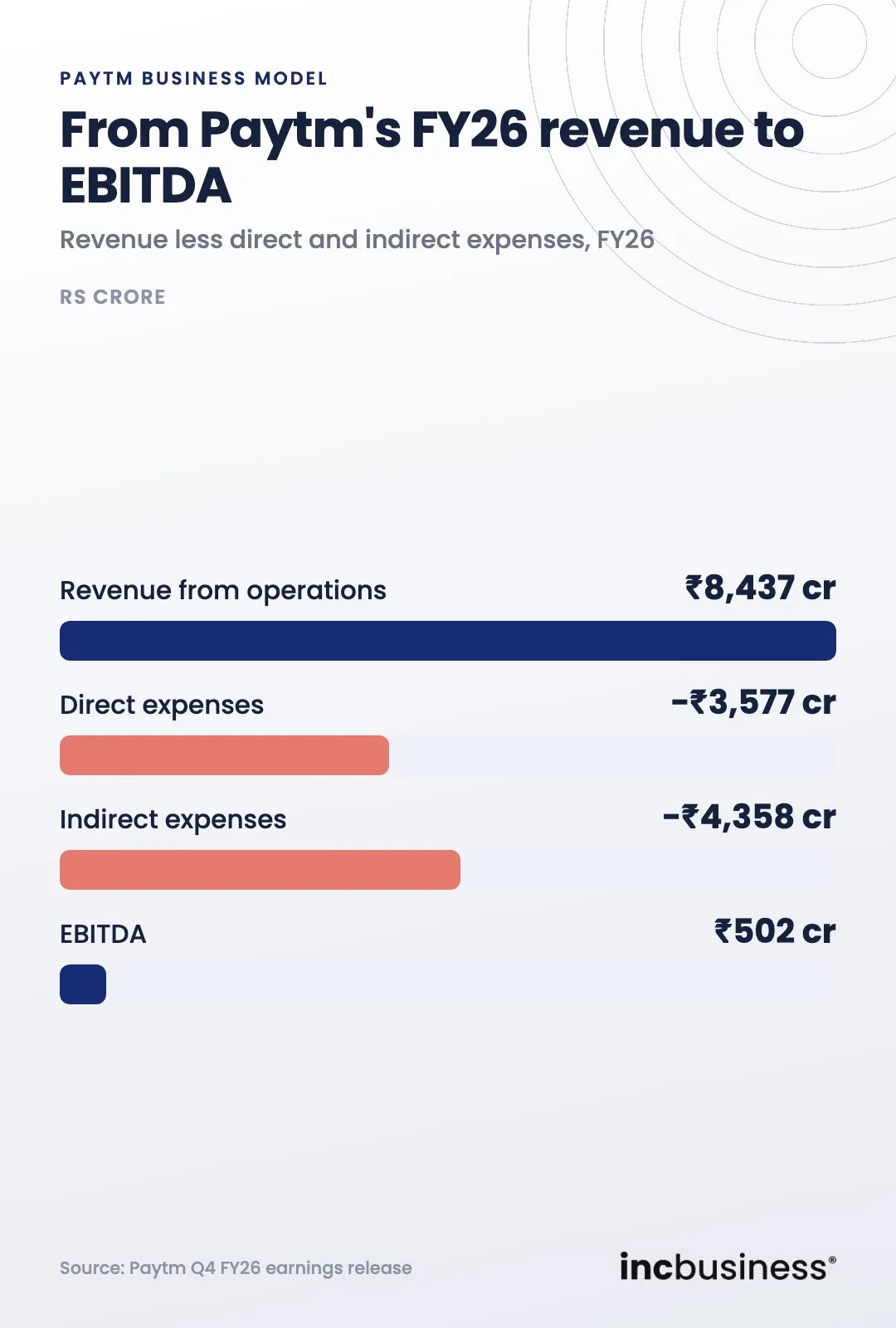
In FY26 Paytm's revenue from operations was Rs 8,437 crore. Direct expenses were Rs 3,577 crore, which left a contribution profit of Rs 4,860 crore. Indirect expenses were Rs 4,358 crore, which left an EBITDA of Rs 502 crore.
| Cost (FY26) | Rs crore |
|---|---|
| Payment processing charges | 2,573 |
| Promotional cashback and incentives | 261 |
| Other direct expenses | 743 |
| Total direct expenses | 3,577 |
| Marketing | 275 |
| Employee cost, including ESOP costs | 2,765 |
| Software, cloud and data centre | 643 |
| Other indirect expenses | 675 |
| Total indirect expenses | 4,358 |
Below EBITDA, Paytm reported other income of Rs 854 crore in FY26. Its FY26 profit after tax also includes a one-time charge of Rs 190 crore for the full impairment of a loan to its joint venture, First Games Technology Private Limited.
Paytm's revenue and profit over three years
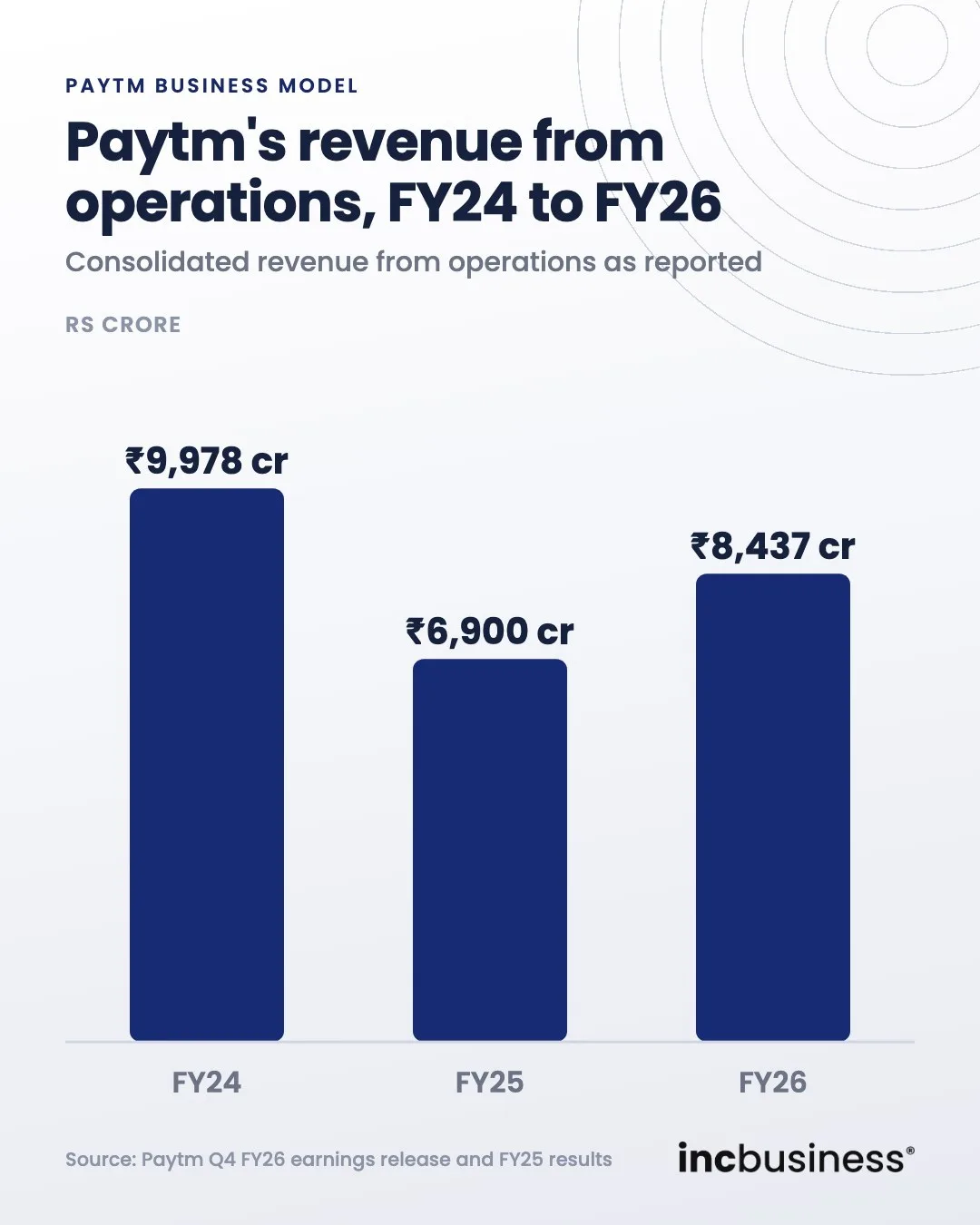
Revenue from operations was Rs 9,978 crore in FY24, Rs 6,900 crore in FY25 and Rs 8,437 crore in FY26. Profit after tax was a loss of Rs 663 crore in FY25 and a profit of Rs 552 crore in FY26. FY25 profit after tax includes a one-time gain of Rs 1,345 crore on the sale of the entertainment business and a one-time charge of Rs 522 crore for ESOP acceleration and other impairments.
| Year | Revenue from operations (Rs crore) | Profit or loss after tax (Rs crore) |
|---|---|---|
| FY24 | 9,978 | Not shown |
| FY25 | 6,900 | Loss of 663 |
| FY26 | 8,437 | Profit of 552 |
Paytm's merchant base and key metrics
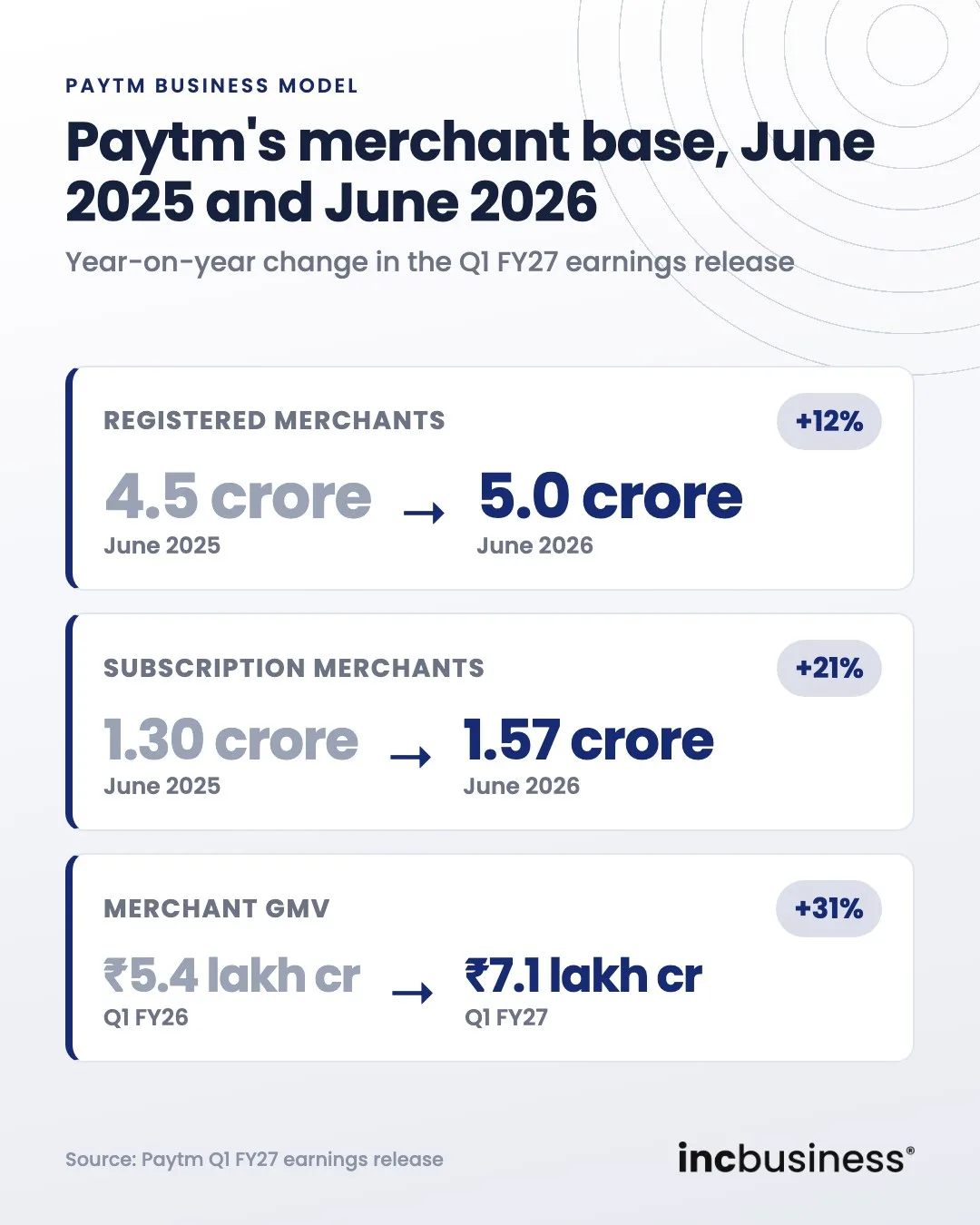
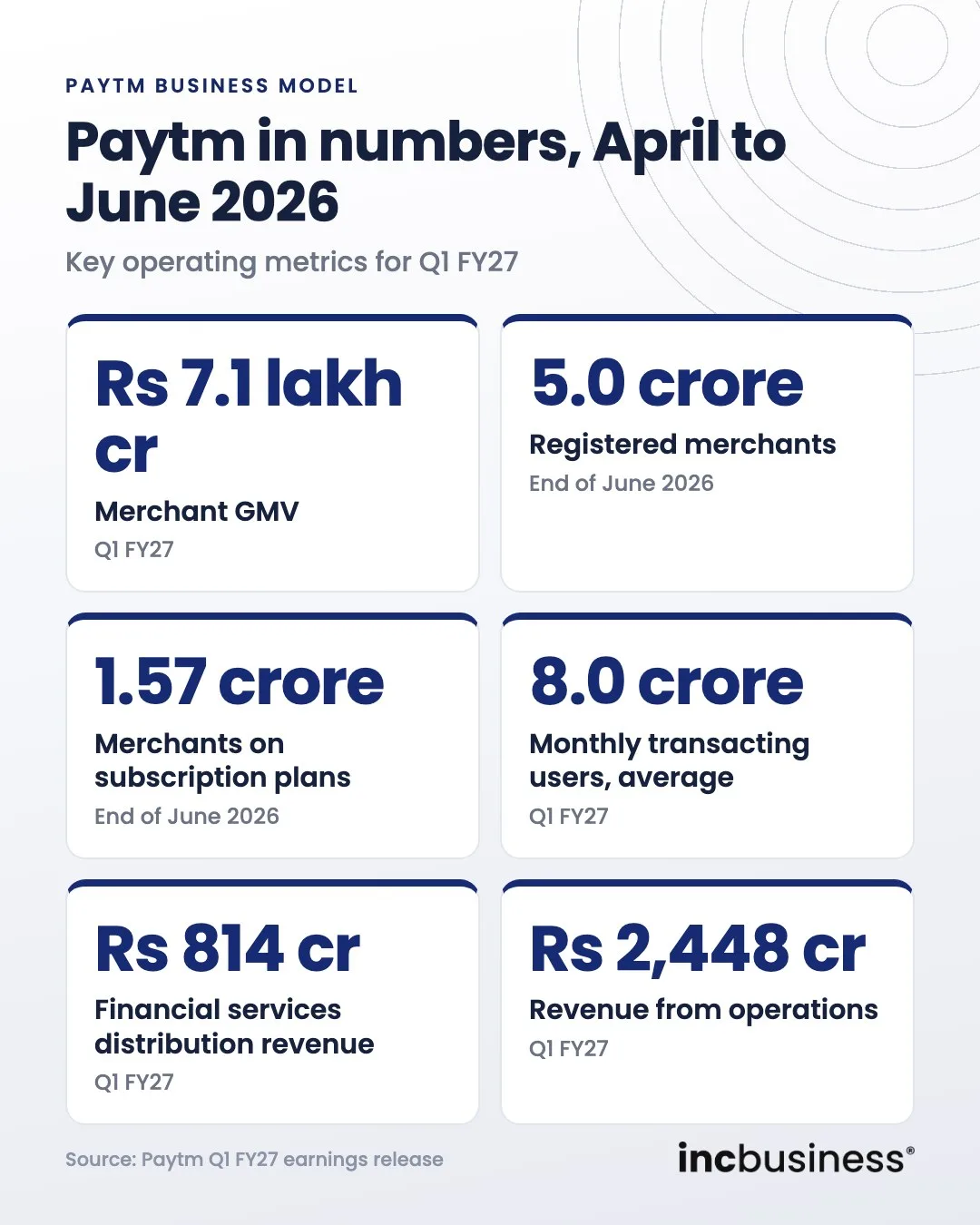
At the end of June 2026 Paytm had 5.0 crore registered merchants, up from 4.5 crore a year earlier. The number of merchants on subscription plans, which includes devices such as the Soundbox, was 1.57 crore, up from 1.30 crore. Merchant GMV was Rs 7.1 lakh crore in Q1 FY27, up 31% from Rs 5.4 lakh crore in Q1 FY26.
On the consumer side, Paytm reported 8.0 crore monthly transacting users on average in Q1 FY27, up 60 lakh from a year earlier. Distribution of Financial Services revenue was Rs 814 crore in the quarter, and the company counted 7.6 lakh key financial services customers.
Paytm's latest quarter
In Q1 FY27 Paytm reported revenue from operations of Rs 2,448 crore, up 28% from Rs 1,918 crore a year earlier. EBITDA was Rs 203 crore, up from Rs 72 crore, and profit after tax was Rs 220 crore, up 79% from Rs 123 crore. Paytm received a government incentive under the Payments Infrastructure Development Fund (PIDF) until December 2025. It received Rs 8 crore of PIDF incentive in Q1 FY27 compared with Rs 54 crore in Q1 FY26, so Paytm also presents comparable figures that leave the incentive out.
Paytm's journey so far
| When | What happened |
|---|---|
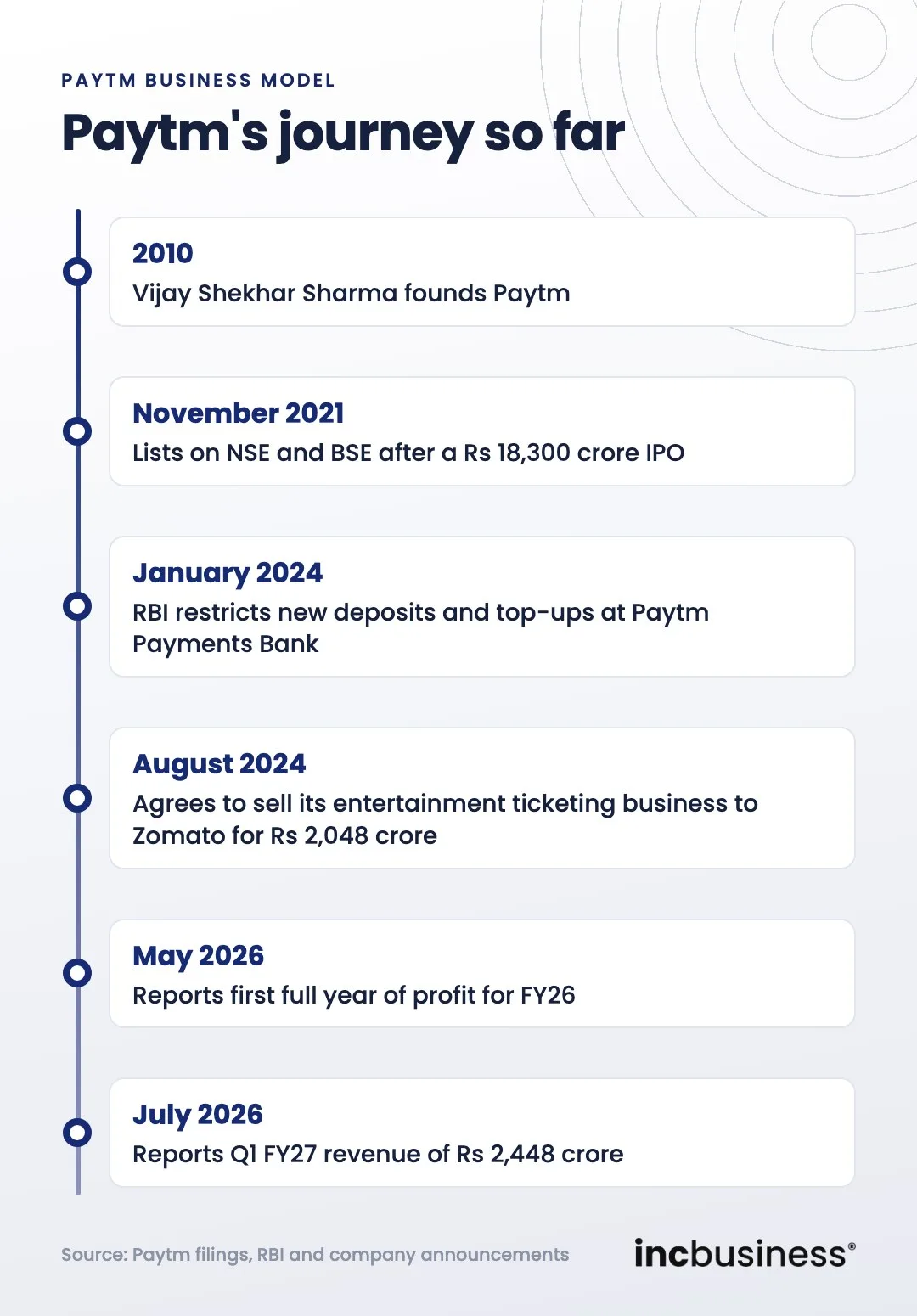
| 2010 | Vijay Shekhar Sharma founds Paytm |
| November 2021 | Paytm lists on the NSE and BSE after an IPO of Rs 18,300 crore at Rs 2,150 a share |
| January 2024 | The RBI directs Paytm Payments Bank to stop accepting fresh deposits and top-ups |
| August 2024 | Paytm agrees to sell its entertainment ticketing business to Zomato for Rs 2,048 crore |
| May 2026 | Paytm reports FY26 results, its first full year of profit |
| July 2026 | Paytm reports Q1 FY27 revenue from operations of Rs 2,448 crore |
Who Paytm competes with
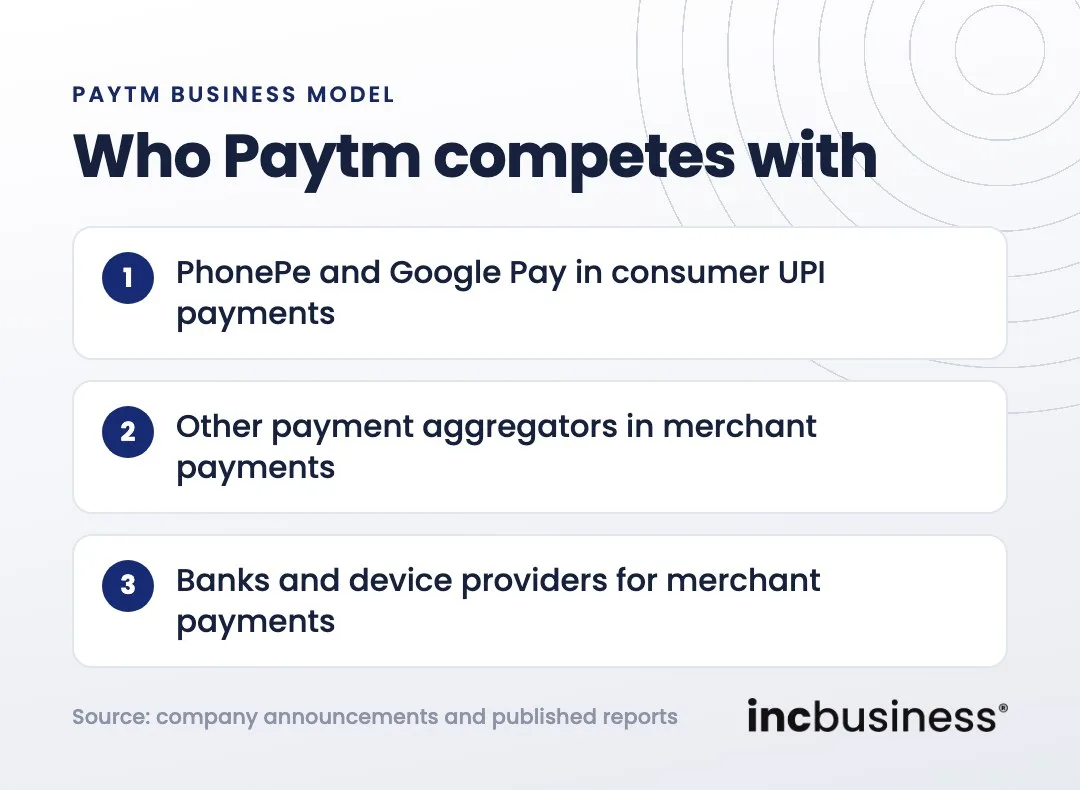
In consumer UPI payments, Paytm competes with PhonePe and Google Pay, which are also large UPI apps. In merchant payments it competes with other payment aggregators, banks and device providers.
Changes in Paytm's incentives, regulation and revenue
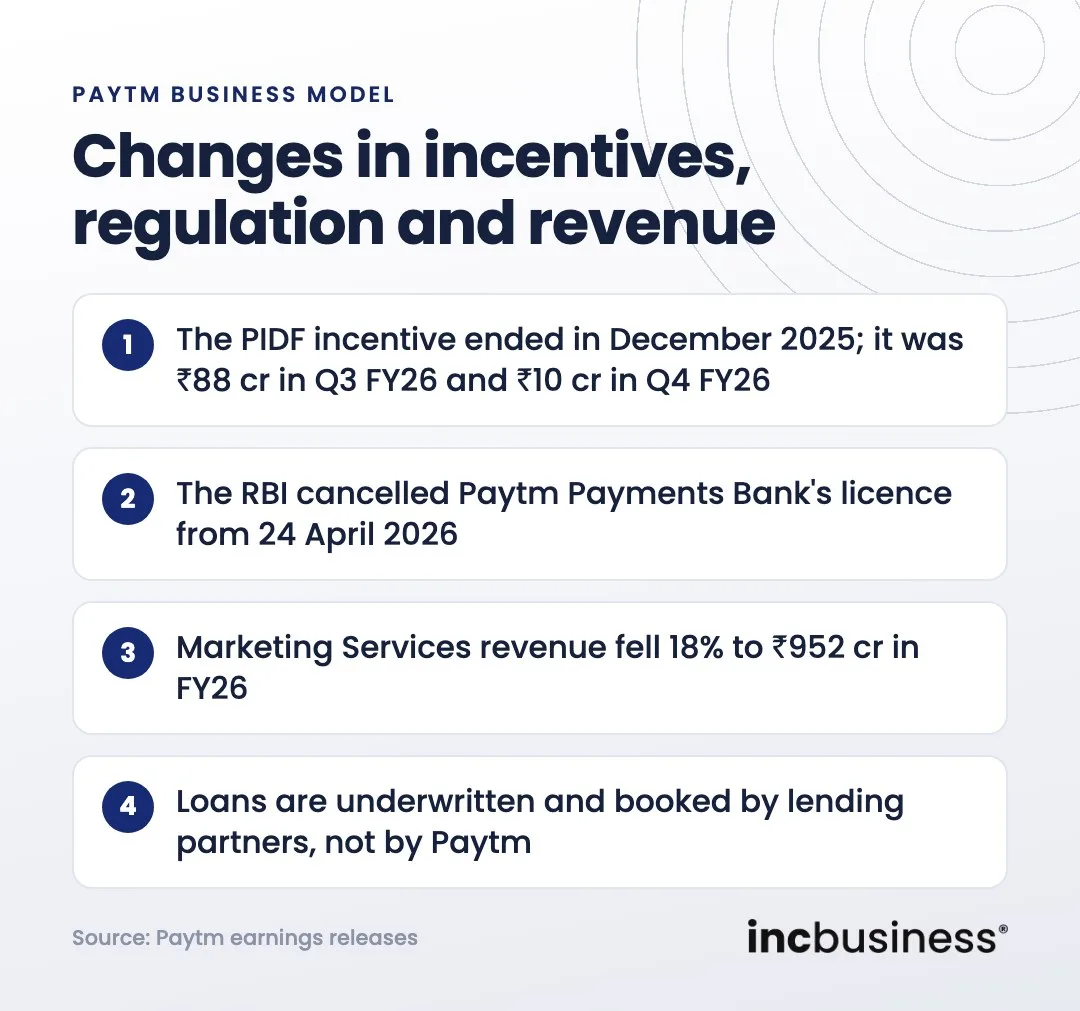
- The PIDF incentive has ended. The PIDF incentive was Rs 88 crore in Q3 FY26 and Rs 10 crore in Q4 FY26, and the scheme was not extended beyond December 2025. Paytm said the FY26 UPI incentive was yet to be finalised when it reported FY26 results.
- Regulation. In January 2024 the RBI restricted Paytm Payments Bank, and the RBI cancelled the bank's licence with effect from 24 April 2026. The Delhi High Court ordered the bank wound up in July 2026. Paytm's subsidiary Paytm Payments Services Limited has applied for a wallet licence, according to the Q1 FY27 earnings release.
- Marketing Services revenue fell. Marketing Services revenue fell 18% to Rs 952 crore in FY26.
- Loans are booked by lending partners. Loans in its distribution business are underwritten and booked by lending partners, not by Paytm.
Conclusion on the Paytm business model
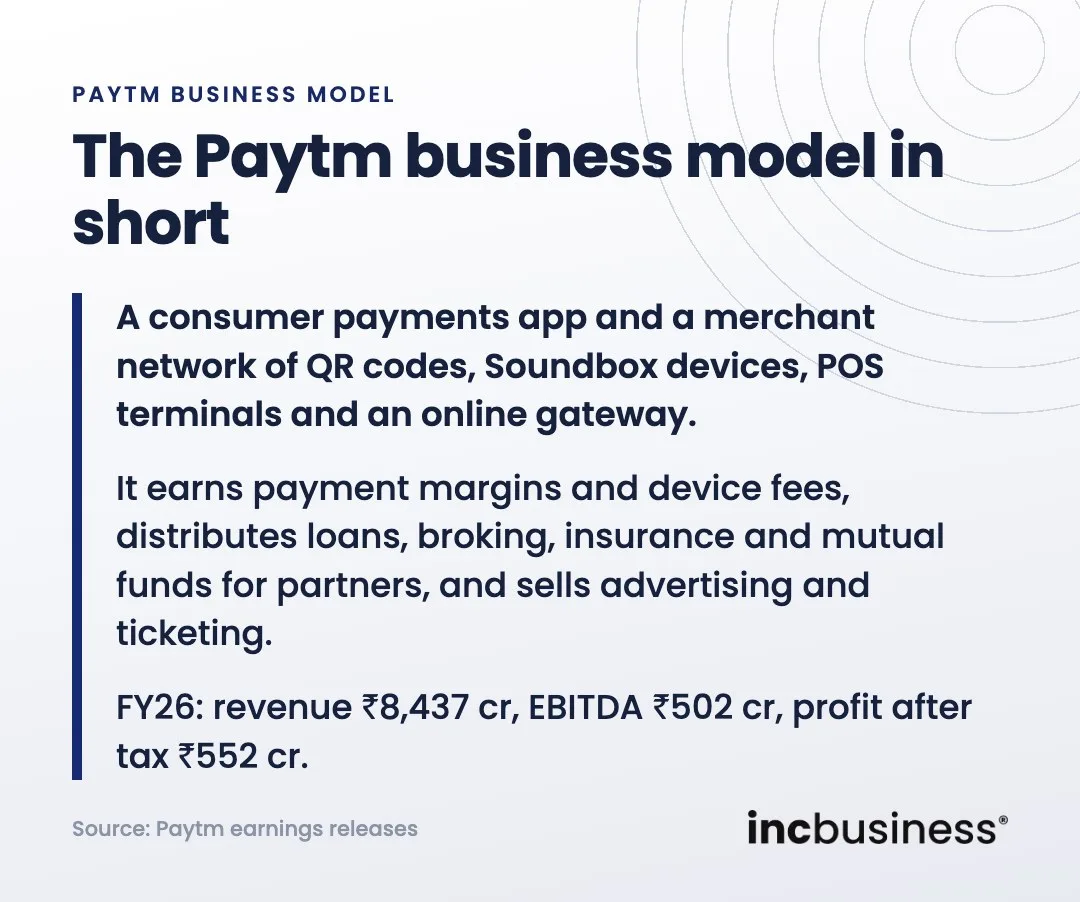
The Paytm business model is built on payments. It runs a consumer payments app and a merchant acceptance network of QR codes, Soundbox devices, POS terminals and an online gateway, and it earns payment processing margins and device subscription fees from them. It then distributes loans, broking, insurance and mutual funds for its partners and sells advertising and ticketing to the same base of consumers and merchants.
In FY26 Paytm reported revenue from operations of Rs 8,437 crore, EBITDA of Rs 502 crore and profit after tax of Rs 552 crore. In Q1 FY27 it reported revenue from operations of Rs 2,448 crore and profit after tax of Rs 220 crore, with 5.0 crore registered merchants and 1.57 crore merchants on subscription plans at the end of June 2026.


