INDmoney Business Model of One App for Indian and US Investing
How INDmoney earns from distribution and brokerage.

Key Takeaways
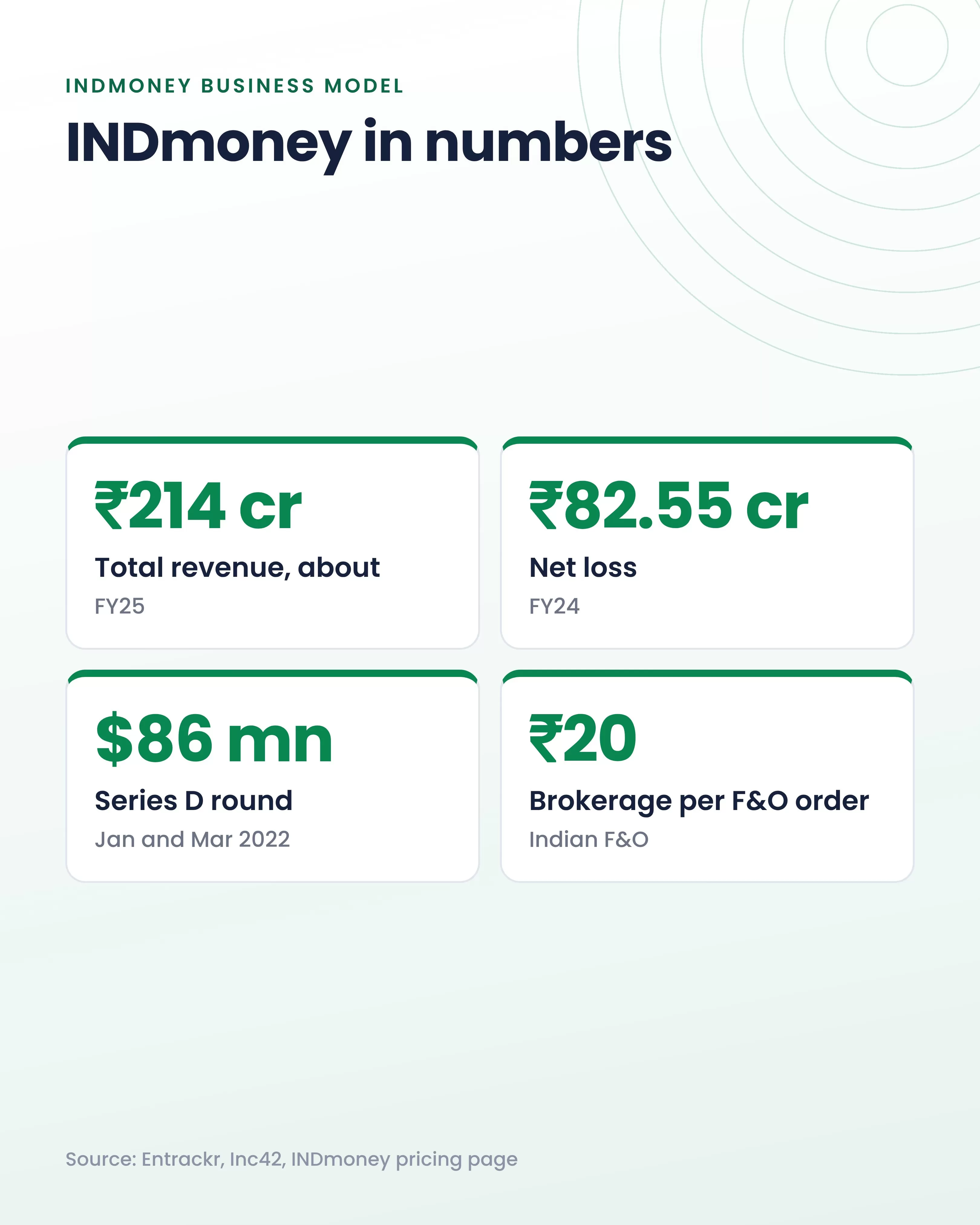
- FY25 total revenue, including other income, was about ₹214 crore.
- Total revenue was about ₹128 crore in FY24, including other income.
- Its net loss was ₹82.55 crore in FY24, against ₹73.9 crore in FY23.
- Its last equity round was an $86 million Series D, raised in early 2022.
Table of Contents 12 sections
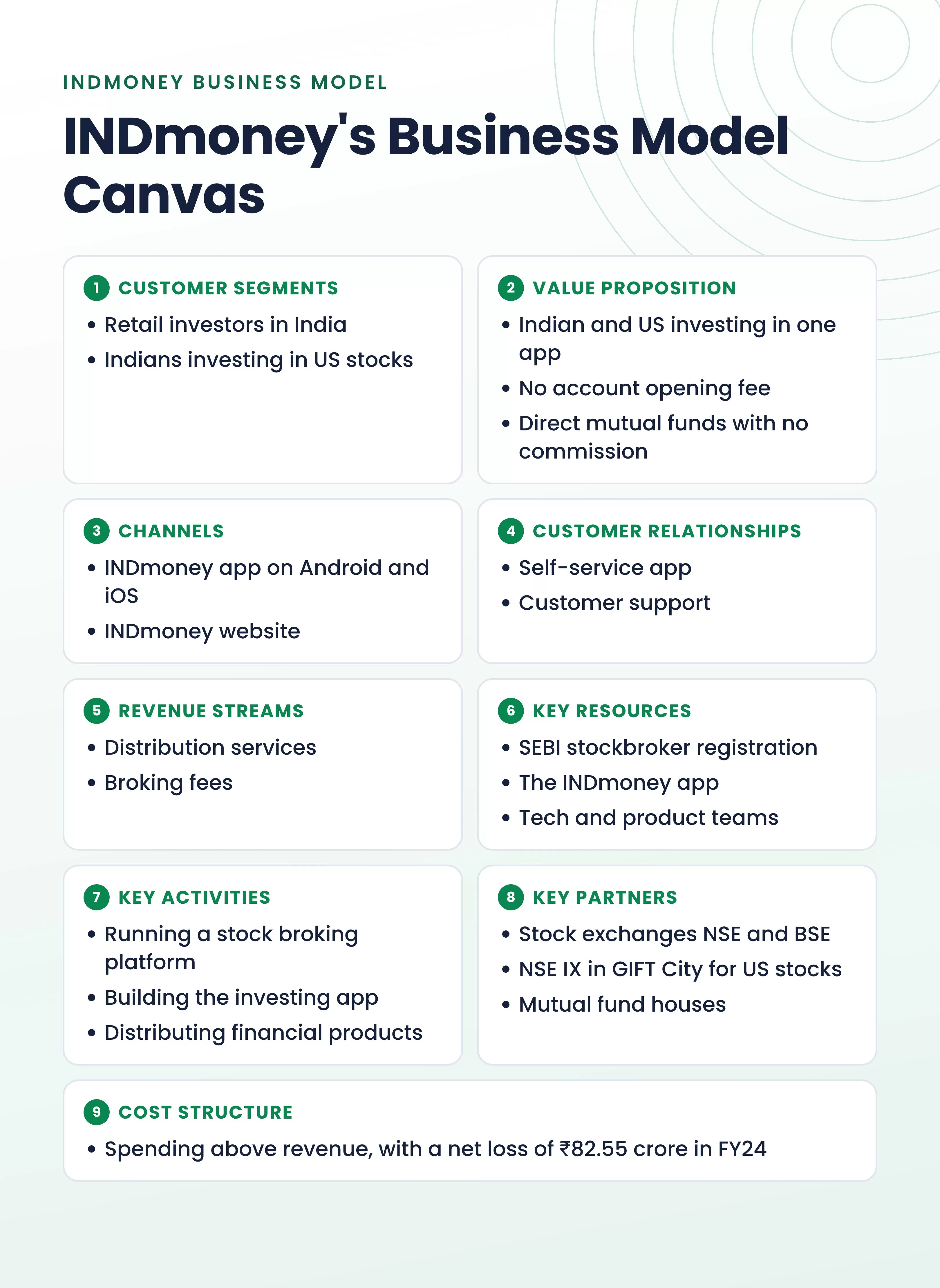
The INDmoney business model is an investing app that lets people in India buy Indian and US stocks, trade futures and options, apply for IPOs and invest in direct mutual funds, ETFs and NPS from one account. It earns mainly from distribution services and broking fees, while account opening is free.
INDmoney's total revenue, including other income, was about ₹214 crore in FY25, against about ₹128 crore in FY24. In FY24, it posted a net loss of ₹82.55 crore.
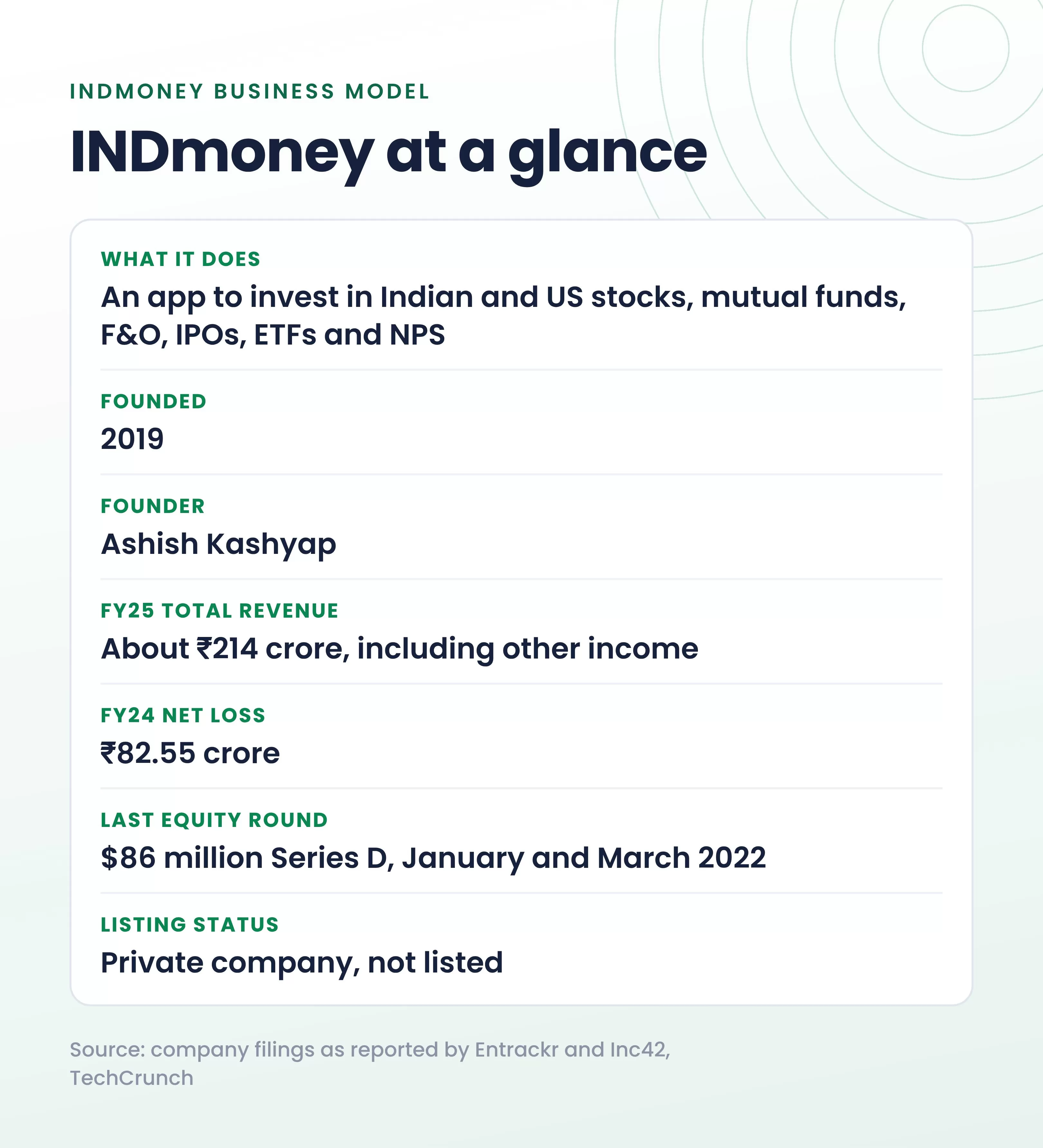
INDmoney at a glance
| Item | Details |
|---|---|
| What it does | An app to invest in Indian and US stocks, mutual funds, F&O, IPOs, ETFs and NPS |
| Founded | 2019 |
| Founder | Ashish Kashyap |
| FY25 total revenue | About ₹214 crore, including other income |
| FY24 net loss | ₹82.55 crore |
| Last equity round | $86 million Series D, raised in January and March 2022 |
| Listing status | Private company, not listed |
What INDmoney does
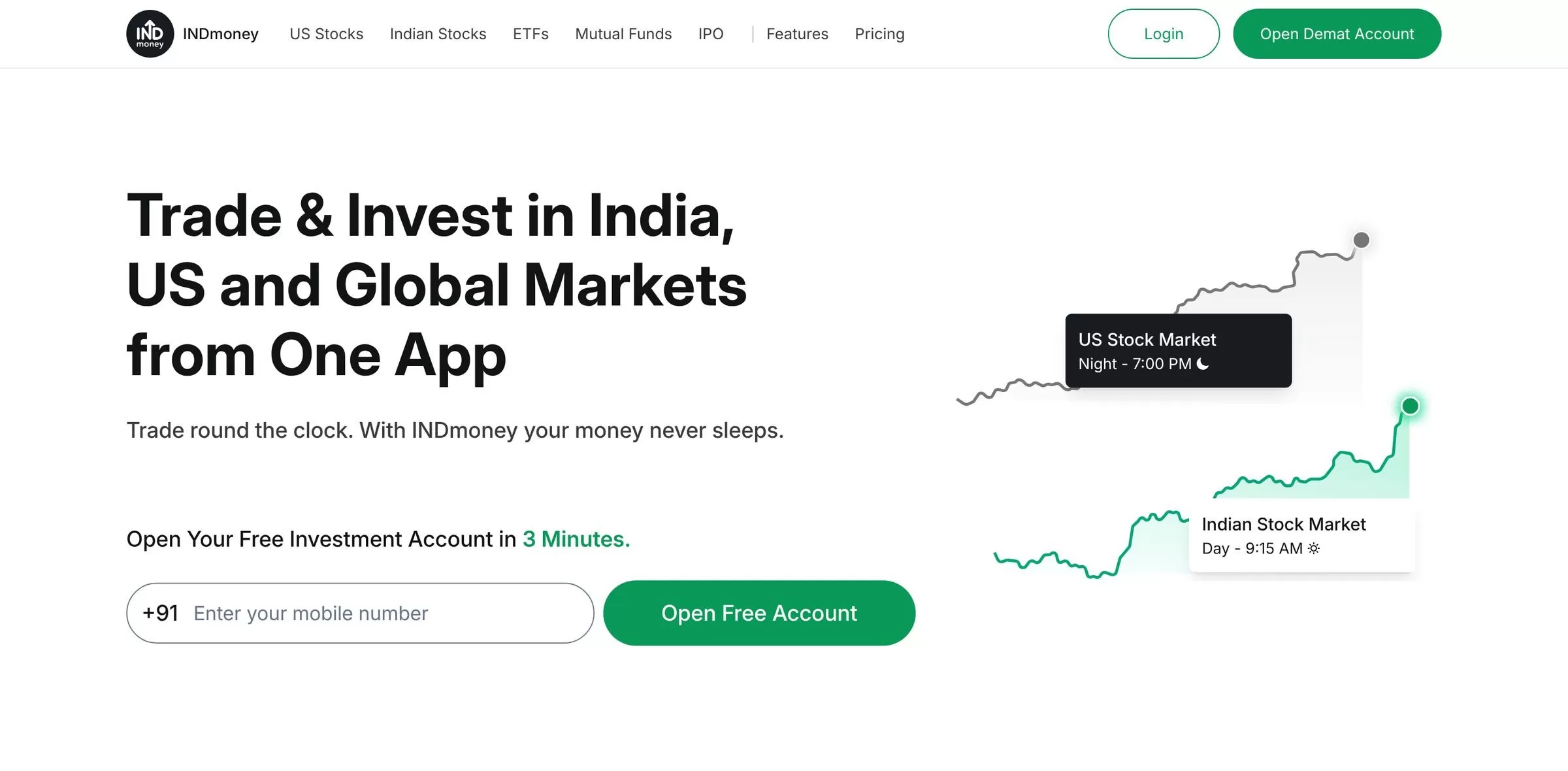
INDmoney is a Gurugram-based investing app. Users can trade Indian stocks, futures and options and commodities, apply for IPOs, buy ETFs on NSE and BSE, invest in US stocks and ETFs, and put money into direct mutual funds and NPS. The app also tracks a user's investments and net worth in one place.
Indian stock broking runs through INDstocks Private Limited (formerly INDmoney Private Limited), which is registered with SEBI as a stockbroker under registration number INZ000305337. US stocks can be bought through INDmoney Global (IFSC) Private Limited, a member of NSE International Exchange (NSE IX) in GIFT City.
How does INDmoney make money
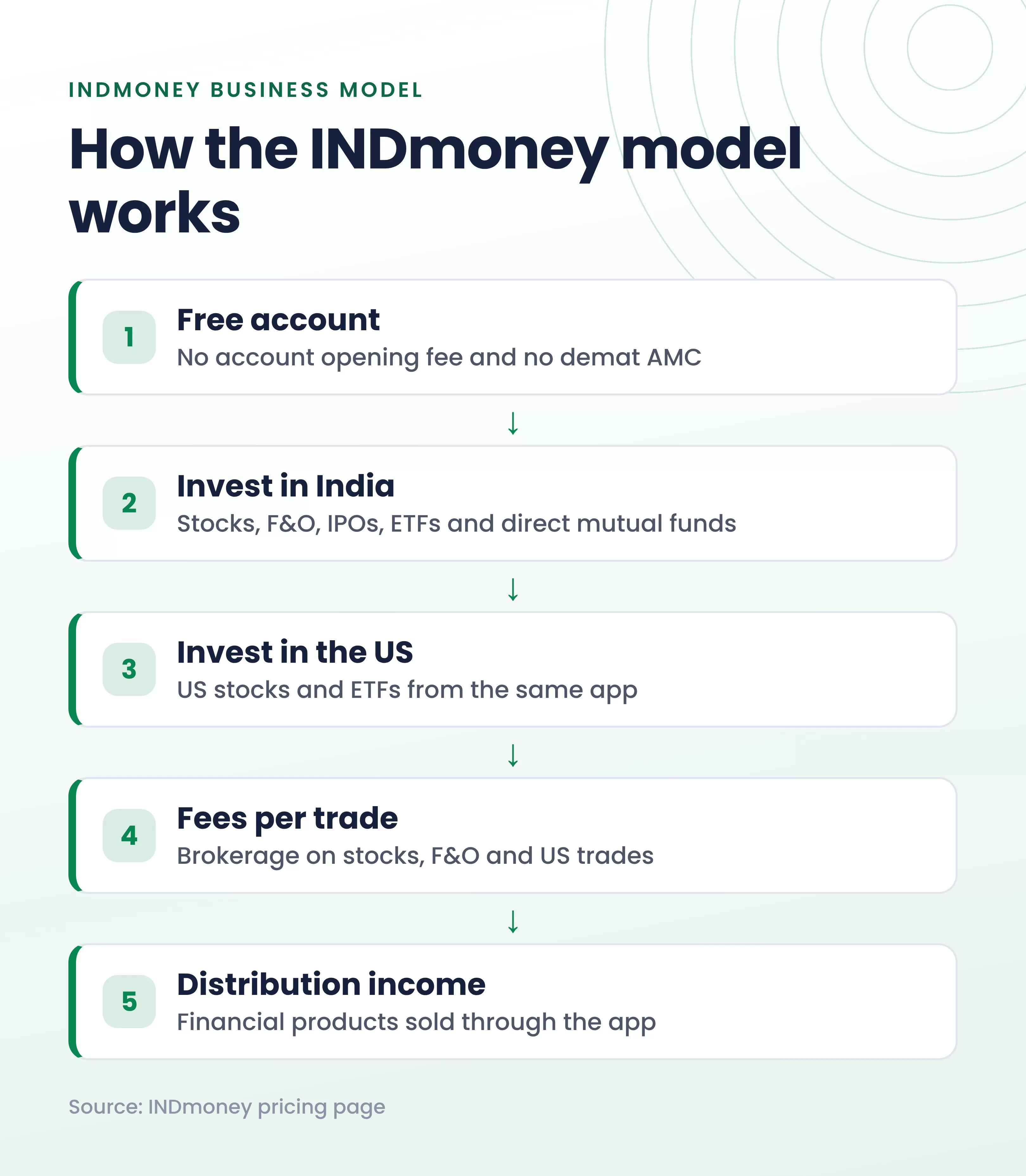
INDmoney's operating revenue comes mainly from two streams. Distribution services bring in income from financial products sold through the app. Broking brings in fees on trades in Indian stocks, F&O and US stocks.
It also earns other income, which is counted in total revenue but not in operating revenue.
INDmoney brokerage charges
Opening an INDmoney trading and demat account costs ₹0, and there is no demat AMC. On Indian futures and options, INDmoney charges ₹20 per executed order. Direct mutual funds carry no commission. For US stocks under its Plan A, brokerage is 0.25% per trade, capped at $25.
INDmoney revenue model and its growth
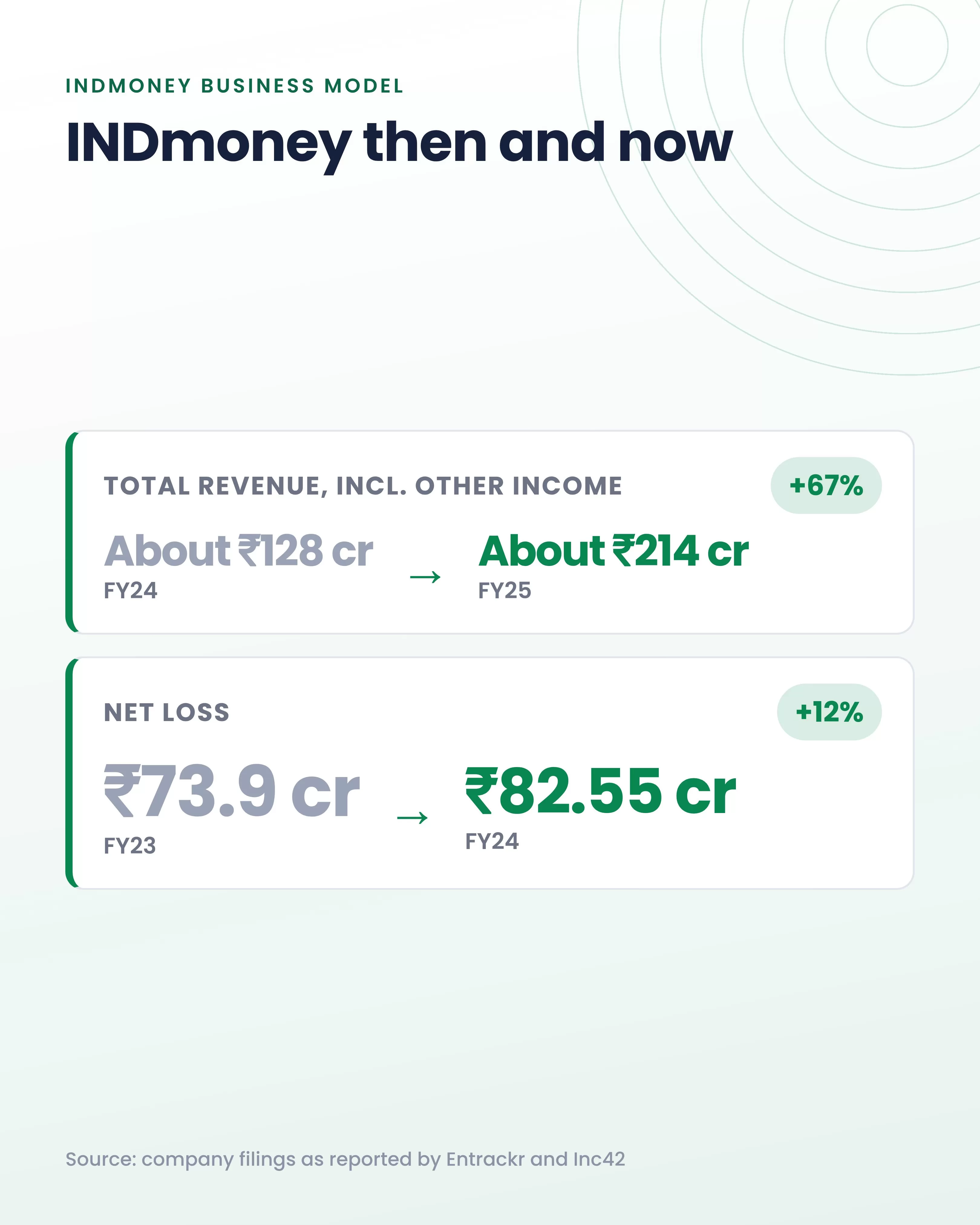
INDmoney's operating revenue was ₹40.6 crore in FY23. Its total revenue, including other income, was about ₹128 crore in FY24 and about ₹214 crore in FY25, a rise of about 67%.
INDmoney's Business Model Canvas
Is INDmoney profitable
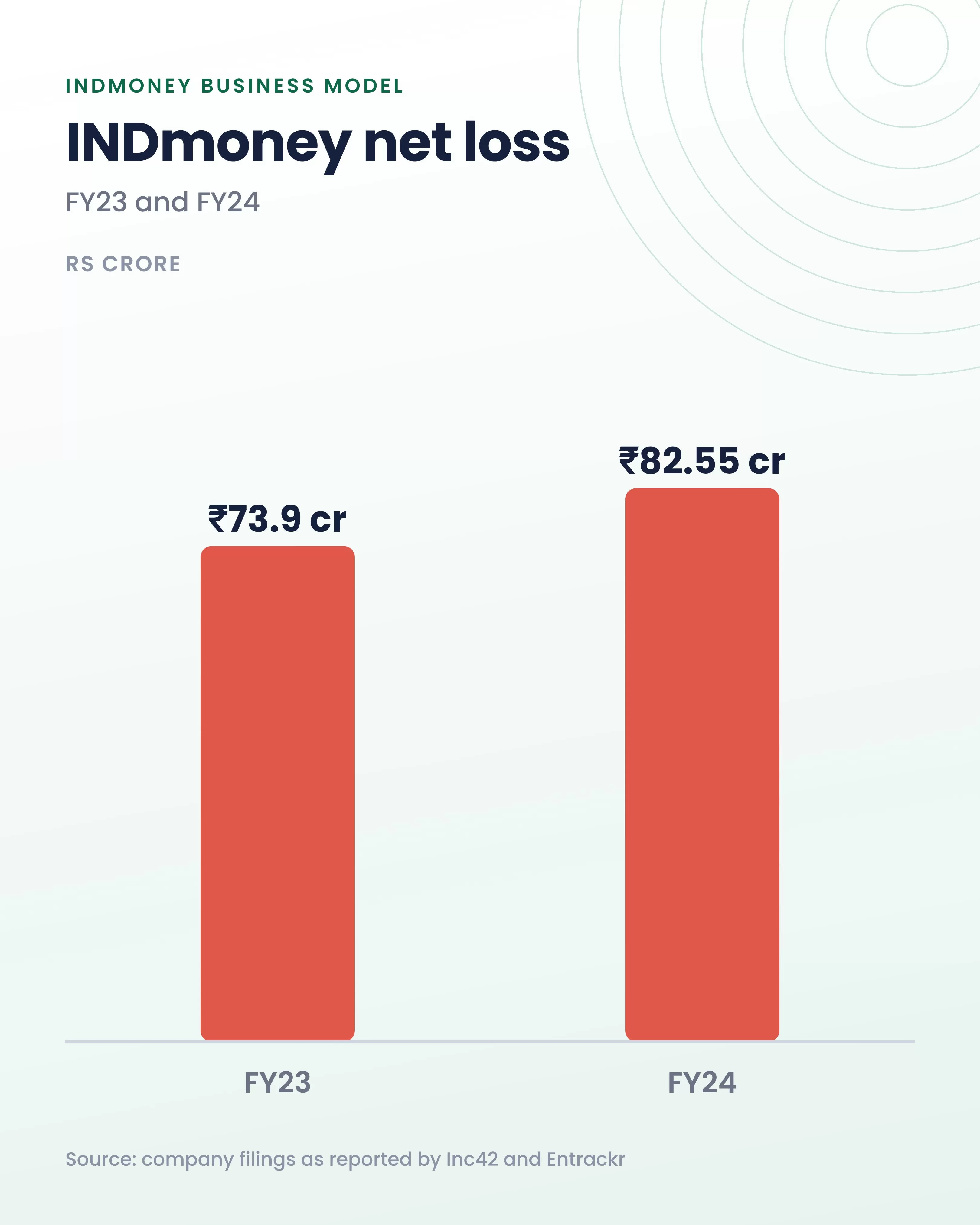
INDmoney has reported a net loss in each of FY23 and FY24. In FY23, it posted a net loss of ₹73.9 crore on operating revenue of ₹40.6 crore. In FY24, the net loss was ₹82.55 crore, about 12% higher.
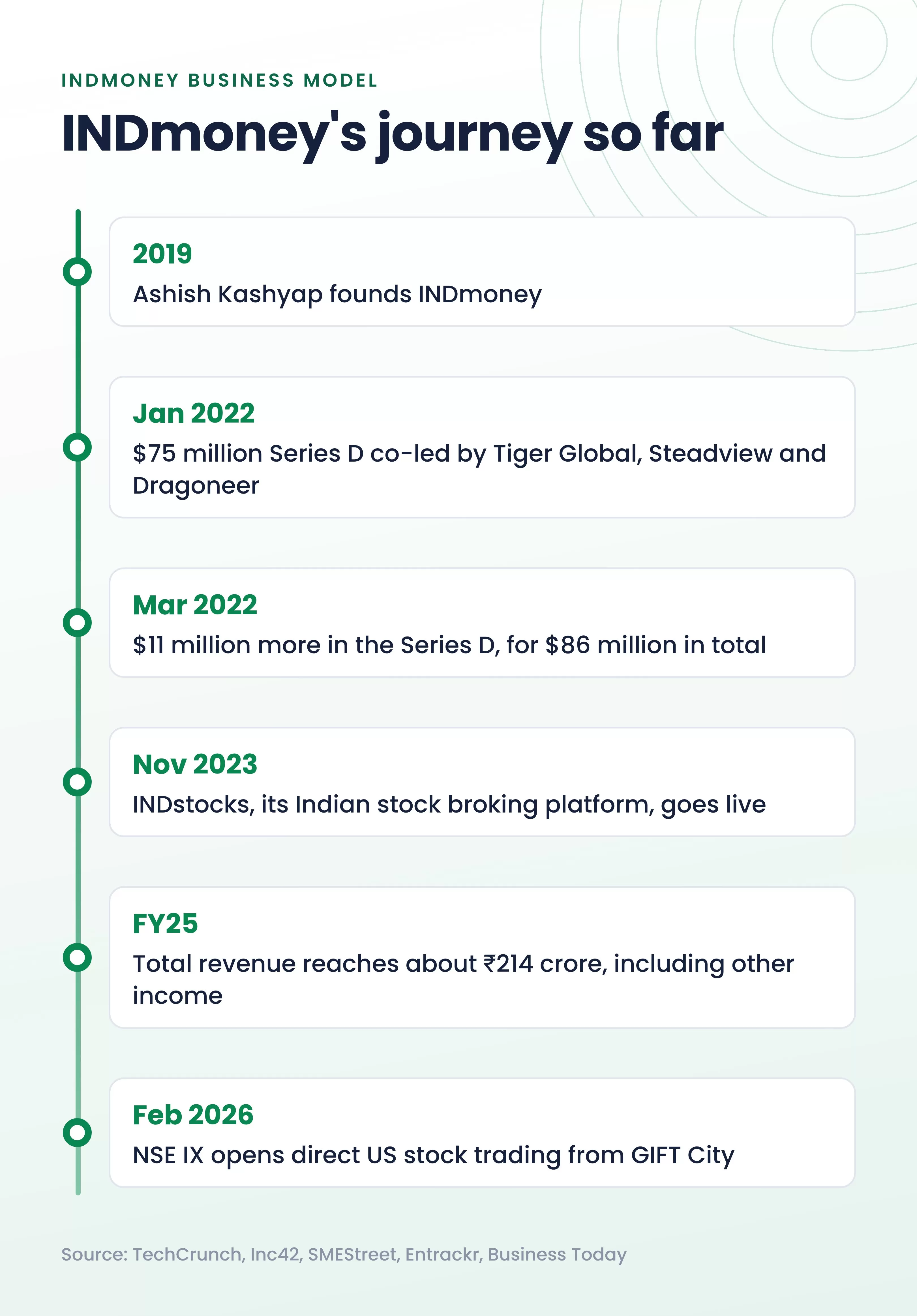
INDmoney's journey so far
| When | What happened |
|---|---|
| 2019 | Ashish Kashyap founds INDmoney |
| January 2022 | Raises $75 million in a Series D co-led by Tiger Global, Steadview Capital and Dragoneer |
| March 2022 | Raises $11 million more in the Series D, for $86 million in total |
| November 2023 | INDstocks, its Indian stock broking platform, goes live |
| FY25 | Total revenue, including other income, reaches about ₹214 crore |
| February 2026 | NSE IX opens direct US stock trading for Indian investors from GIFT City |
Who owns INDmoney
INDmoney is a private company founded by Ashish Kashyap, who leads it. Tiger Global, Steadview Capital and Dragoneer co-led the $75 million first part of its Series D in January 2022, and Sixteenth Street Capital joined the $11 million added in March 2022.
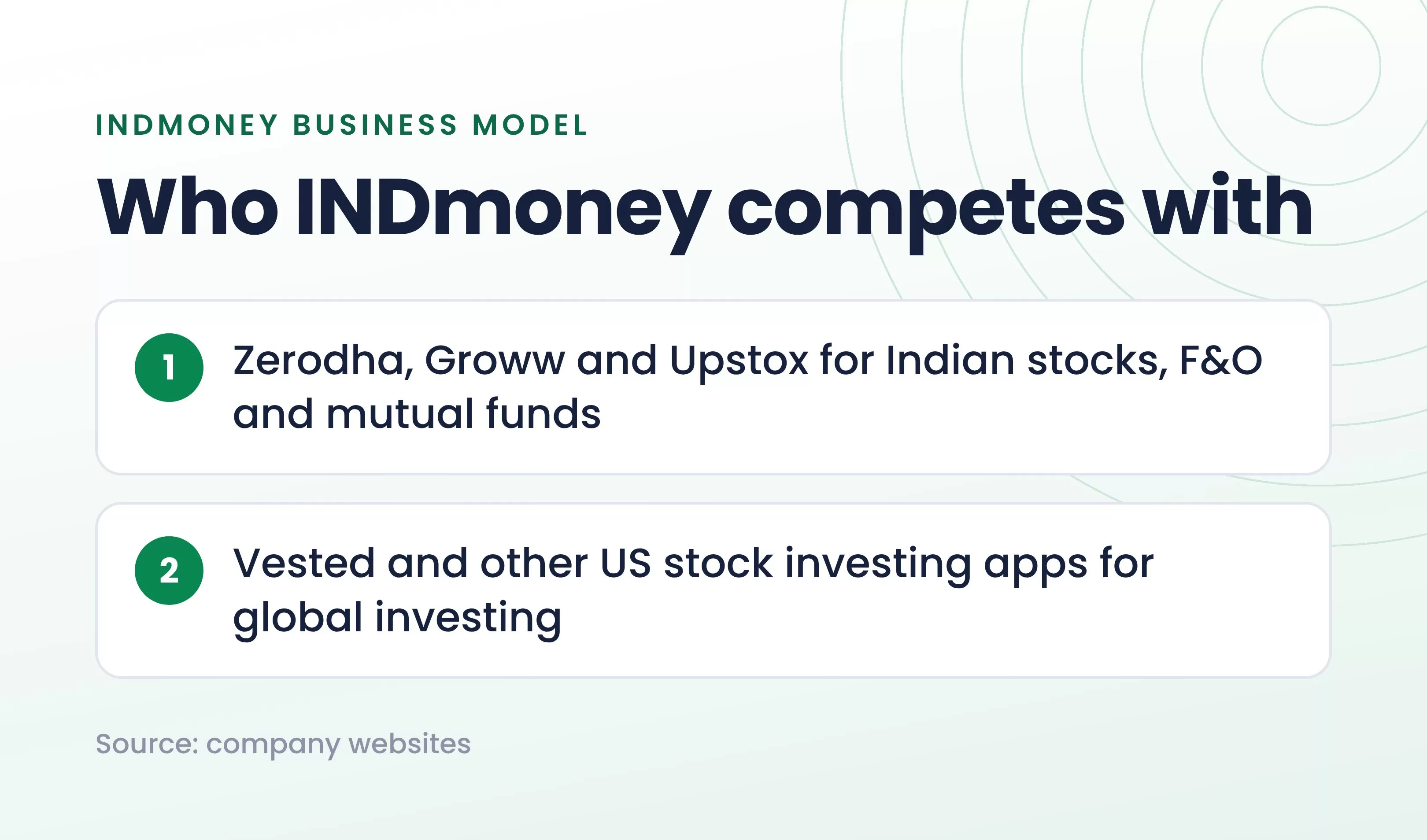
Who INDmoney competes with
In Indian stocks, F&O and mutual funds, INDmoney competes with broking apps such as Zerodha, Groww and Upstox. In US stock investing from India, it competes with apps such as Vested.
Challenges INDmoney faces
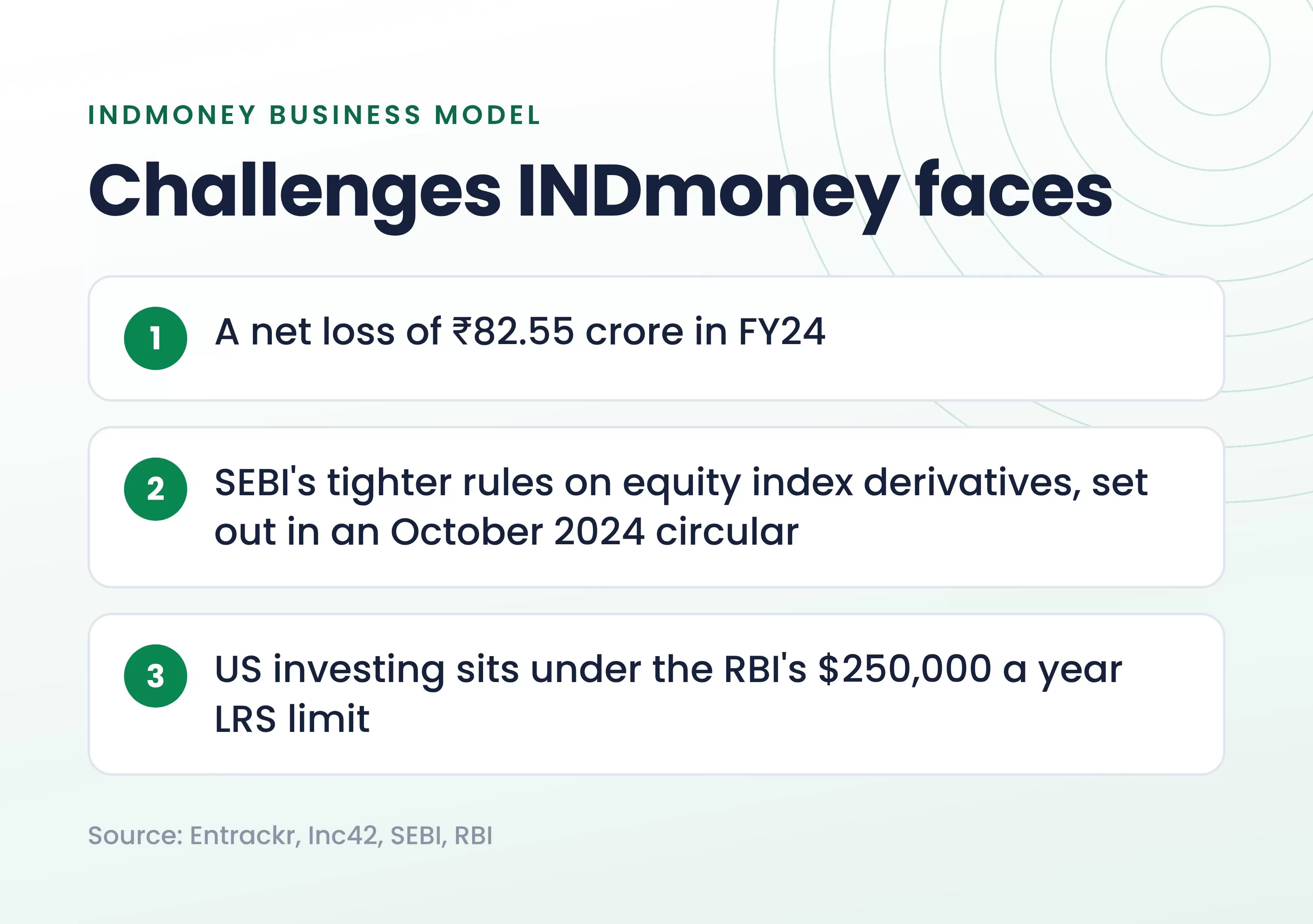
INDmoney reported a net loss of ₹82.55 crore in FY24.
SEBI tightened its rules on equity index derivatives through a circular dated October 1, 2024, which included a larger minimum contract size for index futures and options. US investing by resident Indians sits under the RBI's Liberalised Remittance Scheme, which allows up to $250,000 per financial year.
Conclusion on the INDmoney business model
INDmoney runs one app for investing in Indian and US stocks, F&O, IPOs, ETFs, NPS and direct mutual funds, with free account opening. It earns mainly from distribution services and brokerage.
FY25 total revenue, including other income, was about ₹214 crore.