Company Details
| Company Overview | |
|---|---|
| Founded | 2022 |
| Headquarters | Ernakulam (Kochi), Kerala |
| Sector | DeepTech: Robotics / Physical AI |
| Business Model | B2B and B2G |
| Team Size | Approximately 65 employees |
| Funding Stage | Pre-seed |
| Amount Raised | ₹4.3 crore (approximately $520,000) |
| Key Investors | US-based angel investors (names undisclosed) |
India does not build the robots it uses. From the machines on factory floors to the automation creeping into hospitals and warehouses, the hardware is overwhelmingly imported, which makes it expensive to buy, slow to service, and out of reach for most of the businesses that could use it.
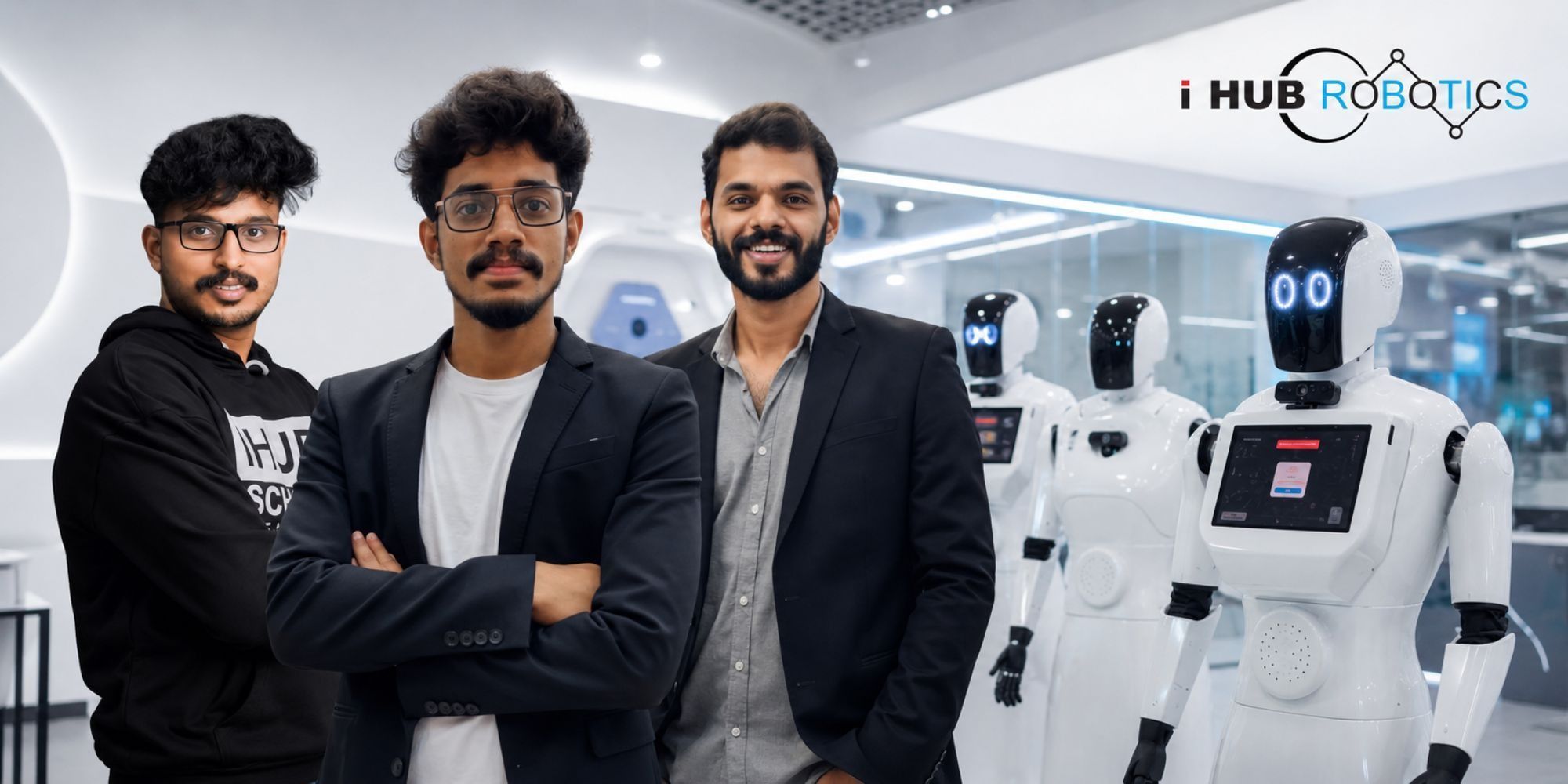
iHUB Robotics, founded in Ernakulam, Kochi, in 2022, is trying to close that gap by building humanoid robots in India from the ground up: the chassis, the embedded systems, and the AI that drives them.
The company took seven years to arrive. Athil Krishna, Akhil K Haridasan and Sarath S, three friends from Kerala, began researching humanoid robots in 2018 while studying mechatronics in Coimbatore, at a point when the Indian ecosystem could barely support the work.
They pitched it to the government anyway, submitting defence proposals in 2019. In 2020, both the Border Security Force (BSF) and the PMO wrote back, and the BSF asked to see a demonstration.
However, COVID arrived before they could build a working prototype, and the demo never happened. They regrouped in 2022 and formally launched iHUB, short for Innovation Hub for Robotics, to turn the research into something they could ship.
Building humanoids end-to-end
The first product arrived in 2024. Tara Gen-1 is a semi-humanoid service robot that can speak more than 100 languages, recognise faces and gestures, hold contextual conversations, and navigate a room on its own using Simultaneous Localisation and Mapping (SLAM).
It ships in variants, Tara Greet, Tara Learn, and Tara Care, tuned for hospitality, healthcare, education, banking and public services. Around 35 units have been deployed across three countries. A heavier machine followed: Daksha, a general-purpose industrial humanoid that lifts payloads of up to 25 kg and works at heights of eight to 10 feet.
Underneath both is what iHUB calls physical AI. Rather than the text-in, text-out logic of a large language model, its robots run on Vision-Language-Action models, which connect what the machine sees to the language it understands and to the movement it can carry out.
The company builds the whole stack itself, from fabrication and embedded systems to model fine-tuning and design, at a Kochi facility in Kalamassery, where a roughly 24,000 sq ft corridor lets robots learn tasks by repetition.
That vertical integration is the pitch, along with the pricing it allows: entry systems start around $10,000, well below imported humanoids. In January 2025, iHUB became the first Indian company selected for NVIDIA's Humanoid Robotics Program.
Also Read How Indian robotics startups are applying automation to real-world problems
Selling at home, shipping to the Gulf
iHUB sells mainly to businesses across sectors like hospitality, healthcare, education, banking, manufacturing and logistics, with a separate line aimed at defence and security. It has signed MoUs with EY Global and SAP Germany, along with several Indian IT and industrial firms, and has exported Tara Gen-1 to the UAE and Saudi Arabia, running so far on revenue from early projects and prototypes rather than heavy outside capital.
It raised Rs 4.3 crore in a pre-seed round announced in March 2025, backed by US-based angel investors, and the money is going toward what the company describes as India's largest humanoid manufacturing facility.
The near-term list is long: scale production, win research grants, and establish an industrial-humanoid R&D centre in Bengaluru, with more than 150 hires planned over two years. Alongside the hardware, the founders want to build an iHub School of Learning to train students in robotics and AI.
The larger ambition is easier to state than to execute, but it is the one they keep returning to: that India should build humanoids rather than import them.
(This story has been researched and compiled using publicly available information.)
Original Article
(Disclaimer – This post is auto-fetched from publicly available RSS feeds. Original source: Yourstory. All rights belong to the respective publisher.)