MSMEs are no longer competing only with businesses in their neighbourhood. Today, they face competition from digital-first brands, online platforms, and larger companies moving into niche markets.
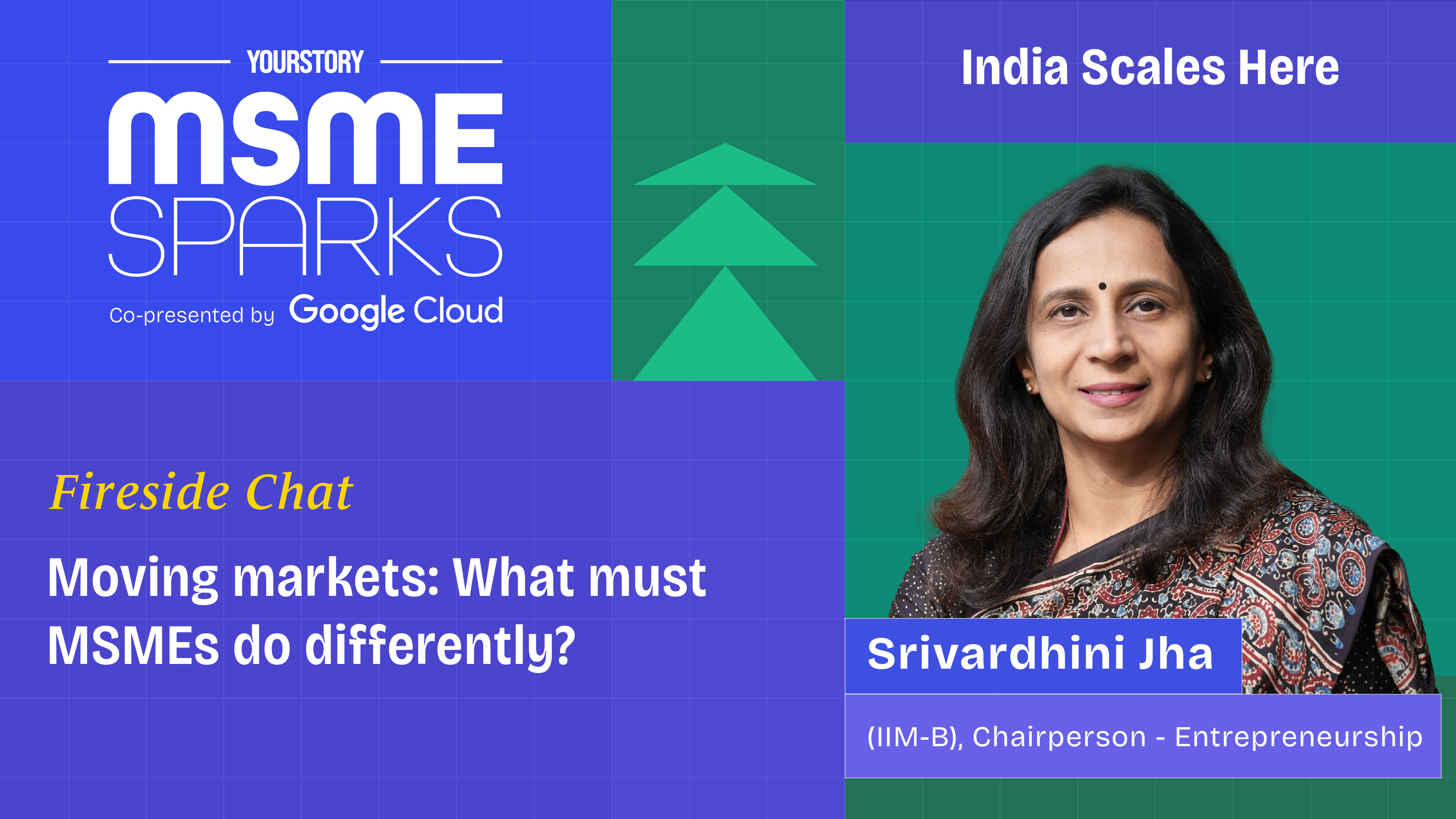
Speaking at MSME Sparks 2026, a five-day celebration that ran virtually from June 22-25 and culminated on June 26 at ITC Gardenia, Bengaluru, Srivardhini Jha, Chairperson of Entrepreneurship at IIM Bangalore, said this changing landscape requires MSMEs to rethink what truly sets them apart.
During a session titled ‘Moving Markets: What Must MSMEs Do Differently?’, in conversation with Shivani Muthanna, Senior Director of Strategic Partnerships & Content at YourStory Media, Jha said founders need to examine which parts of their traditional strengths remain relevant and which need to evolve.
One advantage, she believes, continues to endure.
“MSMEs have always relied heavily on trust as the bedrock of transactions,” she said. “That has been a major source of competitive advantage, and it will continue to matter even as competition becomes less local.”
Technology works only when the business is ready
Jha described technology adoption as essential, but cautioned founders against investing simply because everyone else is doing it.
Instead, she urged MSMEs to build enough digital fluency to assess technology vendors and understand what their businesses actually need, noting that many solutions in the market are designed for companies much larger than typical MSMEs.
“Technology on its own is not going to make a company more efficient,” she said. “You also need the right processes and people. Without standard operating procedures, technology won't help much. Employees, too, need a basic level of digital fluency.”
She made a similar point about artificial intelligence.
According to Jha, AI is only as effective as the data behind it. That data infrastructure doesn't have to be sophisticated; even something as simple as a well-maintained Excel sheet can provide a foundation.
She expects AI adoption among MSMEs to be easier than previous waves of technology, particularly for repetitive and process-driven work such as preparing Requests for Proposals (RFPs), contract management, and market research. However, she advised founders to be more cautious about using AI for creative work or end-to-end customer-facing functions.
“It's almost become a universal expectation that you need to adapt,” she said. “Experiment on a small scale, test with a small group of customers, learn from the feedback, and then expand. That approach is universally applicable.”
Also Read Waste is a resource, not a liability: Wilma Rodrigues of Saahas Zero Waste
Three priorities for the year ahead
Asked what MSMEs should focus on over the next year, Jha outlined three priorities.
The first, she said, is clarity of mission. Many businesses are built around immediate opportunities, but founders should periodically step back and ask why the business exists and what value it creates. That clarity, she said, shapes decisions around products, expansion, and positioning.
Her second recommendation was building a stronger data foundation. “You should build a strong data architecture,” she said. “It doesn't require a lot of capital. Even rudimentary tools like Excel can be enough.”
The third was adopting an entrepreneurial mindset.
Founders, she said, need to stay close to changing customer needs, understand where markets are headed over the next three or four years, and adapt before those changes become obvious.
Also Read Borrow the speed, keep the discipline: Zoho’s startup playbook for MSMEs
Growth often means letting go
Jha also addressed a common challenge in family-run businesses.
She described what she called a “king mindset”, where founders try to retain complete control by avoiding delegation, external capital, or professional leadership. While understandable, she said, that approach can limit long-term growth.
Expanding a business often requires giving up some control, whether by bringing in experienced leaders with equity incentives or by raising outside investment in exchange for building a much larger company.
Closing the session, Jha expressed optimism that technology would become increasingly accessible for MSMEs.
“Many technologies are already affordable; it's about embracing them,” she said. “Creating a basic data architecture doesn't take much. And I'm hopeful AI will make technology even more affordable for MSMEs in the years ahead.”
Edited by Teja Lele
Original Article
(Disclaimer – This post is auto-fetched from publicly available RSS feeds. Original source: Yourstory. All rights belong to the respective publisher.)