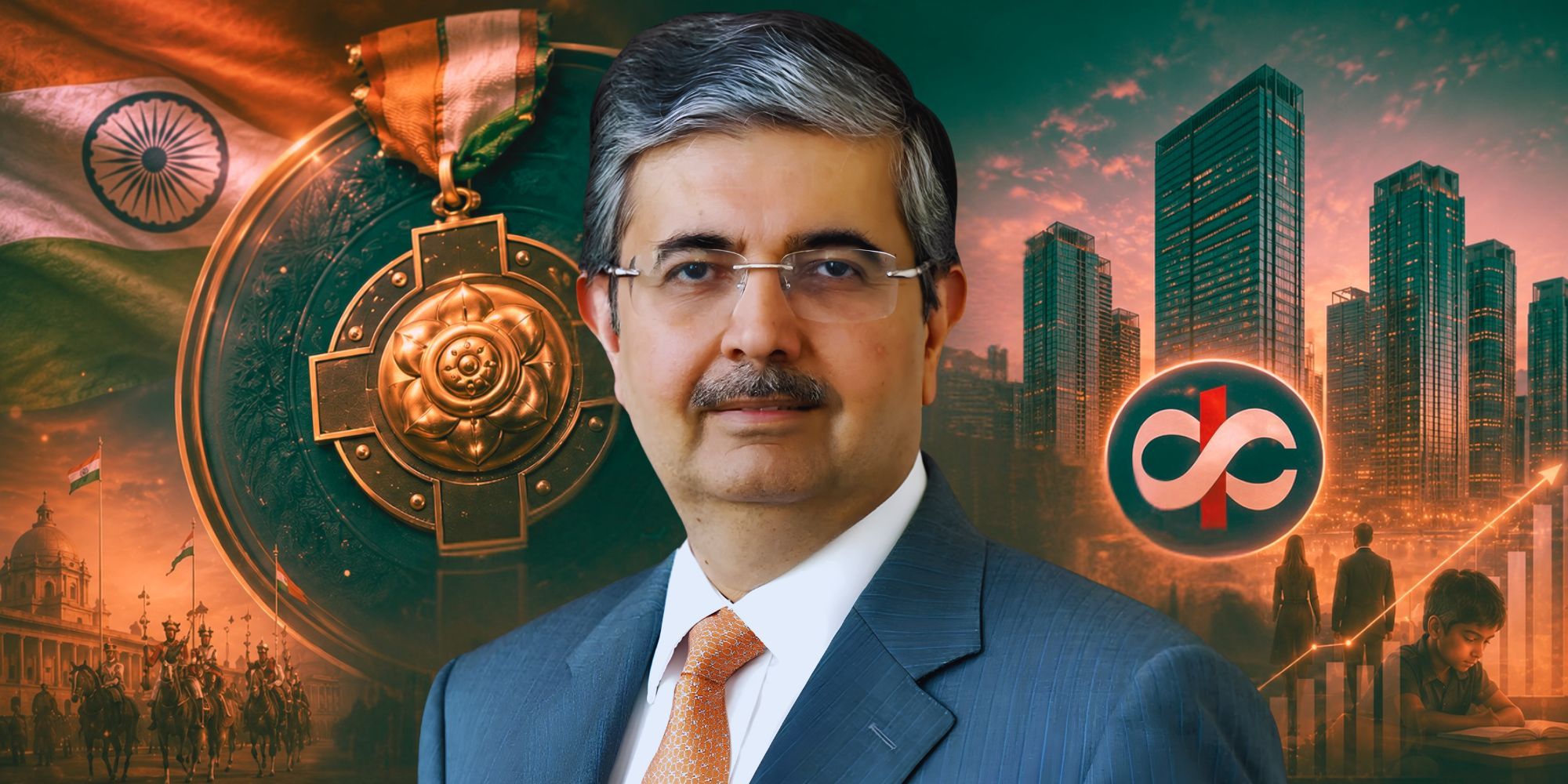
Uday Kotak, the founder of Kotak Mahindra Bank, has been named among the recipients of the Padma Bhushan for 2026, one of the rare instances of India's third highest civilian honour going to a home grown private sector banker. The Uday Kotak Padma Bhushan recognition, part of this year's Republic Day honours list, caps a four decade career in which he turned a modest finance venture into one of the country's largest private banks. For India's startup and business community, it is a reminder that patient institution building still earns the highest acknowledgement the state can offer.
The Padma Bhushan is awarded for distinguished service of a high order, and sits below the Padma Vibhushan and the Bharat Ratna in the civilian honours system. For 2026 it has been conferred on 13 people across fields such as art, public affairs, medicine and sport. Kotak features in the trade and industry category, among a small group of business figures recognised this year. The honour arrives at a point when he has already stepped back from the daily running of the bank he built.
From bill discounting to a banking licence
Kotak's story began in 1985, when, as a 26 year old, he started what was then Kotak Capital Management Finance Ltd with a small pool of money borrowed from family and friends. The business began with bill discounting, an unglamorous corner of finance, at a time when private Indian banks barely existed. Over the following years he widened it into stockbroking, investment banking, car finance, insurance and mutual funds.
The turning point came in March 2003, when Kotak Mahindra Finance became the first non-banking financial company in India to be converted into a full fledged bank, receiving a banking licence from the Reserve Bank of India. From there the group grew into a diversified financial services conglomerate, and Kotak Mahindra Bank is today among India's largest private sector banks by market value. A defining moment in that climb was the acquisition of ING Vysya Bank in a deal worth about 2.4 billion dollars, announced in late 2014 and completed in 2015, which deepened the bank's branch network and its presence in the south.
On 1 September 2023, Kotak stepped down as managing director and chief executive officer, moving to the role of founder and non-executive director. The handover was watched closely, as it was the first time the bank would operate without its founder at the operational helm.
The scale behind the Uday Kotak Padma Bhushan
The numbers give a sense of what has been built over close to four decades. Kotak Mahindra Group reports revenue of around 2.8 billion dollars and employs more than 30,000 people. Kotak's personal wealth, as estimated by Forbes in October 2024, stood at about Rs 1.2 lakh crore, or roughly 14.1 billion dollars, placing him 18th on its list of India's hundred richest. Beyond the bank, he has taken on public roles, chairing a Securities and Exchange Board of India committee on corporate governance in 2017 and stepping in as non-executive chairman of the IL&FS board in 2018 to help steer the troubled lender through its crisis. In February 2026 he received a special jury award at an EY entrepreneurship ceremony for his contribution to Indian banking and financial services.
His description of the group's approach has stayed consistent over the years, summed up in the phrase concentrated India, diversified financial services, and a stated belief that the real measure of a business is sustainable value creation rather than short term gains.
How did a small finance firm grow into a full bank
For readers outside finance, the leap from a finance company to a bank can look like a technicality, but it is a meaningful one. A non-banking financial company, or NBFC, can lend and offer many financial products, but it cannot accept the everyday savings and current account deposits that a bank can.
A banking licence changes that. It lets an institution gather low cost public deposits, which become the raw material for lending at scale, and brings it under the fuller supervision of the Reserve Bank of India. When Kotak Mahindra Finance crossed that line in 2003, it became the first Indian company to make the journey from NBFC to bank, opening the door to the deposit base that funded its later growth.
With the founder now in a non-executive seat and a professional leadership team running daily operations, the question turns to how the bank sustains momentum in an increasingly digital and competitive market. Kotak's son, Jay Kotak, is among the next generation driving the group's digital banking push. The Padma Bhushan, in that light, reads less as a full stop and more as a marker of a career that helped shape modern Indian private banking, and a template the next wave of financial entrepreneurs will study as they build the institutions of the coming decades.
Original Article
(Disclaimer – This post is auto-fetched from publicly available RSS feeds. Original source: Yourstory. All rights belong to the respective publisher.)