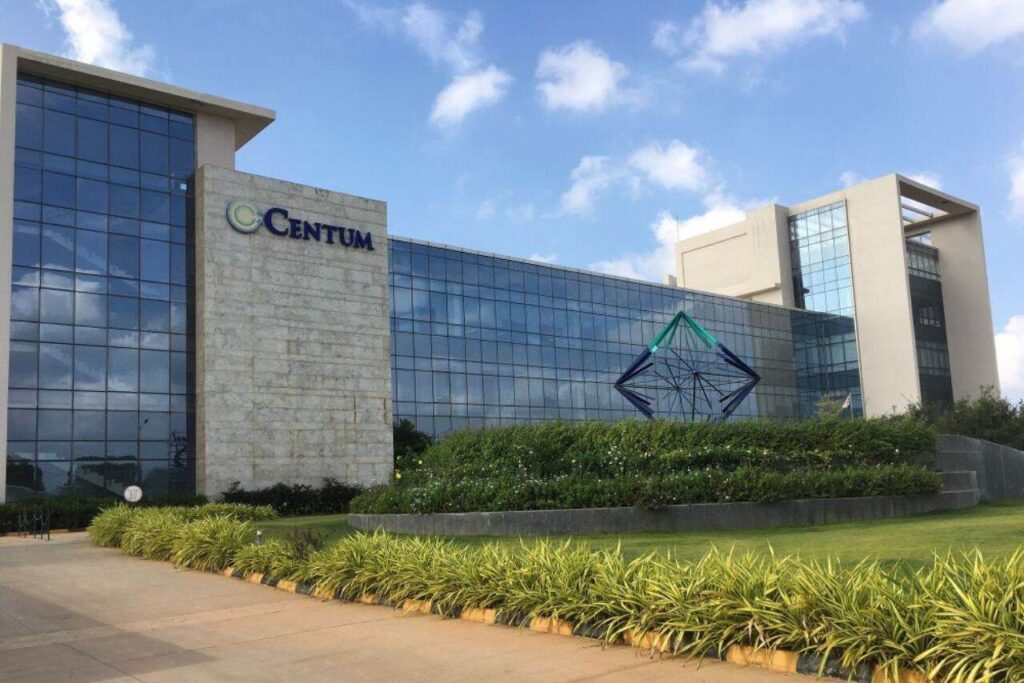
Synopsis: Centum Electronics Limited is witnessing strong growth across defence and semiconductor electronics businesses as it sharpens focus on India’s ESDM opportunity. While semiconductor EMS is driving scale and customer diversification, higher-margin defence BTS programs, radar systems and strategic aerospace opportunities are emerging as the company’s key long-term profitability drivers.
India’s electronics manufacturing opportunity is expanding rapidly, driven by rising defence spending, semiconductor supply-chain diversification and increasing localisation across strategic sectors. Companies with strong design, manufacturing and systems integration capabilities are emerging as key beneficiaries of this trend.
In this backdrop, Centum Electronics Limited is strengthening its presence across defence electronics, aerospace systems and semiconductor equipment manufacturing while focusing on scaling its India-based ESDM platform for long-term growth.
With a market cap of Rs 4,800 crore, the shares of Centum Electronics Ltd are trading at Rs 3,237 and are trading at a PE of 47 compared to their industry’s PE of 32. The shares have given a return of more than 700% in the last 5 years.
A Landmark Year For Centum
For FY26, Centum Electronics Limited saw a pivotal year where the company focused on leveraging the potential of India’s ESDM market even as it exited its underperforming international operations. For management, FY26 was all about “strategic moves, aggressive expansion and solid operations execution” in areas like defence, aerospace, semiconductor equipment and industrial electronics.
For the company, standalone operations became the key driver of growth during the year. In fact, sales from standalone business increased by about 25% YoY to ₹973 crore, whereas standalone EBITDA rose 28% YoY to ₹121 crore. On the standalone front, EBITDA margins were at 12.42%, with profits before exceptional items & taxes surging 63% YoY to ₹100 crore.
However, what was perhaps equally significant was the strategic realignment. The company decided to discontinue operations in Canada and also began the process of restructuring and selling off assets in France. This is because the two businesses had been weighing down on both consolidated margins and management time for a few years now.
Time and again, the management made it clear that the company’s focus going forward would be on scaling the India platform in BTS/EMS businesses. This raises the key investor question: will the next phase of growth be driven more by semiconductor-linked EMS opportunities or by the rapidly scaling defence and aerospace BTS business?
Defence Drives BTS Growth
The biggest strength in terms of growth momentum in FY26 was exhibited by the BTS business, which recorded about 37% y-o-y growth. The growth driver was execution excellence witnessed in radar systems, space-based payloads, missile systems, and strategic aerospace products.
Centum reported an approximately ₹1,645 crore standalone order book position, indicating 23% y-o-y growth. A considerable portion of the backlog pertained to orders received for strategic defence and aerospace projects, enabling the company to have multi-year execution visibility.
A key highlight of FY26 for Centum was the receipt of a marquee AESA radar project from HAL for its UHM platform. The total addressable market in this regard is estimated at more than ₹570 crore, with the first phase alone estimated to amount to ₹66-67 crores and be completed in the next two years, while the second phase extends till FY30/FY31.
The management stated that the above project is a turnkey project where Centum would provide development, qualification, certification, and airborne integration support to HAL for the radar system. It reflects Centum’s shift up the value chain from supplying components to systems-level integration.
Radar Programs Expand Pipeline
Additionally, it has bagged a radar system order for its satellite and space debris tracking application which has been valued at around ₹30 crore. The management highlighted this achievement as being significant for Centum since this is where it made entry into long-range high-power radar systems for strategic surveillance and space-based applications.
Moreover, the firm also indicated that there are opportunities even outside radar systems in electronic warfare, aerospace payload and testing systems, among others. According to the management, it is the expertise in the domain and the ability to create IP indigenously which have helped the company participate in these more valuable projects.
Furthermore, Centum indicated that the majority of defence projects take a lot of time to execute, with some spanning several years. This results in improved visibility for the order book. According to the management, the BTS order book has grown over 2.3x in the past three years at a CAGR of around 32%.
Semiconductor EMS Gains Scale
As much as defence currently takes up most of BTS’ activities, the semiconductor equipment business has proven to be the fastest-growing area in EMS. The company’s leadership reiterated that they have seen good progress in semiconductor equipment orders from their global clients and customer engagement due to the diversification of global supply chains to India.
The EMS business posted around 21% revenue growth compared to last year’s figure in FY26, driven by growth in semiconductor equipment, industrial electronics, electrification, and defence exports.
The semiconductor equipment business is being driven by a large order from a global customer currently. However, the company has been in talks with other global semiconductor OEMs. The company believes that they are on track for the semiconductor opportunities in line with their expectations.
It is also true that the global trend towards manufacturing semiconductors in India provides a positive tailwind for this industry. As per the company’s management, there are several global customers who were sourcing electronic goods outside India; however, they are now looking at India as a manufacturing hub.
Defence Margins Outpace EMS
Profitability is one of the key differences between semiconductor EMS and defence BTS, where management indicated that while BTS would give EBITDA margins of about 20% or above, EMS’ margins would typically be between 9-11%, since EMS is a relatively pure contract manufacturing cost-plus business.
Defence & Aerospace operations look more attractive from a profit standpoint as well, even though EMS represents the largest portion of revenues. Operating leverage is better with BTS, and this line of business adds more value for Centum.
Regarding the standalone EBITDA margin of 12.42% for FY26, it was lower than the 13-15% medium-term target due to the product mix in EMS. As per management, some higher-margin programmes which were supposed to come in FY26 were pushed back to FY27 and would positively impact profitability next year.
In terms of medium-term growth outlook, Centum maintained its 25-30% growth and 13-15% EBITDA margin target on a combined basis. Management sees the leverage, increased contribution from BTS, and improved execution helping boost margins in the next 2-3 years.
Global Defence Tailwinds Rise
The management has consistently reiterated how the defence environment is highly supportive for Centum, both globally and at home. It sees opportunities emerging as a result of the “Make in India” drive as well as higher military budget spends in times of rising geopolitical tensions in radar, electronic warfare, and aerospace segments.
Increasing opportunities were seen both in India as well as overseas, with Europe and the Middle East being particular regions where increased government defence spending has been observed during periods of geopolitical tension.
Its competitive advantage comes from its strength in designing and IP rights. The management made it clear that Centum was developing many systems which are being designed for the first time in India, including space-based electronic warfare payloads, hyperspectral imagery systems, and radar solutions.
This sets Centum apart from the typical EMS player. Rather than just building products, Centum is now becoming more of a system engineering and design company within the Indian strategic electronics space.
EMS Builds Long-Term Scale
Even with better margins in BTS, the management emphasized that EMS is still an essential part of the company’s growth going forward. EMS generates scale, diversified customers, and revenue annuity.
In contrast to BTS, which can take up to two to three years for implementation, EMS can be implemented over six to nine months. This translates to faster conversion into revenues and higher operational utilisation rates.
In the fiscal year 2026, more than 80 new product launches have been achieved. This has helped in customer ramping activities and winning new business. Moreover, Centum increased its capacity by adding manufacturing lines and implementing automation and systems integration.
The management expects that future growth in EMS will continue due to supply chain diversification to India. With global OEMs looking for trustworthy partners for production in India, Centum will benefit even more.
Defence or Semiconductor?
The solution seems increasingly to be a combination of both, though for different reasons. While semiconductor EMS will still probably be the greater growth opportunity, in terms of revenues and customer reach, the structural headwinds from semiconductor supply chain diversification and electronics localisation to India will persist.
However, the defence and aerospace BTS business is likely to generate more value from a profitability and strategic standpoint. The much better margins, large order flow visibility and increasing system-level play make the BTS business inherently more appealing.
Management themselves have said that the BTS business has the potential to outgrow the EMS business in some years owing to the strength of the program pipeline. Nevertheless, EMS will form the base for future growth.
Overall, Centum Electronics seems to be morphing from an electronics manufacturing firm to an Indian ESDM platform with capabilities on both the semiconductor manufacturing as well as the defence electronics front.
Disclaimer: The views and investment tips expressed by investment experts/broking houses/rating agencies on tradebrains.in are their own, and not that of the website or its management. Investing in equities poses a risk of financial losses. Investors must therefore exercise due caution while investing or trading in stocks. Trade Brains Technologies Private Limited or the author are not liable for any losses caused as a result of the decision based on this article. Please consult your investment advisor before investing.
The post Centum Electronics: Semiconductor or Defence – Which Segment Will Drive Growth? appeared first on Trade Brains.
Original Article
(Disclaimer – This post is auto-fetched from publicly available RSS feeds. Original source: Tradebrains. All rights belong to the respective publisher.)