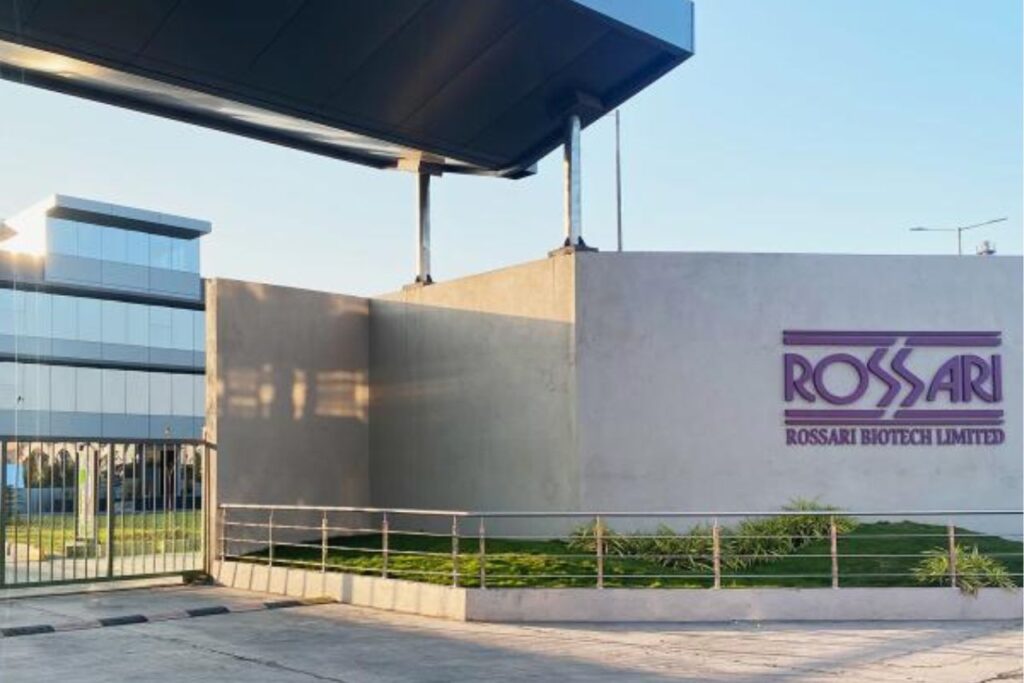
Synopsis: Rossari Biotech Limited delivered 15% revenue growth in FY26, supported by broad-based segment growth, 11% export growth, and near-full capacity utilisation. With pharma expected to deliver the highest margins, agro and oil & gas emerging as key growth drivers, and global expansion accelerating, Rossari appears to be building multiple engines for its next phase of growth.
After reporting its highest-ever quarterly revenue and EBITDA and closing FY26 with ₹2,396.4 crore in revenue and ₹286 crore EBITDA, Rossari Biotech Limited is entering FY27 with stronger manufacturing capabilities, rising export momentum, and a sharper focus on higher-margin specialty segments.
From expanding ethoxylation capacity to 66,000 MTPA to building new opportunities in pharma, agro, oil & gas, and international markets, Rossari is gradually shifting from pure scale-driven growth toward a more diversified, margin-led specialty chemicals strategy.
A Strong FY26 Sets the Stage
Financial Year 2026 saw yet another year of strong execution for Rossari Biotech Limited, where management mentioned that FY26 had been another year of good execution and capability building.
At the end of the year, the company reported its best performance ever in terms of revenues, with the quarter reporting the best revenue and EBITDA numbers seen before. Overall, for the year, the revenue from operations stood at ₹2,396.4 crore, which represented 15% year-on-year growth, whereas EBITDA grew to ₹286 crore, representing an 8% year-on-year increase.
Management pointed out that such growth had been mainly attributable to volume and had been aided by healthy traction seen across various businesses along with consistent progress made in international markets despite uncertainties associated with the raw materials, supply chains, and geopolitical situations in the Middle East region.
All Three Core Segments Delivered
The positive aspect of the FY26 for Rossari was the diversity of the growth seen across its three main business divisions. In Q4, the HPPC division saw 18% growth, while the Textile Specialty Chemicals division grew by 20%. Finally, the AHN business witnessed 14% growth.
This achievement is largely due to management’s focus on deeper customer relationships, product innovation, increased market penetration, and effective implementation of strategies. The remarkable thing about this growth is that none of the business segments is entirely responsible for generating growth. Instead, the diversified presence of the company across all these business lines helped it deal with the sluggish domestic demand environment and expand its footprint.
According to management, the margins in all of these businesses were consistent with those of the overall company. However, AHN currently has the highest gross margins in comparison to other segments.
Exports Are Becoming a Bigger Growth Driver
Despite some subdued demand in certain periods of the year, the export segment for Rossari continued to build traction. According to management estimates, exports increased 11% in FY26, driven by an improvement in wallet share amongst existing customers and better market penetration in geographies including Latin America, Europe, South East Asia, and Africa.
Export momentum has become very important for Rossari, which is seeking to enhance its earnings diversification profile. The other area that the management believes has the potential to perform well is the international binder business for Rossari, which offers access to new customers and high-end applications.
The textile segment will continue to see strong export performance driven by new market developments in Bangladesh, South East Asia, Turkey, and Brazil. In agro and personal care segments as well, the company is looking to capitalise on new export opportunities in North America while building a presence in Latin America.
Capacity Expansion Supports Future Scale
Further, Rossari’s next growth cycle will also be supported by new manufacturing capacity. In FY26, its subsidiary Unitop added more capacity for ethoxylation at its Dahej plant. This brings the installed ethoxylation capacity to 66,000 metric tonnes annually.
According to management, this helps improve supply security and enables Rossari to cater to increasing demand from customers. Importantly, capacity utilisation has been very strong, with the current level between 90% and 100%. According to the management, the plants operate almost all day and night, almost throughout the year.
Further, Rossari can also expect additional ethylene oxide capacity coming in from Reliance by Q3 FY27. Order pipelines continue to be robust across agro, personal care, and industrial chemical segments. Thus, it suggests that this capacity addition will not remain underutilised.
Pharma Could Become Rossari’s Highest-Margin Business
Of all the issues that were covered during the call, one of the most interesting ones was definitely Rossari’s expansion into the pharma business. As was highlighted by the management during the presentation, it was noted that upon scaling up its pharma business operations, the pharma division should deliver the highest gross margins compared to all other business lines of Rossari.
The management also mentioned the initial plan of developing the company’s presence in surfactant chemistry and polyethylene glycols, including different kinds of molecules like PEG 400, 600, 1000, 2000, 3350, 4000, 6000, 10000 and more. At the same time, the management indicated that Rossari is planning to develop the pharma coatings, gel-forming products, esters, and even personal care products. Finally, it should be mentioned that a new production line for the pharma sector was planned to be built at the expense of the capital expenditures of FY27.
Agro, Oil and Gas Add Another Layer of Opportunity
Although pharma may be the segment where the company will look at margins for driving growth, agro and oil and gas seem to be immediate areas for growth. The management had clearly highlighted agro, oil and gas, and pharma as the top three segments that would drive the FY27 performance.
In HPPC, it seems that agro and oil and gas have higher margins compared to many other products. On top of the strong presence in the agro segment, Rossari is also gaining from the expansion of its export markets in Latin America and North America. However, the pipeline of new projects built over the past one year would help the company grow in FY27.
Although there was an acknowledgement from the management about the impact of weather on demand in agriculture due to El Niño effects, it seems that current order visibility is quite robust.
Profitability Is Being Protected Through Portfolio Optimization
Although there is significant top-line momentum, EBITDA margins in FY26 came down slightly to 11.9%, from 12.7% in FY25. During Q4, EBITDA margins declined to 11.3% against 12% last year. According to management, the margins were affected due to the increase in raw material prices by 25%-30% during the month of March along with old order shipments at the same price level.
However, for Rossari, the bulk of these price hikes have been passed on in April and May. Furthermore, management laid out a clear plan to enhance margins. Rossari intends to dispose of some low-margin consumer-based businesses, which currently account for revenue generation of ₹250 crore to ₹260 crore but are weighing on its margins.
Without these businesses, Rossari’s B2B business alone generated EBITDA margins of 14% in FY26. In addition, according to management, going forward, as it scales up in high-margin segments like pharma, food, cosmetics, and animal health, the margins are expected to improve in the coming two to three years.
Can Pharma, Agro and Exports Power the Next Growth Phase?
Based on the commentary from the management, it seems that the answer is yes. Rossari enters FY27 with new capacities, high utilisation rates, growing exports, and several growth engines being developed.
It looks like management expects at least the same level of growth as last year, which means that Rossari should have at least a growth rate of about 15% in FY27, despite challenging global conditions. The EBITDA margins should stay at the level of about 12% to 13%, although we can expect an improvement driven by new business areas that will start generating revenues in H2 of the year.
Rossari is also focused on capital allocation discipline with reduced debts, divestments of non-core business units, and limited spending on capital expenditure in FY27 of ₹50 crore to ₹75 crore. Given that Rossari is developing its exports in various continents, pharmaceuticals should bring the highest margins, agro and oil & gas businesses are picking up, and there are almost fully utilised capacities, it looks like the company is positioning itself well for the next stage of growth.
Disclaimer: The views and investment tips expressed by investment experts/broking houses/rating agencies on tradebrains.in are their own, and not that of the website or its management. Investing in equities poses a risk of financial losses. Investors must therefore exercise due caution while investing or trading in stocks. Trade Brains Technologies Private Limited or the author are not liable for any losses caused as a result of the decision based on this article. Please consult your investment advisor before investing.
The post Rossari Biotech: Can Pharma, Agro and Global Exports Fuel Its Next Growth Cycle? appeared first on Trade Brains.
Original Article
(Disclaimer – This post is auto-fetched from publicly available RSS feeds. Original source: Tradebrains. All rights belong to the respective publisher.)