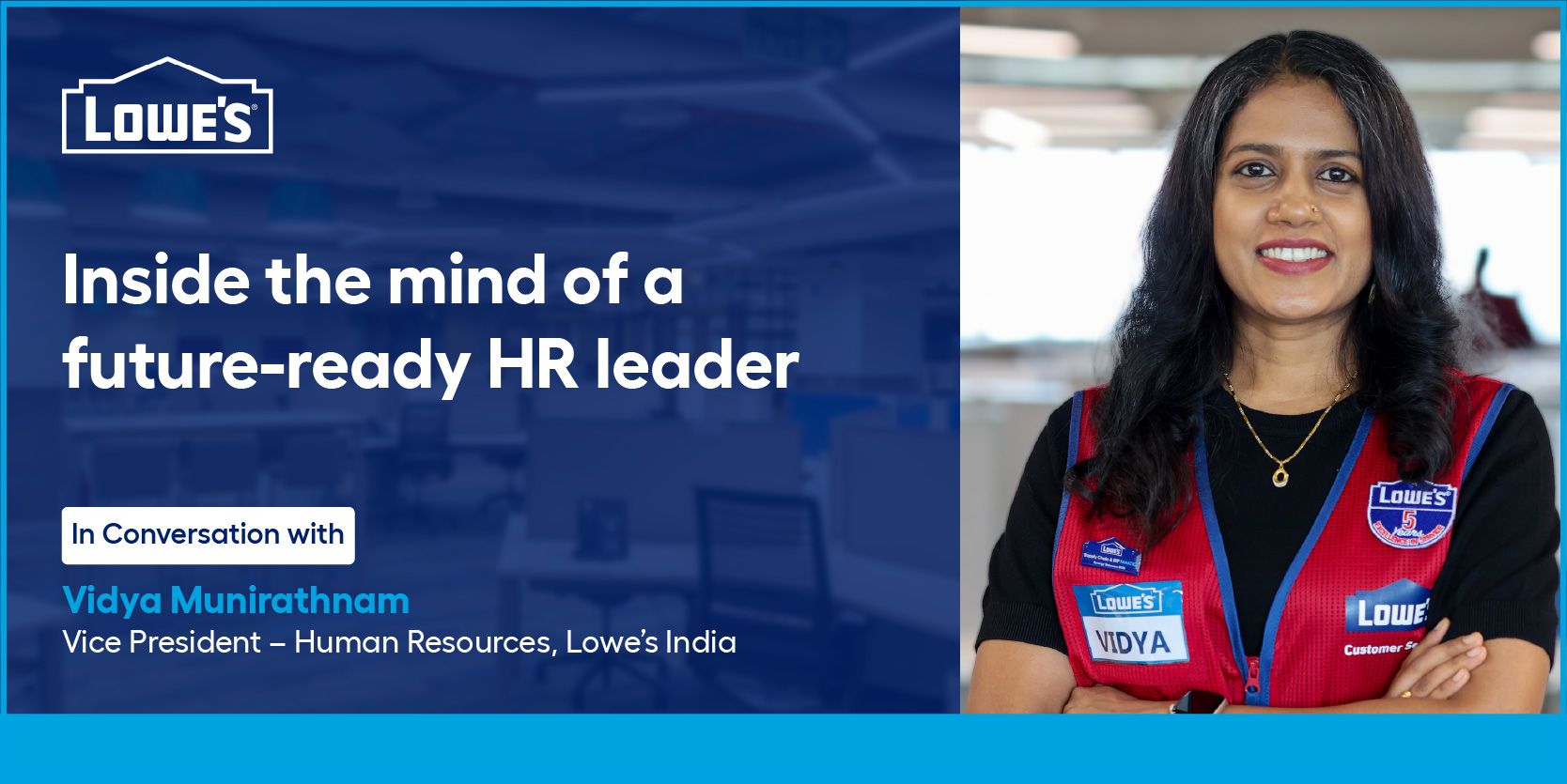
For Vidya Munirathnam, VP – Human Resources at Lowe’s India, the evolving role of HR is not just about adapting to change it’s about shaping it. Her leadership is rooted in building agile, future ready talent while staying deeply committed to trust, fairness, and associate experience.
From driving internal mobility to building new capabilities across teams, she focuses on creating an environment where people can grow alongside the business. Her approach balances strategic priorities with empathy, ensuring transformation is both effective and inclusive. By rethinking skill development, strengthening capabilities, and anchoring decisions in transparency and values, she is helping shape a more dynamic and forward looking HR function.
In this conversation, Vidya shares how she navigates complex decisions, builds resilient teams, and prepares organizations for a future where human potential and technology evolve together.
YourStory (YS): Before the meetings begin and the dashboards open, what grounds you at the start of your day as a people leader?
Vidya Munirathnam (VM): For me, every day begins with a simple but powerful question: what is the business problem we need to solve today, and how can HR enable that?
Business challenges are no longer static; they evolve constantly. What worked yesterday may not apply today. That’s why I’ve moved away from a purely policy led mindset. While policies provide direction, they cannot be the only lens for the present or the future.
I anchor my thinking in being both democratic and dynamic. Democratic, means decisions are grounded in clear, transparent principles that apply fairly across the organization. Dynamic, in the way we remain agile enough to adapt those decisions based on context.
It’s about creating a framework with a few core anchors that guide decision making, while staying open to recalibrating when conditions change. Equally important is ensuring people understand the ‘why’ behind decisions. Clarity and objectivity build trust and empower teams.
At the end of the day, HR’s role is not just to govern, but to enable the business to achieve its goals thoughtfully, consistently, and with agility.
YS: HR leadership today involves balancing strategy with deeply human conversations. In the middle of a strategy heavy day, what reminds you why you choose this profession?
VM: There are days when the work feels deeply strategic, but it’s the human moments that stay with you.
In the middle of those days, what brings me back is seeing people grow. Recently, an employee I didn’t even know wrote to share that they’d moved into a new role through our internal mobility program. That moment of someone feeling seen, supported, and able to grow within the organization stays with you.
It’s a reminder that at its heart, HR is about people and possibilities. And when people grow within the system, they don’t just build careers they begin to truly believe they belong.
YS: When faced with difficult talent decisions, whether around hiring, performance, or organizational change, what internal compass guides you most: data, instinct, experience, or values?
VM: For me, it comes down to a combination of all these but if I had to prioritize, it would be values first, followed by data, and then experience.
Over time, I’ve consciously moved away from relying heavily on instinct. While instinct has its place in business, talent decisions require a higher degree of objectivity and fairness.
Values act as the non negotiable foundation, ensuring every decision is principled and consistent. Data brings objectivity and helps reduce bias. Experience plays a role, but I’ve also learned that in today’s environment, people and outcomes can still surprise you.
One guiding question I always ask myself is: in the given scenario, would I apply this same decision consistently to anyone in the organization, including myself? If the answer is yes, it’s usually the right path. If not, it’s a signal to pause and re-evaluate.
YS: In a world where skills are evolving faster than degrees, how is Lowe’s India rethinking hiring, learning, and internal mobility?
VM: The shift is clear skills are evolving faster than traditional talent pipelines can keep up with. As an organization, we recognize that we cannot rely solely on external hiring to bridge that gap. We are evolving our approach to hiring by placing greater emphasis on potential, learning agility, and adaptability.
At the same time, we are building a strong, future ready learning ecosystem anchored in cross skilling, upskilling, and internal mobility. We believe learning is most powerful when it happens in the flow of work where associates learn by doing, solving real problems, and applying new skills in real time.
As AI becomes integral to how work gets done, our focus is on fostering a growth mindset encouraging associates to stay curious, experiment, and confidently integrate these tools into their everyday work. Enabling easy access to relevant, high impact learning opportunities anytime, anywhere remains a key priority for us.
Internal mobility is especially close to my heart. As skills evolve rapidly, organizations must take thoughtful bets on their own talent. If we value potential in external hiring, we should be even more intentional about recognizing and unlocking it internally.
It’s no longer about perfect skill matches it’s about building the right capabilities, mindset, and ability to adapt. At the same time, balance remains important. While we invest deeply in developing our internal talent, we also bring in fresh perspectives to continue evolving as an organization.
At the heart of it is a simple belief: building future ready talent starts with intentionally nurturing, developing, and continuously enabling our people to learn and grow every day.
YS: AI and automation are reshaping workplaces everywhere. How do you see the role of HR evolving in an AI enabled organization, and which human capabilities will become even more valuable in this new environment?
VM: As AI becomes more embedded in how we work, the role of HR is evolving from managing processes to shaping capabilities and mindsets.
As AI enhances efficiency and decision making, it also amplifies the importance of distinctly human skills. Capabilities such as critical thinking, emotional intelligence, and influencing are no longer optional; they are becoming core to effective leadership.
In many ways, AI handles the ‘what’ and ‘how’, but humans must focus on the ‘why’, ‘should we’, and ‘what next’.
HR’s role, therefore, is to help build an organization where people can think critically in complex situations, navigate ambiguity with confidence, influence and collaborate across boundaries, and bring empathy into decision making.
The future of work will not be defined by humans versus AI but by humans + AI.
YS: What qualities are becoming essential for the next generation of leaders at Lowe’s India, and how are you nurturing those capabilities?
VM: The next generation of leaders will need to operate very differently.
First, there must be a strong openness to learning and experimenting. The pace of change demands continuous reinvention. Second, leaders need enterprise thinking: the ability to look beyond their function and understand the broader impact of decisions.
The ability to integrate technology with business problem solving is vital not as technologists, but as leaders who ask how technology can simplify and enhance outcomes.
The most effective leaders will put the business problem at the center, collaborate across functions, design solutions that are intuitive and easy to adopt, and think in systems, not silos.
Ultimately, leadership will be defined by the ability to simplify complexity and create solutions people can actually use and embrace.
YS: At the end of a long day, what gives you the greatest sense of satisfaction as a people leader?
VM: When teams come prepared with well considered perspectives, anticipating challenges, incorporating feedback, and arriving at balanced decisions, it’s a sign that they are empowered. That’s when leadership begins to scale beyond the individual.
I often reflect on Viktor Frankl’s words: “Between stimulus and response, there is a space. In that space is our power to choose our response.” Leadership, in many ways, is about helping teams operate within that space, pausing, thinking critically, and choosing thoughtful responses over reactive ones.
When teams challenge each other constructively, think beyond the obvious, and take ownership, it’s deeply fulfilling. That’s when HR has done its job, building not just capability, but confidence and judgment at scale.
Original Article
(Disclaimer – This post is auto-fetched from publicly available RSS feeds. Original source: Yourstory. All rights belong to the respective publisher.)