AI coding assistants can now generate code, documentation, and tests in minutes. But faster code doesn’t always mean faster product delivery.
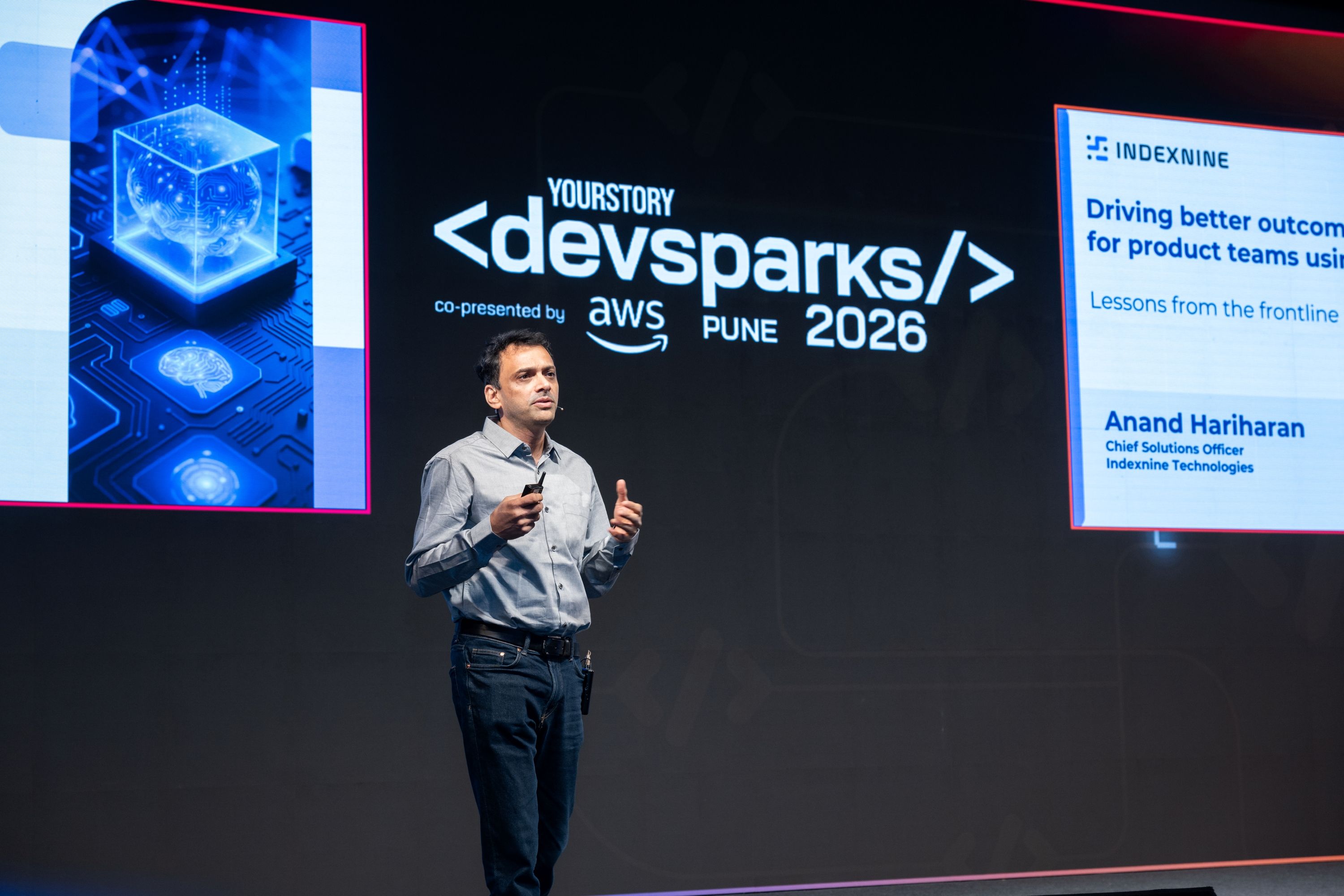
At DevSparks 2026 in Pune, a nationwide movement by YourStory focused on empowering India’s developer ecosystem with next-generation technologies. One session explored a growing paradox in AI-assisted software development: developers are moving faster, but product teams aren’t.
In a lightning talk titled ‘Driving Better Outcomes for Product Teams with AI: Lessons from the Frontline’,Anand Hariharan, Co-founder and Chief Solutioning Officer at Indexnine Technologies, unpacked why the productivity gains from AI tools often fail to translate into faster outcomes at the team level.
Drawing on Indexnine’s experience building more than 100 SaaS products, Hariharan discussed that the real bottleneck emerges when AI-generated code enters collaborative development workflows.
The ‘verification tax’ slowing teams down
AI tools can dramatically accelerate individual coding tasks. But once code moves into team workflows, it still needs to pass through multiple review layers.
Senior engineers must verify whether AI-generated code aligns with system architecture, infrastructure constraints, and long-term scalability. That extra scrutiny can offset the speed gained from code generation.
Hariharan described this hidden cost as a “verification tax”.
Even when AI produces functional code, teams must confirm that the implementation fits the broader architecture of the platform before it can move into production.
Why context is the missing ingredient
According to Hariharan, the core issue lies in the lack of context provided to AI tools.
Most developers prompt coding assistants with the feature they want to build. But those prompts rarely include deeper architectural decisions that shape how the system should behave. Without that context, AI systems generate code based on the immediate task – not the broader design of the platform.
Hariharan illustrated this with an example from backend development. A developer might ask an AI assistant to generate an endpoint that creates a user activity report. The AI may produce a synchronous implementation that works technically, but fails when deployed in a production environment handling millions of records.
Without context, AI output often requires significant revision before it fits within a real product environment, Hariharan said.
Writing the blueprint first
To address this challenge, Hariharan recommended spec-driven development, an approach that prioritizes defining system behavior before generating code.
Instead of writing code first and documenting it later, teams create structured specifications describing how a feature should work. These specifications outline the API contract, the expected workflows, and interactions between different components.
Hariharan described the approach simply: write the blueprint before you build.
Providing AI tools with structured specifications allows engineering teams to guide code generation toward outputs that align with the intended architecture.
Context engineering and living documentation
Specifications alone, however, are not enough. Teams must also ensure that AI tools have access to the architectural context of the system.
Hariharan referred to this practice as context engineering. Context includes the design decisions that shape a platform: framework choices, infrastructure patterns, integrations, and architectural constraints.
Rather than storing this knowledge only in external documentation tools, Hariharan suggested maintaining concise markdown files within repositories. These files capture product requirements, system guidelines, and architectural decisions that AI coding agents can reference during development.
He described context as the “living documentation of your domain knowledge”.
When this information is embedded within the development environment, AI-generated code is more likely to align with the system architecture, reducing the burden on senior engineers.
From individual productivity to team outcomes
For engineering teams adopting AI-assisted development, the challenge is no longer just generating code faster. The real goal is ensuring that AI-generated output integrates smoothly with the broader system architecture.
Hariharan suggested treating specifications and architectural context as living artifacts that evolve alongside the codebase. Maintaining these shared references ensures that AI tools continue producing solutions that fit the platform’s design patterns.
Without that shared context, he warned, AI may speed up individual developers while creating more verification work for the rest of the team.
The takeaway from the session was clear: AI can dramatically increase developer productivity, but only if teams rethink how software is designed, documented, and built.
Original Article
(Disclaimer – This post is auto-fetched from publicly available RSS feeds. Original source: Yourstory. All rights belong to the respective publisher.)