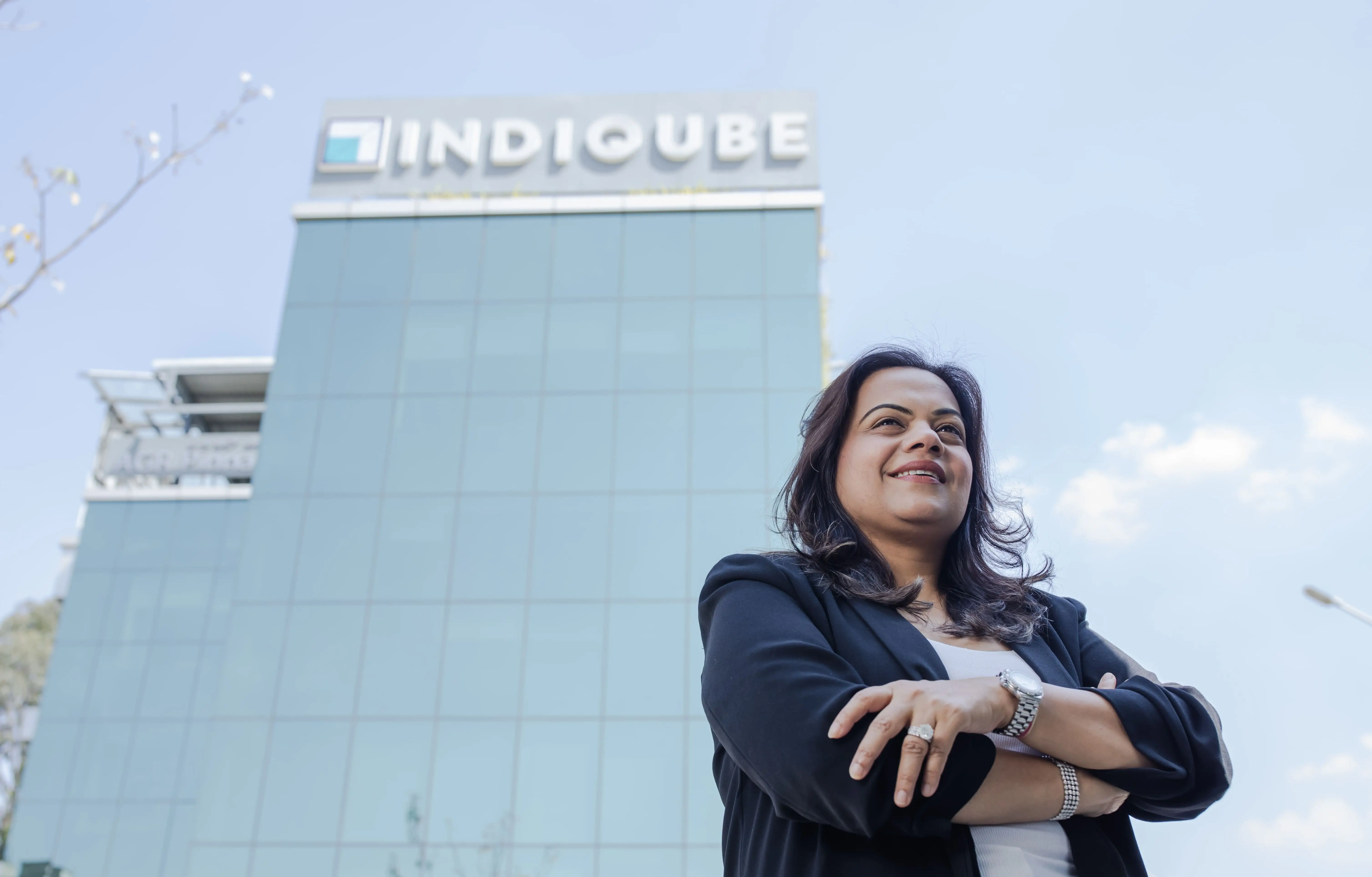
When IndiQube rang the opening bell at the National Stock Exchange (NSE) on July 30, 2025, it marked a new chapter in the company’s decade-long journey of shaping India’s workspace ecosystem. For Co-founder Meghna Agarwal, the moment carried a mix of pride, gratitude, and renewed responsibility.
“It felt like a validation of the journey, but also a reminder that the market has put its trust in us, and now we have to deliver, quarter after quarter,” Meghna told YourStory.
And deliver they did. In its first quarterly results as a publicly listed company, IndiQube posted its highest-ever IGAAP equivalent revenue: Rs 313 crore for Q1 FY26, up 27% year on year. Nearly 98% of this revenue was recurring, underscoring a business model built on stability rather than volatility. Margins also expanded sharply, with EBITDA margin climbing from 13% to 21% and PAT margin from 2% to 6%.
Breaking down the numbers
IndiQube’s revenue mix is highly stable, with long-term leases averaging more than three years. No single client dominates the books; only about , ensuring diversification across regions and micro-markets.
One headline number in the statutory accounts, however, drew questions: a reported net loss under Ind-AS of Rs 37 crore. Meghna explains, “Because of the way Ind-AS works, we end up recognising depreciation on right of use and interest on lease liabilities, even though operationally these leases are cash-flow positive. It’s a little dichotomy — we’re paying taxes at about 25%, and still people see ‘losses’ on paper.”
Occupancy discipline and growth markets
Occupancy across IndiQube’s portfolio stands at 80–85%, with mature centres (over 12 months old) consistently hitting 85–90%. Meghna is clear that 100% is not the goal: “If I go beyond 90%, there’s no room for my clients to grow. We like to leave headroom.”
While Bengaluru remains IndiQube’s largest market, she sees strong growth potential in Coimbatore, with its talent base and affordability, and in Hyderabad’s high-tech corridors like Raidurg, HITEC City and Gachibowli, driven by GCC expansion. “You have to divide the country into micro-markets, not just cities,” she notes.
A moat beyond co-working
Unlike many in the sector, IndiQube doesn’t call itself a co-working company. “From day one, we’ve been an integrated workspace solutions provider,” Meghna says.
The company’s model spans tech parks, independent buildings, renovated assets, campuses, and even individual floors — enabling it to serve both startups and global multinationals.
This also positions IndiQube to play a key role in retrofit and green renovation. “Half of India’s existing commercial real estate is more than 10 years old. By 2030, making these buildings green will not be optional but a necessity. We can play a big role in bringing these assets back to life.”
Tech at the core
IndiQube’s MiQube app, with over 83,000 downloads, has become central to how employees and companies interact with workspaces. The app integrates food ordering, transport pooling, seat and parking management, and subsidy utilisation.
For example, its space management module enables hybrid teams to hot-desk effectively, while transport pooling reduces costs and carbon footprint. Subsidies and vouchers can be repurposed seamlessly, with data insights helping employers optimise benefits.
“Any service that improves the employee experience, we’re adopting,” Meghna says. “We focus not just on the physical space but equally on the software layer — the services and applications that make those spaces work better.”
In June, IndiQube commissioned a 20 MW solar farm in Karnataka, generating over 9.8 lakh units of green power in the first month and saving Rs 68 lakh per month. About 30% of its portfolio consists of renovated centres, and 29 centres are already green-certified.
“It’s all captive use,” Meghna explains. “After rent, power is our biggest cost, so this is both a financial and an ESG win.”
Deploying IPO capital for expansion
Of the Rs 650 crore raised in fresh issue proceeds from its IPO, IndiQube has earmarked Rs 462 crore for capacity expansion. Out of 8.7 million sq. ft. signed, 6.5 million sq. ft. is operational, while 2.2 million sq. ft. is under ramp-up or renovation. With average capex of Rs 1,500 per sq. ft., this translates to about Rs 300 crore in immediate investment needs.
“We’ve given guidance for 30% top-line growth,” Meghna says. “With this fundraise and our internal accruals, we’re good for the next two to three years unless we see an opportunity for 50–70% growth, in which case we’ll re-assess.”
A message to investors
IndiQube’s IPO was a resounding success, with the retail portion subscribed over 13 times. Meghna sees this as a reflection of trust in a still-evolving industry: “This is a fairly new industry; people are still learning how to read it. It’s a long-term play. The fundamentals of Indian commercial real estate are among the strongest in the world, and flexible, tech-driven solutions will only grow from here.”
She likens IndiQube’s role to the infrastructure providers of the gold rush era: “Whether or not everyone finds gold, the people providing the picks, shovels, and logistics win. We’re the infrastructure partner for India’s next decade of business growth.”
.
Original Article
(Disclaimer – This post is auto-fetched from publicly available RSS feeds. Original source: Yourstory. All rights belong to the respective publisher.)