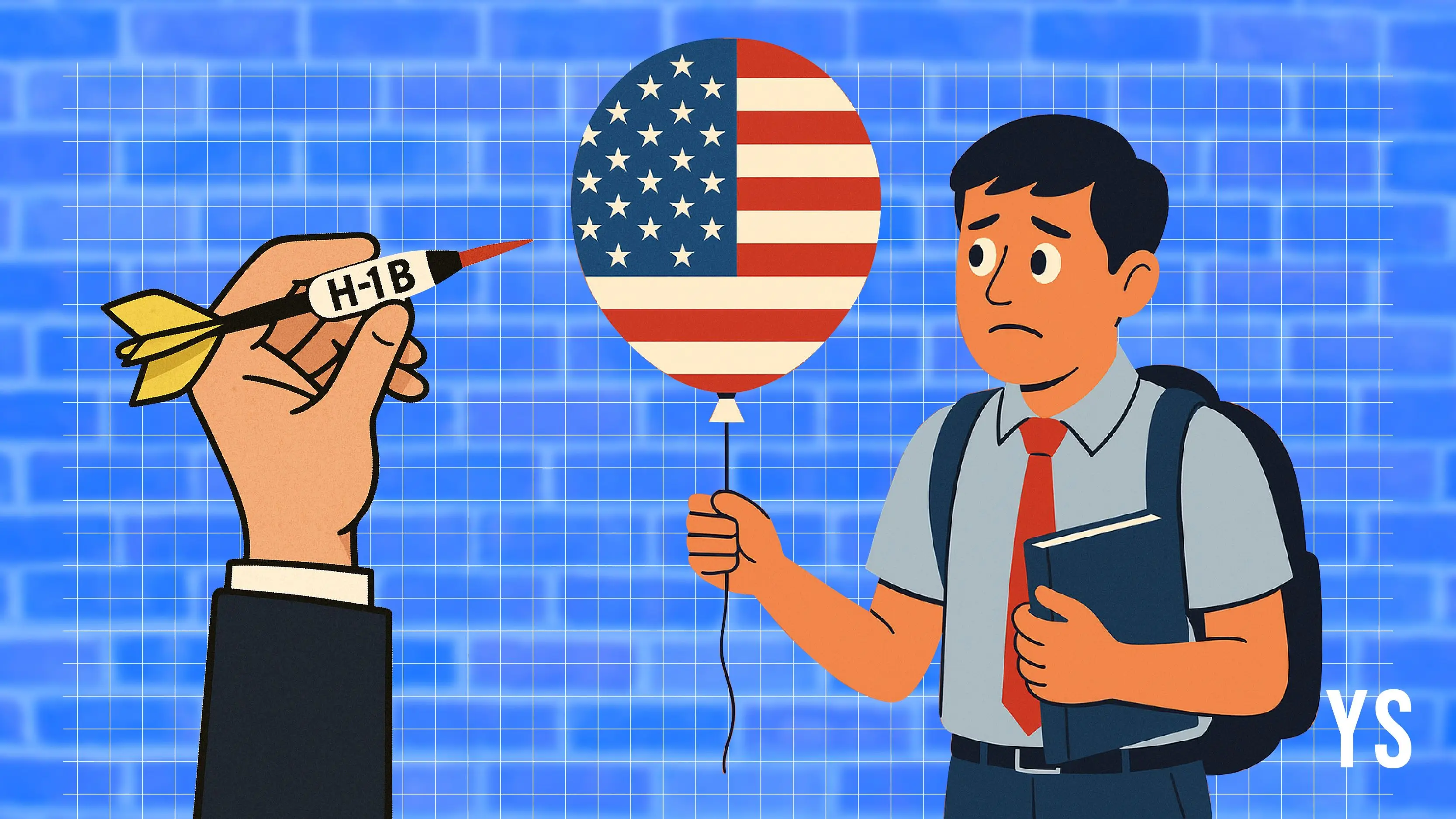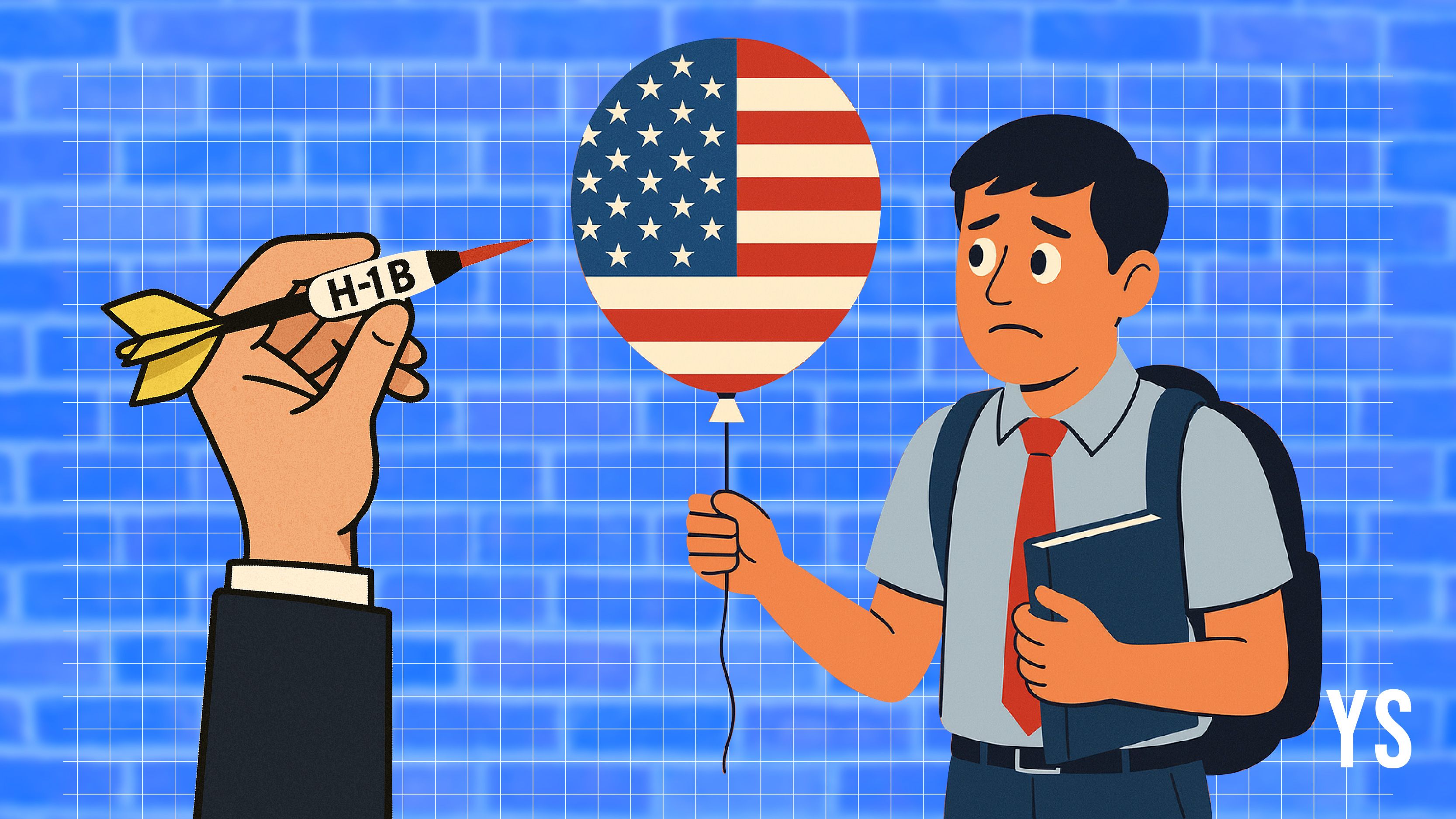
Srikanth (name changed) is a second-year engineering student in Hyderabad. He had planned to follow in the footsteps of his elder brother, who did a master’s degree in the United States and is now working at a technology firm there.
But with the recent H-1B visa hike, Srikanth knows that his great American dream has become a lot more difficult to achieve. He is worried that after paying for an expensive master’s programme in the US, he may find it hard to find an employer willing to take on the steep cost of his H-1B visa. His family, too, is apprehensive.
Many such families are now running through various permutations and combinations of possible master’s programmes, potential employers, and the return on investment.
While students planning to study abroad have some serious decisions to make, there is no cause for panic, say experts in the field of higher education. It all boils down to picking the right course and universities with good job links and strong placement records. If possible, they must opt for STEM degrees, they advise.
These include courses in specialised fields with advanced skills such as AI, data science, cybersecurity, electrical and electronics engineering, biotechnology, advanced finance, and analytics. Such courses not only improve employability but also make students more attractive to large companies to absorb the higher sponsorship cost, according to these experts.
Students may also start looking at other countries, including Canada, Germany, the United Kingdom and Australia, where the path from study to work is more straightforward, and, most importantly, less expensive, at least from a visa point of view, they add.
The dynamics of H-1B visa
The United States has introduced a $100,000 fee—a 50-fold hike—on new H-1B petitions for employers, a move the White House says will apply to new filings and not existing H-1B holders or renewals.
The annual H-1B programme is capped at 65,000 regular visas, with another 20,000 set aside for holders of advanced US degrees. Traditionally, India has consistently accounted for the majority of approvals.
Praneet Singh, Associate Vice President, Study Abroad, upGrad, points out that recent filing cycles recorded hundreds of thousands of applications. “In 2023, there were about 483,000 applications, and roughly 72% of successful petitions historically go to Indian nationals,” he says.
Employers in the US with deeper pockets may continue to sponsor employees’ H-1B visas selectively, while smaller firms and startups may withdraw or scale back.
The immediate takeaway is that the new visa policy will impact employer petitions for new hires rather than the students who have gone to the US to study.
Aman Singh, Co-founder, GradRight, an ed-fintech platform that simplifies the process of pursuing higher education, says, “If a student has gone there, he is on F1. He will spend $50,000 or $100,000 in studying there and then transition to H1-B on the behest of the employer.”
The visa fee does not cancel student visas or the OPT (optional practical training) period that often follows graduation.
OPT is the employment authorisation that lets students on an F-1 visa work after graduation. The standard period for OPT is 12 months. Students who graduate in eligible STEM subjects may apply for a further 24-month extension, thus gaining a total of up to 36 months of practical training.
There are two factors to consider here. First, STEM students have a longer work window and will not face an immediate squeeze due to the visa fee hike, because they can remain on authorised work status for up to three years while seeking long-term sponsorship, say experts.
Second, while OPT is under scrutiny and its continued existence is being debated and challenged by lawmakers and administration officials, the prevailing belief is that high-quality students would continue to be eligible for OPT.
What is most likely to happen
While OPT buys time, what happens when the students are ready to be absorbed in the workforce in the US? Large technology firms may bear the new fee, but startups and mid-sized companies are likely to scale back on sponsorships, caution industry observers.
upGrad’s Singh says, “When this $100,000 deposit kicks in, the elite employers, the nine or ten names that I took (including Meta, Apple, Amazon, Microsoft, and Google), are mostly in a position to pay this for every student that they onboard. But fewer and fewer startups will participate anymore because of the leaner and tighter budgets that they run with.”
Another scenario is also likely to play out, leading to a clear distinction between committed, high-calibre students and those who simply want to go to America at any cost via any college.
GradRight’s Singh warns that the bottom 20%-30% of the market could be wiped out. “What will shift is the bottom of the pile. The kids who generally want to go to America, who are ready to enter any college, who are driven by agents and counsellors—they will be scared.”
Narayanan Ramaswamy, National Leader – Education and Skill Development, Government and Public Services, KPMG in India, says the short-term shock of the visa fee hike will push many students to consider alternatives.
“This (hike) might get reversed, may not get reversed, but the fact remains that something that we thought was very stable is not,” he says, adding that all stakeholders in India must seize the opportunity to strengthen the country’s own higher-education options for students.
There could be a student churn towards Canada, Germany, the United Kingdom, and Australia. Non-STEM students could especially find these alternatives attractive as they have only 12 months of OPT, say experts.
upGrad’s Singh singles out Germany for its affordable education and a transparent pathway from study to work, followed by permanent residence. He describes Germany as an “intuitive pivot” for students who now seek predictable outcomes.
Online courses could also gain momentum amid the rising uncertainty.
Navigating the new landscape
But do these new developments signal the end of the great American dream? Not quite.
The US will remain a premier destination for high-quality training and research and will continue to attract top talent. And many employers here will continue to hire meritorious candidates, say experts. They stress that the current visa fee hike is more of a policy shock and not a complete closure of the road ahead.
“The American dream is still there, and it will always be,” Singh says, while noting that the pathway will now be more selective going forward.
Students are advised to favour programmes with demonstrable employer ties and strong placement records, giving extra weight to STEM courses that offer longer OPT windows and improve their chances of sponsorship. Students and families must also assess programme quality and pick fields of study that are likely to withstand the vagaries of evolving policies before signing loan papers or boarding flights.
Edited by Swetha Kannan
Original Article
(Disclaimer – This post is auto-fetched from publicly available RSS feeds. Original source: Yourstory. All rights belong to the respective publisher.)