Table of Contents
Cloud kitchens — also known as ghost kitchens or delivery-only restaurants — are reshaping India’s food industry. They let entrepreneurs run profitable food businesses without investing in expensive dine-in spaces. If you’re wondering how to start a cloud kitchen in India, the good news is that the process is easier than ever. A great example is Rebel Foods (behind Faasos and Behrouz Biryani), which started small and scaled into multiple delivery-only brands across cities by focusing on delivery demand. With delivery apps like Swiggy and Zomato deeply integrated into urban life, 2025 is an ideal time to get started. Below is a 10-step guide with each step broken into four actionable points, followed by FAQs.
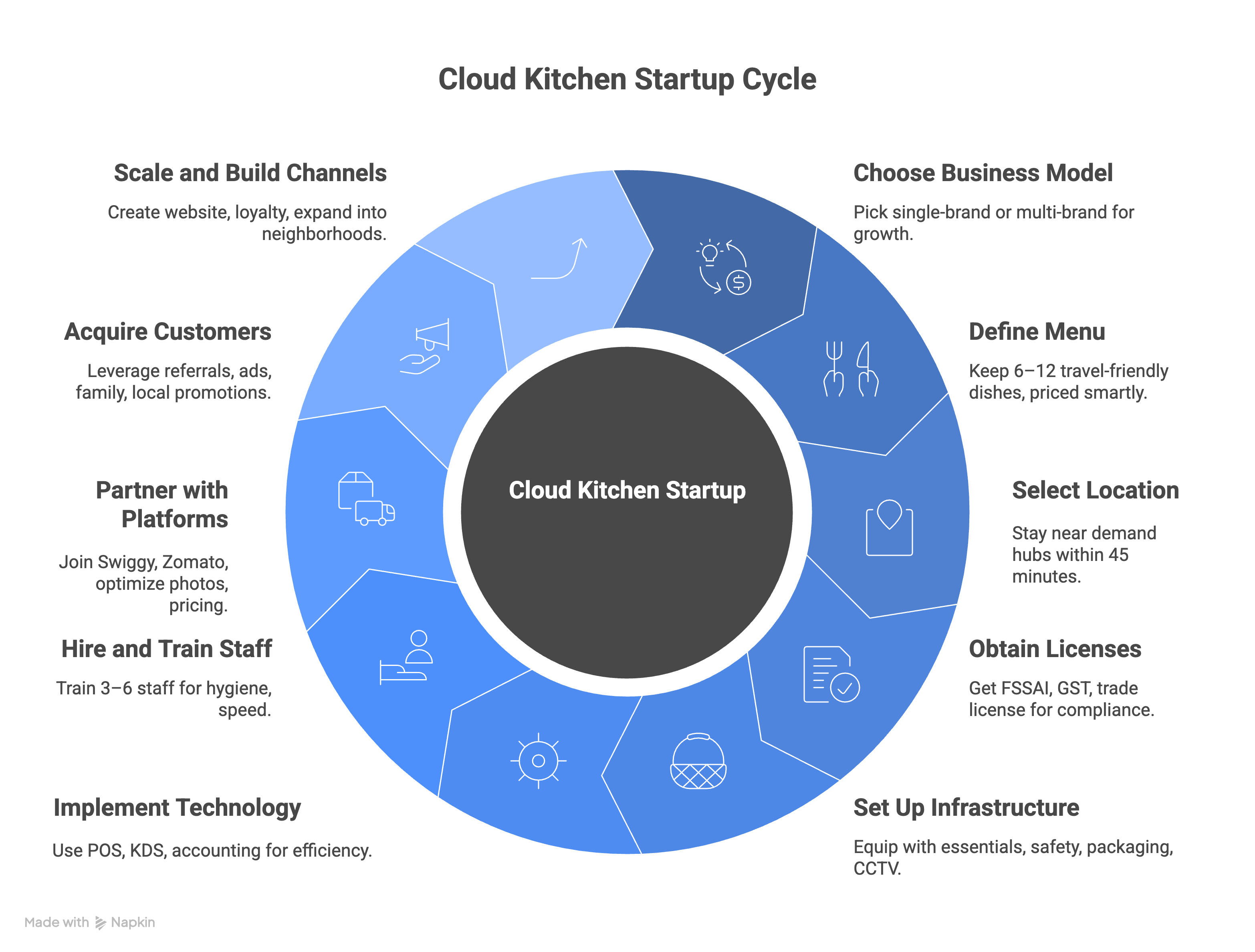
Step 1: Choose Your Business Model
- Identify your customer group (students, professionals, families).
- Select single-brand or multi-brand approach.
- Estimate investment needs and growth potential.
- Tools: Google Trends, Swiggy Partner, Zomato Trends
Step 2: Define a Delivery-Friendly Menu
- Shortlist 6–12 items that travel well.
- Test dishes after 30–40 minutes of delivery.
- Keep recipes simple and quick to prepare.
- Tools: Petpooja, DotPe
Step 3: Select the Right Location
- Stay within a 30–45 minute delivery radius of customers.
- Target clusters near colleges, IT hubs, or residential zones.
- Balance metro demand vs. Tier-2/3 affordability.
Step 4: Register and Obtain Licenses
- Apply for FSSAI License (mandatory).
- Register for GST to comply with tax laws and to partner with Swiggy/Zomato. GST also allows you to claim input tax credits, which reduces overall costs.
- Get a local Shop & Establishment/Trade License.
- Secure Fire NOC or landlord approval if required.
- Tools: FSSAI Portal, GST Portal, Vakilsearch, IndiaFilings
Step 5: Set Up Kitchen Infrastructure
- Purchase equipment: stoves, ovens, refrigeration, and basic CCTV cameras to monitor staff and operations.
- Install safety systems: exhausts, fire extinguishers.
- Use high-quality packaging (tamper-proof, branded).
- Tools: Indiamart for kitchen equipment, Ecoware or PapelKart for eco-friendly packaging.
Step 6: Implement Technology Tools
- Install a POS system for billing and reports.
- Integrate aggregator orders into one dashboard.
- Add a Kitchen Display System (KDS).
- Tools: POSist, Zoho Books, Tally
Step 7: Hire and Train Staff
- Recruit 3–6 staff (chefs, helper, packer, manager).
- Train on hygiene, food safety, and portion control.
- Practice mock orders for speed and accuracy.
Step 8: Partner with Delivery Platforms
- Onboard with Swiggy, Zomato, or local apps.
- Upload quality photos and optimized menu descriptions.
- Factor in 15–30% commissions while pricing.
- Tools: Swiggy Partner App, Zomato Partner, Canva.
Step 9: Get Your First Customers
- Ask family/friends to order via apps for initial reviews.
- Run local ads and distribute flyers nearby.
- Offer referral bonuses or freebies for new customers.
- Tools: WhatsApp Business, Meta Ads Manager, Google Ads.
Step 10: Build Direct Channels and Scale
- Create your website, WhatsApp ordering, or branded app.
- Run loyalty rewards for repeat orders.
- Add new virtual brands or expand into new neighborhoods.
- Tools: DotPe, GloriaFood, Shopify, Zoho CRM, HubSpot.
Estimated Investment Summary
| Cost Head | One-Time (₹) | Monthly (₹) |
|---|---|---|
| Kitchen setup & equipment | 1,00,000 – 3,00,000 | – |
| Renovation & fittings | Up to 1,00,000 | – |
| Licenses & registrations | 5,000 – 30,000 | – |
| Packaging & branding | 30,000 – 1,50,000 | – |
| Rent | – | 20,000 – 2,00,000 |
| Staff salaries | – | 40,000 – 2,00,000 |
| Raw materials & packaging | – | 25–40% of order value |
| Utilities, maintenance & CCTV | – | 35,000 – 2,50,000 |
| Delivery platform fees | – | 15–30% of order value |
| Digital ads (Meta/Google) | – | 10,000 – 50,000 |
Total: Small kitchens may start with ~₹2–6 lakh upfront and expect ~₹2–3 lakh monthly running costs.
Also check – How to Start a D2C Brand in India: Powerful Step-by-Step Guide 2025
Final Takeaway
Starting a cloud kitchen in 2025 is one of the most exciting opportunities in India’s food sector. By following these 10 clear steps — from planning your model and menu to building your team, getting first customers, and scaling smartly — you can build a profitable delivery-only food business that grows with the rising demand for online orders. If you are looking for practical guidance on how to start a cloud kitchen in India, this guide gives you the roadmap, costs, tools, and strategies needed to succeed.
Is FSSAI mandatory for cloud kitchens?
Yes, it is compulsory for every food business.
How much investment is required to start?
Small kitchens usually need ₹2–6 lakh upfront and ₹2–3 lakh monthly expenses.
Can I run multiple brands from one kitchen?
Yes, multi-brand setups are common and help increase visibility.
How much do delivery platforms charge?
Commissions range from 15–30% depending on the platform and city.
Is GST mandatory to work with Swiggy or Zomato?
Yes. Swiggy and Zomato typically require partner restaurants and cloud kitchens to have a valid GST registration number. This ensures tax compliance and allows you to claim input credits. As per Indian law, GST registration becomes legally compulsory once your annual turnover exceeds ₹40 lakh (₹20 lakh in some special category states). Even if you are below the limit, getting GST is advisable if you want to partner with these platforms.
How long does it take to break even?
Typically 6–12 months, depending on order volume and cost management.