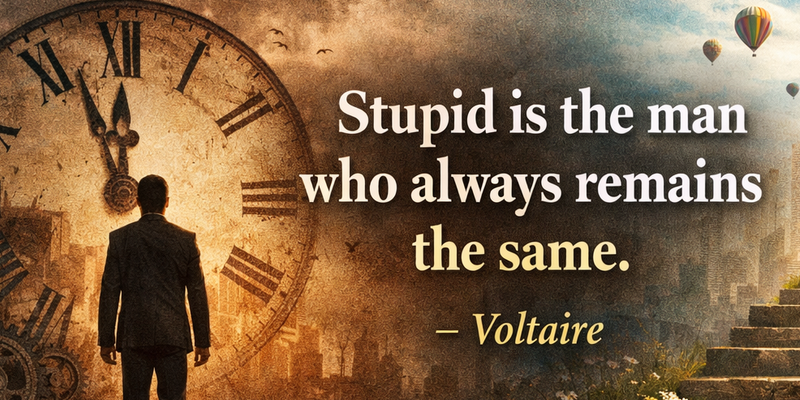
“Stupid is the man who always remains the same.” — Voltaire
It is a sharp statement, almost confrontational. But beneath its bluntness lies a truth that feels even more relevant today than it did centuries ago. Voltaire was not criticising consistency. He was warning against stagnation.
In a world defined by constant change, the real risk is not failure. It is the decision to stay exactly as you are.
Change is the new baseline
The modern world does not reward stillness. Industries are evolving faster than ever. Skills that were valuable five years ago can become obsolete today. From technology to media to business, adaptability has quietly become the most important skill.
Remaining the same is no longer a sign of stability. It is often a signal of resistance.
This is where Voltaire’s insight becomes powerful. Intelligence is not just about knowledge. It is about the ability to update that knowledge.
The illusion of comfort
Staying the same often feels safe. Familiar routines, established beliefs, and predictable outcomes create a sense of control.
But this comfort is deceptive.
It discourages curiosity. It limits exposure to new ideas. Over time, it builds a mindset that avoids questioning itself. The result is not stability, but stagnation.
People who refuse to evolve often do not realise it immediately. The impact is gradual. Opportunities are missed. Relevance begins to fade. The gap between them and the changing world slowly widens.
Growth is a continuous process
One of the biggest misconceptions about growth is that it has a clear start and end point. In reality, growth is ongoing.
It shows up in small, consistent ways. Learning a new skill. Rethinking an old assumption. Being open to feedback. Adapting to new environments.
Those who succeed in the long run are not necessarily the most talented. They are the most adaptable. They understand that change is not something to fear, but something to work with.
Why rigidity is risky
Refusing to change can have long-term consequences, especially in professional and personal development.
It reduces your ability to respond to new challenges.
It limits innovation and creativity.
It creates dependence on outdated methods.
Over time, rigidity becomes a barrier. Not because change is impossible, but because it becomes uncomfortable.
Voltaire’s quote highlights this exact danger. It is not ignorance that holds people back. It is unwillingness.
Reinvention as a mindset
The idea of reinvention often sounds dramatic, but it does not have to be. It is less about making drastic changes and more about staying responsive.
Reinvention can mean upgrading your skills, shifting your perspective, or simply staying curious. It is about recognising when something no longer works and being willing to adjust.
In fast-moving environments, this mindset is what separates those who remain relevant from those who fall behind.
Final takeaway
Voltaire’s words are not meant to offend. They are meant to challenge.
Remaining the same in a changing world is not a neutral choice. It is a risky one.
The real measure of intelligence today is not how much you know, but how willing you are to evolve, adapt, and grow with time.
Because in the end, progress belongs to those who are ready to change.
Original Article
(Disclaimer – This post is auto-fetched from publicly available RSS feeds. Original source: Yourstory. All rights belong to the respective publisher.)