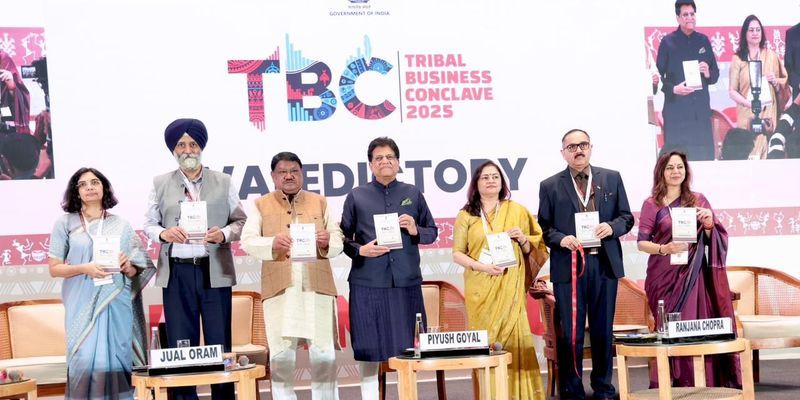
Union Minister of Commerce & Industry Shri Piyush Goyal has announced a comprehensive plan to promote India’s tribal products in international markets, pledging full support through e-commerce platforms, global warehouses, and trade networks. Speaking at the Tribal Business Conclave 2025 held at Yashobhoomi, New Delhi, Shri Goyal emphasized the government’s vision to transform tribal products from “Van Dhan to Vyapar Dhan.”
Organized by the Department for Promotion of Industry and Internal Trade (DPIIT) in collaboration with the Ministry of Tribal Affairs and the Ministry of Culture, the conclave marked the 150th birth anniversary of Bhagwan Birsa Munda during Janjatiya Gaurav Varsh, symbolizing India’s commitment to empowering its indigenous communities.
“Local Goes Global”: Shri Piyush Goyal’s Vision
Shri Goyal highlighted that tribal craftsmanship possesses immense potential for global markets. He stated that a dedicated export promotion scheme is being designed to ensure tribal products receive the visibility they deserve both domestically and internationally.
“The Prime Minister believes that the nation can truly prosper only when the indigenous people prosper,” he said. “India’s growth and development depend on ensuring that progress reaches every household, particularly in tribal and remote regions.”
Goyal further noted that the Department of Commerce and the Ministry of Tribal Affairs will continue collaborating to build trade opportunities and strengthen the value chains that connect tribal enterprises from village markets to global buyers.
Empowering Through Policy and Commerce
The Minister revealed that 3,900 Van Dhan Kendras have already uplifted over 12 lakh tribal members, and that the budget for the Ministry of Tribal Affairs has been increased by 50% this year. Under the PM-Janman Yojana, ₹24,000 crore has been disbursed to benefit nearly 50 lakh families from particularly vulnerable tribal groups (PVTGs).
He also announced a major reform: the Geographical Indication (GI) tag fee has been slashed by 80%, from ₹5,000 to ₹1,000, encouraging more tribal products to gain official recognition and protection.
Honouring Birsa Munda’s Legacy
Paying tribute to Bhagwan Birsa Munda, Shri Goyal reflected on his leadership and sacrifice, calling him a guiding force for the tribal community.
“We must draw inspiration from Birsa Munda’s life and follow his footsteps to uplift our tribal brothers and sisters, ensuring every household is filled with happiness and prosperity,” he said.
He lauded tribal communities for preserving their traditions, crafts, and resilience through generations, calling their contribution to India’s cultural and social fabric “invaluable.”
Minister Jual Oram: Turning Potential into Prosperity
Union Minister of Tribal Affairs Shri Jual Oram praised the conclave for showcasing the vast economic potential in tribal regions rich with mahua, sal seeds, handicrafts, and forest products.
“Tribal communities are custodians of natural wealth and wisdom. This conclave demonstrates our resolve to turn that potential into prosperity,” he said.
Minister Durgadas Uikey: Mainstreaming Tribal Entrepreneurs
Hon’ble Minister of State for Tribal Affairs Shri Durgadas Uikey, who inaugurated the event, reaffirmed the government’s commitment to empowering tribal entrepreneurs:
“By empowering them with knowledge, capital, and technology, we are creating pathways for self-reliance, dignity, and long-term prosperity.”
Key Announcements at the Conclave
1. Launch of Gramya Yuva Arth Niti (GYAN) Lab
A collaborative initiative by IIT Bombay’s Ashank Desai School of Public Policy and PRAYOGI Foundation, supported by the Ministry of Commerce and Industry.
The GYAN Lab aims to bridge field experience, technology, and policy innovation, piloting models like the Tribal Entrepreneurship Index and micro-equity-based incubation for inclusive enterprise growth.
2. Tribal Affairs Grand Challenge
Launched by the Ministry of Tribal Affairs with Startup India and DPIIT, this initiative seeks high-impact startup solutions for tribal communities, offering mentorship, visibility, and funding support.
3. Roots to Rise Pitching Platform
Out of 115 enterprises, 43 were DPIIT-registered.
57 enterprises received investment interest exceeding ₹10 crore from 50+ investors, including IFCI Venture Capital and Arora Venture Partners.
The selected startups created 1,500 direct and 10,000+ indirect jobs, benefiting over 20,000 tribal individuals across sectors.
4. Boost in Market Access via GeM
Over 60 new registrations and 50+ inquiries were recorded on the Government e-Marketplace, linking tribal entrepreneurs directly to institutional buyers.
5. Distribution of GI Certificates
New GI recognitions were conferred on tribal crafts such as Kannadippaya (Kerala), Apatani Textile (Arunachal Pradesh), Marthandam Honey (Tamil Nadu), Lepcha Tungbuk (Sikkim), Bodo Aronai (Assam), Ambaji White Marble (Gujarat), and Bedu & Badri Cow Ghee (Uttarakhand) — marking a milestone for indigenous artisans and regional branding.
A Cultural and Economic Milestone
The conclave’s theme, “Tribal Bharat @2047: Sustaining Culture, Scaling Commerce,” featured six panel discussions, four masterclasses, and vibrant cultural performances celebrating tribal heritage. Over 250 enterprises, 150 exhibitors, and 100 startups participated, symbolizing a renaissance in tribal entrepreneurship.
The Tribal Business Conclave 2025 is not merely an event—it represents a national mission to transform heritage into enterprise, skills into industries, and communities into catalysts of growth. Through initiatives like GYAN Lab and the Tribal Affairs Grand Challenge, the government is laying the foundation for an era where tribal innovation and entrepreneurship drive sustainable livelihoods and inclusive prosperity.
“As tribal communities rise, so does India,” Shri Piyush Goyal concluded, envisioning a future where Local truly goes Global.
Original Article
(Disclaimer – This post is auto-fetched from publicly available RSS feeds. Original source: Yourstory. All rights belong to the respective publisher.)