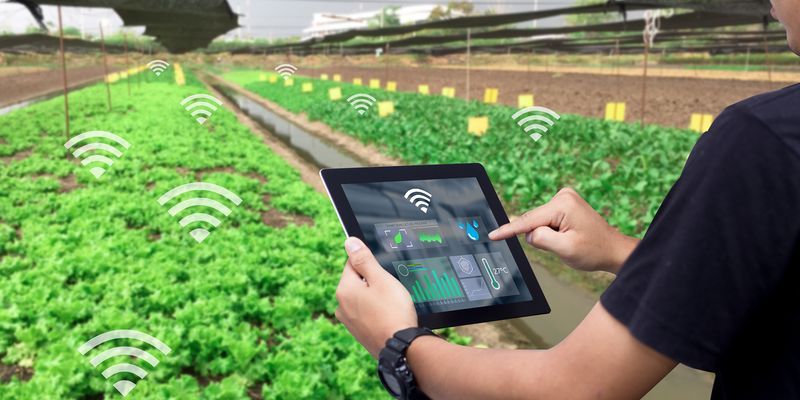
For once, the AQI index was dipping in Delhi even as the AI index was rising—both during the third week of February at the six-day India AI Impact Summit. With the afterglow of that summit still fresh, this seems like a fitting moment to reflect on a thesis for the future of AI in the Indian context.
The thesis took shape while navigating the corridors of Bharat Mandapam and bumping into random conversations with people who were, all at once, confused, curious, and confident about what AI can do to propel India into a hypergrowth trajectory.
Three sectors received disproportionate attention at the summit: healthcare, education, and agriculture—a refreshing focus, particularly in the context of the Viksit Bharat goals.
I am not positioned to sketch a multi-sectoral AI framework, but I can certainly attempt it for agriculture—a sector core to the Viksit Bharat vision and a sector that I understand little bit.
Technology interventions prior to the AI diffusion phase in Indian agriculture have been broadly branded as 'agritech'. AI is now resetting that thesis at a pace that may well surprise startups, investors, and policymakers alike.
This article traces the evolution from 'agritech' to 'agriAI' and explores how the convergence of Digital Public Infrastructure (DPI), Open Networks for Agriculture (ONA), and AI could represent the inflection point Indian agriculture has long been waiting for.
The pre-AI era of Indian agritech
The Indian agritech ecosystem, despite being in its adolescence, has already weathered multiple cycles over the past 15–20 years. Entrepreneurs remain at the fulcrum, driving tech-enabled business models within a fairly robust ecosystem supported by the government, incubators, investors, multilaterals, financial institutions, and foundations.
The diversity of innovation themes is striking—there is arguably a solution for every problem Indian farmers face, whether it is timely and accurate advisory services, market linkages, price discovery, warehousing, quality inputs, mechanisation, or affordable financing.
There are over 10,000 agritech startups in the country, with roughly one-third having crossed the proof-of-concept stage and about one-tenth having raised institutional capital—totalling approximately $4 billion over the past decade.
The last two decades of Indian agritech have been characterised by three distinct phases: scepticism and experimentation (until around 2017), GMV-driven scale and investor optimism (2018–22), and a capital-efficiency-induced path to profitability (2022–26). The next phase (2026-30) is expected to propel several businesses towards IPO readiness—with approximately five agritech IPOs anticipated by 2030.
This phase will also likely witness convergence of agritech with fintech, spacetech, deeptech, biotech, and broader ruraltech, making business models more scalable and defensible.
Yet the elephant in the room remains the scale of farmer adoption of agritech solutions. Empirical evidence suggests that only 10–15% of Indian farmers—approximately 20 million out of 150 million—have adopted some form of agritech solution. While encouraging as a starting point, the headroom for deeper technology penetration is vast, both within India's approximately 120 million smallholder farms and across the 500 million smallholder farms globally.
The entrepreneurial dividend India has built in the agritech space must be supported not just by capital but also by enabling policy. Both are powerful multipliers for innovation diffusion and adoption. While investors recognised the value of scaling agritech during the pandemic, policymakers too have placed technological innovation at the core of their vision for India's agricultural economy, as reflected in multiple policy announcements in the last five years.
The emergence and convergence of DPI, ONA, and AI
The agricultural sector is hungry for data that is accurate, timely, and actionable—data for both farmers and supply chain players making critical decisions. The persistent lack of availability, accuracy, and authenticity of data continues to hamper farmers' decisions and adversely impact farm economics. This is precisely where public data stacks as 'sources of truth' become indispensable.
The era of Digital Public Infrastructure (DPI) in Indian agriculture formally began in 2021 with the announcement of Agristack, which brings together farmer, farm, and crop identities under a unified umbrella. Over 70 million farmers are now registered under Agristack, with states like Maharashtra, Uttar Pradesh, Madhya Pradesh, Gujarat, Rajasthan, and Haryana in advanced stages of implementation.
Beyond Agristack, there is significant opportunity to build complementary stacks—a climate stack capturing weather, soil, and water data; a dairy stack linking farmer and cattle IDs; pest surveillance stacks; mandi stacks; warehouse stacks, and many more.
Simultaneously, pilots to build the Open Network for Agriculture (ONA) have been launched in states like Uttar Pradesh and Maharashtra, facilitated by policymakers, philanthropies, multilaterals, foundations, and large technology companies. ONA enables farmers to access products and services through an app-agnostic digital interface in a frictionless manner.
For service providers—particularly agritech startups with limited customer acquisition budgets—ONA substantially reduces the transactional cost of reaching farmers. The prohibitively high first- and last-mile cost of farmer engagement has historically been a primary reason why many agritech models have defaulted to B2B (business-to-business) rather than D2F (direct-to-farmer) approaches. Early farmer response to ONA has been encouraging; however, a lot of collaborative effort is required to scale it, preferably under the leadership of respective state governments.
It is fortuitous that the emergence of DPI and ONA has coincided with the maturation of AI applications at scale. AI is a powerful enabler, capable of making data available in farmer-friendly formats, in the language and dialect of the farmer's choosing. Many agritech startups—both new entrants and more established players—are pivoting towards AI-driven tools to interact directly with farmers and other supply chain participants. In the Union Budget, the government also announced AI-driven initiatives such as Bharat-VISTAAR, aimed at delivering multilingual, AI-assisted advisories to farmers using the digital stack as its foundation.
Together, DPI (the creator), ONA (the doer or preserver), and AI (the transformer or multiplier) form a powerful and a unique trinity with the potential to transform how agriculture is practised—bringing farmers closer to markets, services, and knowledge.
Bringing the trinity together
DPI: The foundational layer
DPI provides the plumbing architecture for the entire ecosystem. It encompasses secure identity frameworks, consent mechanisms, standardised APIs, and shared catalogues that allow service providers to access authenticated data—a verifiable source of truth—without having to reinvent basic building blocks. The responsibility for making DPI open-source and accessible will rest primarily with state governments, which own AgriStack and other DPIs that may follow.
ONA: The frictionless farmer interface and a digital companion
ONA enables a frictionless, faceless interface with farmers. Farmers often prefer bots over apps—many use phones that cannot accommodate multiple applications. ONA has the power to replace the app as the primary interface for farmers, manifesting as a chatbot, voicebot, or videobot with farmer-friendly UI/UX that understands and responds to queries like a knowledgeable and trusted friend. ONA's power multiplies when farmer data is contextualised with Agristack records, eliminating the need for farmers to manually fill in profile information each time.
AI: The intelligence engine
AI enables speed, quality, personalisation and accuracy of response, alongside powerful analytics capabilities. Farmers typically do not navigate beyond three clicks on any app—they want responses that are prompt and precise—contextualised to their needs than a generic advice. AI is perfectly suited to deliver this. Beyond farmer-facing interactions, AI can build analytics and models that transform raw data into actionable insights for farmers and service providers alike.
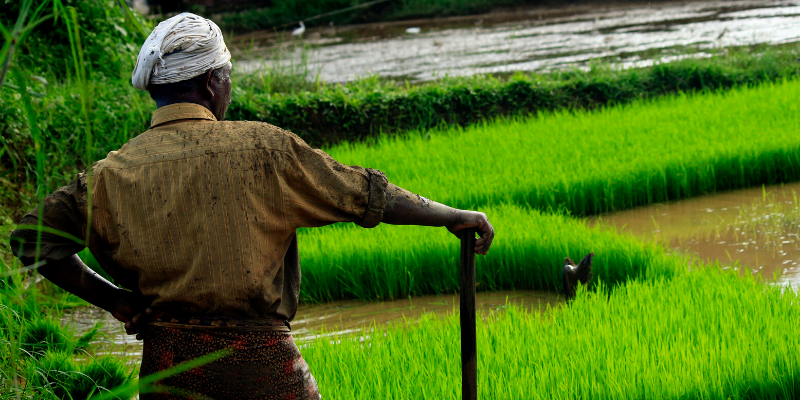
Farmers typically do not navigate beyond three clicks on any app—they want responses that are prompt and precise—contextualised to their needs than a generic advice. AI is perfectly suited to deliver this.
Key success factors for DPI + ONA + AI
Realising the full potential of this trinity will require tcareful attention to several principles:
- Farmer privacy: DPI must embed consent, disclosure, and purpose limitation into its architecture—safeguarding the interests of farmers above all else.
- Democratised data access: Data must be accessible to all stakeholders under a clear data-sharing protocol framework. DPI and ONA aim to mitigate data concentration risk by standardising APIs and promoting federated or open models.
- Model fairness: AI trained predominantly on data from large farms will underperform for marginal or minority farming systems, potentially excluding the poorest farmers. The datasets on which AI is trained must reflect the full diversity of the farming universe.
- Human in the loop: Winning farmer trust is essential. Digital services must augment—not necessarily replace—human extension workers, particularly local community members and village level entrepreneurs who already enjoy farmers’ trust. Traditional knowledge and local networks must be integrated with, not displaced by, new-age models.
- Support infrastructure: High-speed connectivity, digital literacy, and vernacular language support are baseline requirements for open networks to succeed.
- Dispute resolution: While the DPI and ONA construct is designed to benefit farmers, disputes can and will arise—whether over incorrect advisories or suboptimal service responses. An efficient dispute resolution mechanism must be established before large-scale rollout.
How agritech startups and investors benefit from the trinity
The evolution of agri-DPI stands in sharp contrast to the trajectory of DPI in financial services. In fintech, Aadhaar enrolment began around 2010, followed by the JAM trinity in 2014 (linking Aadhaar to mobile numbers and bank accounts) and then UPI in 2016—which together catalysed India's fintech boom—ushering financial innovations and catalysing significant venture capital (with over $30 billion of cumulative investments in the Indian fintech sector)
In agriculture, it was startups that initiated the digitisation wave. Pioneers such as CropIn, BigHaat, DeHaat, AgroStar, Prompt, Samunnati, Unnati, and Innoterra (part of agritech’s first wave) demonstrated the power of digitisation. They were followed by a second wave startups such as SatSure, Avanti, ScaNxt and Behtar Zindagi building further application layers.
These first and second-wave startups built proprietary databases and proprietary technology, which ultimately led to the realisation that public stacks and network—DPI and ONA—were essential for scaling agritech solutions. Agristack, the DPI for agriculture, arrived almost a decade after the agritech startup wave had begun.
Once DPI access is made available to private players including startups, they will no longer need to invest in building and maintaining their own databases. Similarly, as ONA becomes mainstream, the need for proprietary farmer-facing apps will diminish. Startups can become significantly more capital-efficient, redirecting resources toward building differentiated APIs and complementary physical-layer solutions. The integration of DPI and ONA, powered by AI, could represent another major inflection point—one that both founders and investors have been anticipating. It also provides a level playing field to new entrants, hopefully with public stack enabled acceleration. The trick for the startups will be to leverage government led stacks and Big Tech led AI models (rather than competing with them) for triangulating and augmenting their innovation layers.
Use cases enabled by the trinity
The trinity will unlock, accelerate and modify farmer-centric use cases that have long struggled with first- and last-mile challenges. Some of the use cases in their modified form could include:
- Timely, affordable credit and insurance: DPI-based KYC, ONA-enabled farmer onboarding, and AI-led underwriting—drawing on multiple data points from Agristack and transaction histories (e.g., input purchases, off-take receipts)—can transform credit access. For crop insurance, AI can combine satellite imagery, IoT sensor streams, and verified farmer claims routed through ONA-style registries to accelerate payouts and reduce fraud.
- Precision advisory at scale: AI models trained on federated datasets—weather, soil, and water data from weather stations, soil labs, and satellite imagery—can deliver contextualised, field-level soil nutrition profiles, climate risk assessments, sowing window recommendations, fertiliser dosing guidance, and pest alerts, delivered through trusted channels registered on DPI rails. Integration with ONA identifiers enables personalisation by crop, soil type, and local market conditions.
- Transparent supply chains and quality assurance: DPI-enabled batch IDs and traceability standards allow AI systems to link quality assaying and warehouse/cold-chain telemetry to physical consignments all the way to the distributor, wholesale, retail, or consumer level—increasing buyer trust and enabling premiums for quality or sustainability. ONA-enabled aggregation of agricultural input demand, combined with AI-driven fertiliser and pesticide application guidance, will further optimise input costs.
- Markets and price discovery: AI-powered demand forecasting, coupled with DPI-facilitated discovery protocols, can dynamically connect farmers with buyers and logistics service providers—improving price realisation and reducing post-harvest losses. ONA at scale will be able to orchestrate data and product flows across multiple network participants.
- Delivery of government schemes: Governments can use DPI to administer subsidies, input distribution, and extension services with greater precision; AI can analyse programme effectiveness and detect leakages or eligibility errors.
The trinity's potential extends well beyond these use cases. More importantly, the multiple points of friction and high transactional costs that act as deterrents in today's fragmented supply chains can be overcome by building complementary digital and physical journeys on the trinity backbone.
Institutional framework for scale
Implementing this framework at scale will require structured collaboration between three groups of stakeholders:
- Policymakers—especially state governments—who can open-source data and drive farmer awareness and mobilization through district and village administration.
- Agritech startups and agribusinesses, who can be onboarded as network partners and service providers for farmers
- Facilitators and system integrators, who can bring multiple stakeholders together, demonstrate pilots, and build pathways to scale.
A civilisational bet
The convergence of DPI, ONA, and AI is not merely a technological upgrade; it is a civilisational bet on India's 150 million farmers. For too long, the smallholder farmer has been the last to benefit from innovation and the first to bear its absence. This trinity offers a rare chance to reverse that equation.
The plumbing (DPI) is being laid, the rails (ONA) are being built, and the intelligence (AI) is being trained. What remains is the will—of policymakers, entrepreneurs, and investors—to see it through. If we get this right, Indian agriculture will not just feed a nation; it will set a global benchmark for inclusive, AI-powered rural transformation.
The author is an investor, mentor, and board member with agritech, dairytech, deeptech, fintech, and climate-tech startups.
Edited by Swetha Kannan
(Disclaimer: The views and opinions expressed in this article are those of the author and do not necessarily reflect the views of YourStory.)
Original Article
(Disclaimer – This post is auto-fetched from publicly available RSS feeds. Original source: Yourstory. All rights belong to the respective publisher.)