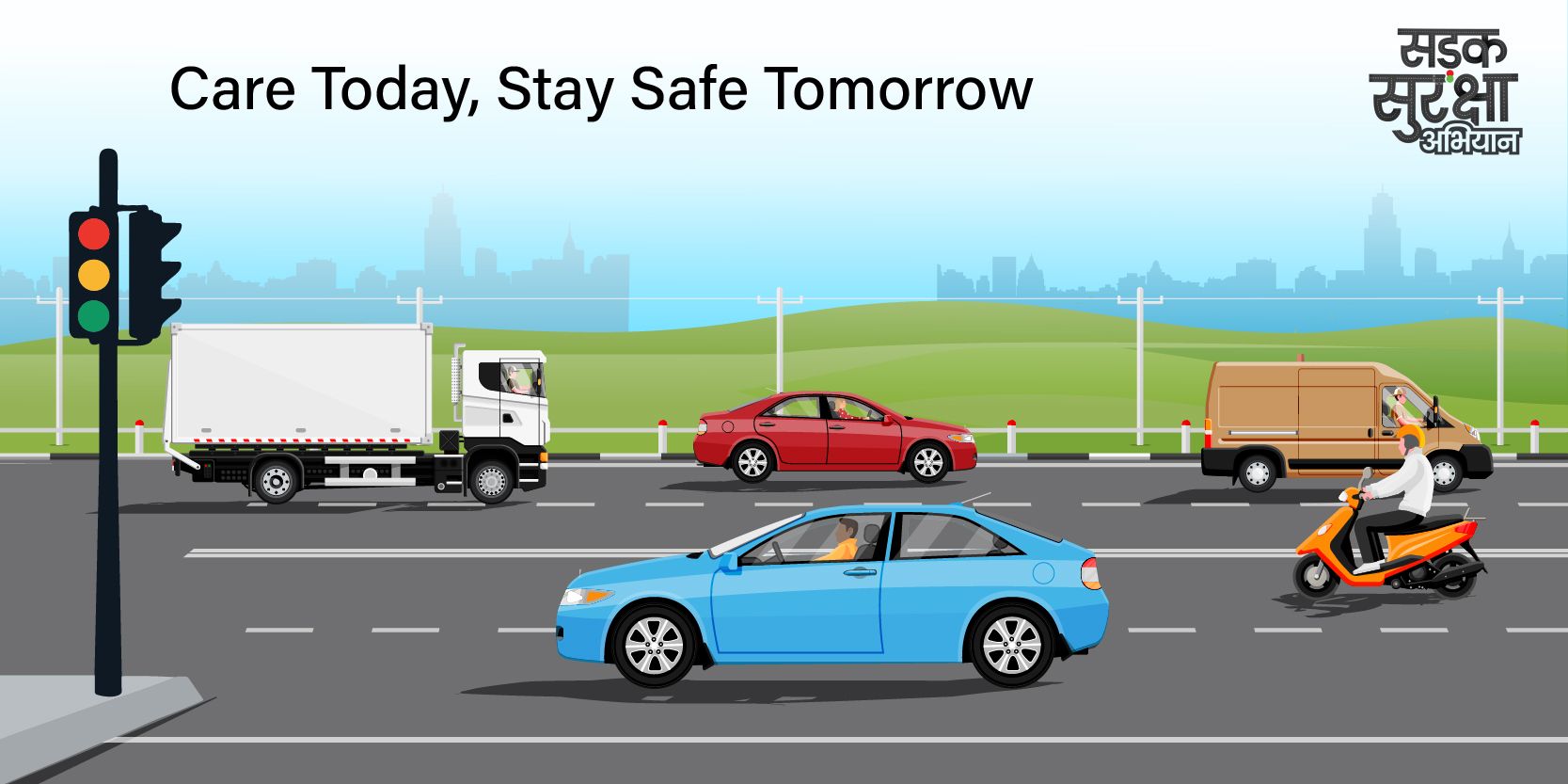
India’s road safety crisis isn’t defined by statistics alone; it plays out every day in missed signals, unmarked potholes, reckless turns, and moments of inattention that cost lives.
The numbers reveal just how urgent the situation has become.
In 2023 alone, India recorded 4,80,583 road accidents, resulting in 1,72,890 deaths and 4,62,825 injuries. Out of the 1,72,890 road accident fatalities during 2023, pedestrians, bicycles and two-wheelers accounted for around 68% of total fatalities. Young adults in the age group of 18 – 45 years accounted for 66.4% of victims during 2023.
While road maintenance, government initiatives, and stronger traffic enforcement are essential to reducing accidents, they are only part of the solution. Citizens, too, play a vital role through everyday actions such as stopping at traffic lights and zebra crossings, wearing seatbelts, ensuring driver and pillion riders have helmets, and stepping in to help victims of road accidents.
This is the premise behind Sadak Suraksha Abhiyan (SSA). Through public education and safety awareness, the initiative endeavours to make India’s roads safer. SSA actively informs the public about schemes such as Raah Veer, Driver Training Institutes, and PM Rahat to ensure no victims of motor accident goes untreated.
At its core, SSA reinforces a simple but powerful idea: road safety is a shared responsibility and saving lives begins with individual action.
What drives poor road behaviour
Human error is often cited as one of the leading causes of road accidents in India, and is a consequence of many factors: overspeeding, drunk driving, distractions (mobile phones), fatigue, and a general disregard for rules.
Often, small and seemingly insignificant actions on the driver’s part can escalate into serious accidents. Glancing at a message on the phone for a second, tailgating by a few inches or drifting slightly outside of the lane – all subtle actions that can impair reaction time, disrupt traffic flow and even impact hazard perception. Over time, these habits, compounded by the fatigue of life or distractions can create a dangerous chain of reactions from a minor infraction.
In high-pressure urban environments, many drivers adopt a survival-first mindset rather than a rule-following one. Signal jumping, driving on the wrong side of the road or even on pavements, abrupt lane changes, and overspeeding have become routine—these are the kind of behaviours that SSA is looking to change. The campaign highlights the actions of drivers – fuelled by high stress levels, time pressure, and work-related demands and the – cost of these rash decisions on the road.
Public education: the first line of defence
At the heart of road safety lies behaviour, and Sadak Suraksha Abhiyan (SSA) positions public education as its strongest preventive tool. Launched on January 18, 2021, the nationwide initiative aims to reduce road accidents, fatalities, and injuries by promoting safer behaviour among all road users, including drivers, riders, pedestrians, cyclists, school children, and enforcement agencies.
One of SSA’s most visible efforts is Sadak Suraksha Ki Pathshala, a public awareness campaign featuring Bollywood veteran Amitabh Bachchan. Structured around the Hindi alphabet and familiar idioms, the campaign uses short videos and films to spotlight everyday behaviours that often lead to accidents. Each episode turns a common phrase into a practical lesson—on traffic rules, safe driving and dangerous behaviours—framed as simple, conversational guidance rather than instruction from authority.
A cross-country network of initiatives
Beyond awareness, the Ministry of Road Transport and Highways (MoRTH) is implementing a multi-pronged strategy to address systemic gaps in road safety. Driver Training Institutes form another pillar of the initiative, focusing on creating skilled, safety-first drivers. Black spot correction is ongoing to lower higher accident rates in hazardous locations.
To strengthen emergency response and personal safety, vehicles will be equipped with panic buttons that alert monitoring centres in case of accidents, threats, or medical emergencies. Vehicle Location Tracking Devices (VLTDs) will further enhance safety by continuously monitoring and transmitting real-time data on a vehicle’s location, speed, and status to central servers. While technology plays a critical role in reducing human error, SSA emphasises that strong compliance—through laws, enforcement, and training—remains essential to manage unpredictable behaviour on the road.
Raah Veer: Empowering first responders
Delayed emergency response is a major contributor to road fatalities, often costing victims the critical “golden hour” for trauma care. MoRTH’s Raah Veer scheme addresses this gap by empowering ordinary citizens to act as first responders.
Under the scheme, individuals who assist victims of serious road accidents, either by providing immediate first aid or transporting them to a hospital within the golden hour, are eligible for a cash award of Rs 25,000, along with a certificate of appreciation. If multiple people are involved, the reward is shared equally. In addition, 10 national-level awards of Rs 1,00,000 each are presented annually to the most deserving Raah Veers or Good Samaritans. The initiative not only saves lives but also builds confidence, recognition, and a culture of collective responsibility.
In addition to these initiatives and schemes, the upcoming Cashless Treatment of Road Accident Victims Scheme of 2025 will provide treatment cover of up to Rs. 1.5 lakh per victim at designated hospitals across the country. Any person who is the victim of a road accident caused by the use of a motor vehicle will be eligible for treatment for a maximum of 7 days from the date of the accident.
Road safety is not merely about preventing accidents; it is about building a shared culture of accountability. When citizens follow rules, respect fellow road users, and stay alert—and when governments invest in safer infrastructure, enforcement, and education—roads become collective spaces of care. Lasting safety emerges when responsibility goes both ways: where policy enables protection, and everyday choices sustain it.
Original Article
(Disclaimer – This post is auto-fetched from publicly available RSS feeds. Original source: Yourstory. All rights belong to the respective publisher.)