A ninth-grade student recently turned to a university graduate and asked a question that would have been unthinkable a decade ago. How did you prepare for your exams without AI?
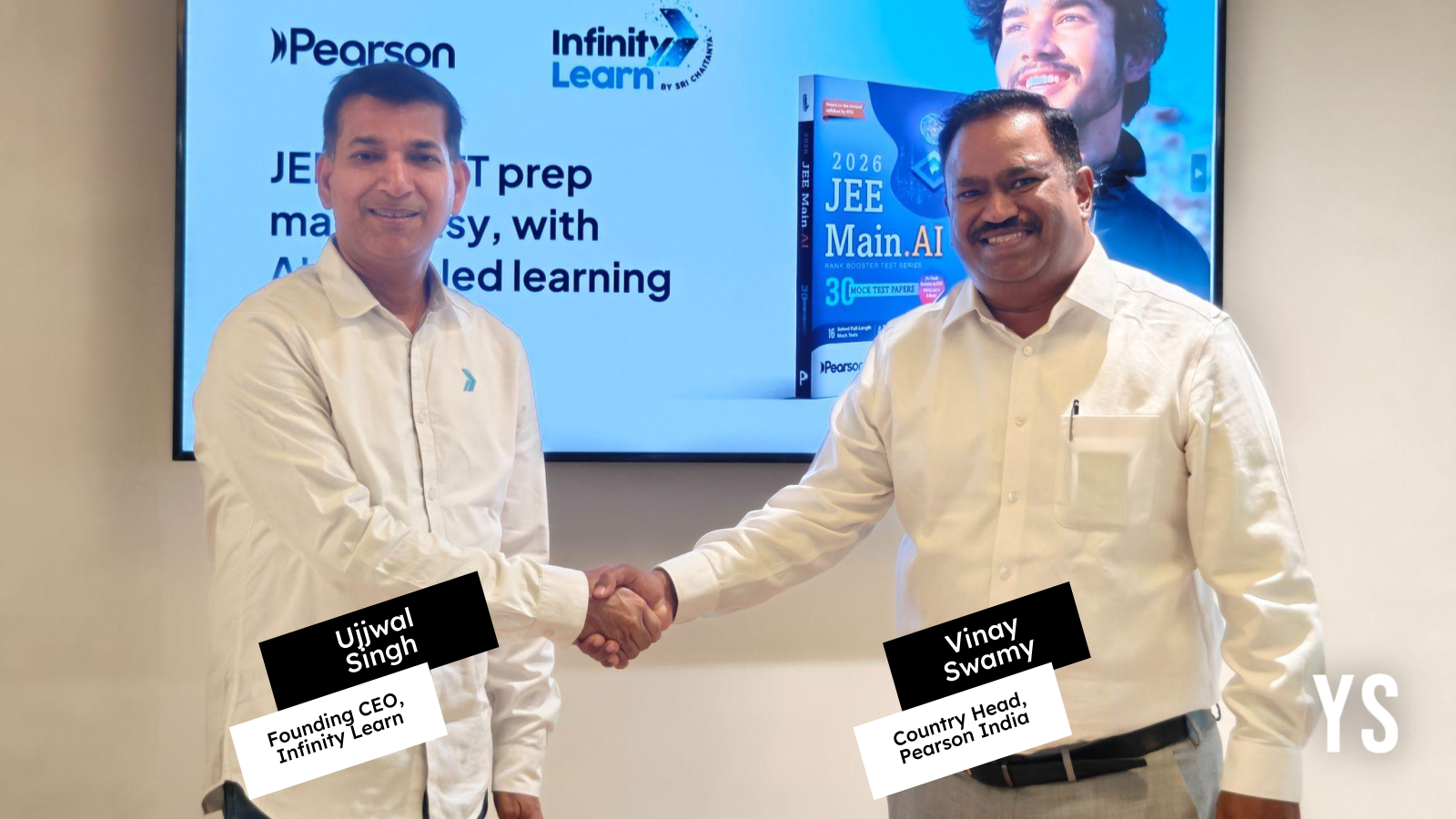
Ujjwal Singh, Founding CEO of Infinity Learn shared this interesting anecdote during a conversation with Yourstory around the company’s partnership with Pearson India.
The simple query from the student highlights a profound shift in the Indian educational sector. Today, the conversation is no longer about whether technology should be used in the classroom, but how quickly established institutions can adapt to a generation that views AI as a fundamental right rather than a luxury.
The transition from digital natives to AI natives is the defining characteristic of the current crop of students tackling the Joint Entrance Examination (JEE), and the National Eligibility cum Entrance Test (NEET). These students, often referred to as the Zen Alpha generation, do not just use digital tools, they think through them.
Singh notes that this demographic shift is resetting the playing field for everyone in the industry. He observes that even in rural pockets like Balia in Eastern Uttar Pradesh, nearly 90% of students in a classroom are aware of tools like ChatGPT, even if they have not yet mastered how to use them for complex problem-solving.
This urgency is mirrored in the scale of the market. India’s test preparation segment is one of the largest in the world, consistently seeing strong double-digit growth. Vinay Swamy, Country Head of Pearson India, points out the sheer volume of aspirants entering this high-stakes arena.
For these AI natives, the traditional boundaries of learning are dissolving. They might begin their studies at two in the morning and expect immediate answers to their doubts. In this environment, a lack of digital agility can lead to what Swamy describes as a “Kodak moment”, a failure to adapt that leads to obsolescence.
Also Read Pearson draws strength from partnerships to cater to the unique Indian market
Full-circle partnership
To address the needs of this evolving learner, Pearson India and Infinity Learn have collaborated to introduce an AI-driven test preparation series. Pearson has spent a decade building “trusted content” aligned with changing syllabi and exam formats, while Infinity Learn, an initiative of the Sri Chaitanya Educational Institutions, brings a robust technology platform and advanced AI capabilities.
The collaboration aims to complete what Vinay Swamy calls a “full circle.” Previously, legacy publishers provided the content and assessments while tech firms provided the platforms, but neither side possessed the complete loop required to guide a student through a multi-year journey. By joining forces, they seek to create a synergy where the final product is far more valuable than its individual components.
This strategic alliance has birthed the JEE Main.AI 2026 series. It is a product that combines physical mock tests with a digital mentor named AINA, a voice-first AI designed to provide step-by-step problem-solving and instant doubt clarification.
This approach, Singh believes, focuses on the long-term academic cycle rather than short-term market gains, intending to remain relevant as the needs of learners continue to change rapidly.
Reverse loop learning
At the heart of this new series is a pedagogical shift away from traditional schooling methods. In a standard classroom, the sequence is learning and then assessment, wherein a teacher covers a chapter, and then the student takes a test. However, the Infinity-Pearson partnership adopts an assessment and learning model, a philosophy often found in professional sports coaching.
In this reverse loop, a student starts with an assessment to identify specific patterns of failure. The AI does not just tell a student they got a question wrong, but it identifies the underlying conceptual flaw. If a student consistently makes the same assumption error in algebra, the system recognises this pattern and directs them to a specific video, a flashcard, or three targeted practice questions to fix that exact gap.
“Test prep is reverse. First I’ll do the assessment, then I’ll send you to learn, then I’ll do the assessment so that I keep improving you. And that’s where AI will be an amazing help. Because now I have all your context. And I don’t need any manual intervention,” Singh notes in a statement, explaining this philosophy.
The JEE Main.AI 2026 series facilitates this by offering 20 paper-based mock tests alongside 10 computer-based tests, which replicate the real exam environment.
When students use the unique activation code found in their books, they unlock a digital universe that includes performance analytics and quick-revision tools. This allows students to benchmark themselves against a massive pool of peers, which is critical for understanding their standing in a competition that involves over 1.3 million candidates.
Also Read Slow and steady: Inside Sri Chaitanya group’s dual growth strategy for education dominance
Trust as the ultimate product
Ultimately, all technological innovation in the education sector rests on a single pillar: trust. In high-stakes exams where a single point can determine a student’s future, there is no room for AI hallucinations or errors.
Swamy says that while students are the users, parents are the primary payers who seek credibility and reliability above all else.
If a trusted brand like Pearson were to have a spelling or factual error in a textbook, a student might fight their parents to prove the book is right because of the authority the brand carries.
Maintaining this level of accuracy is a significant challenge when integrating AI, which is why the partnership is “choosy” and “wise” about its technical integrations. The aim is to build the student’s confidence, which is often the deciding factor on the day of the exam.
“Trust is the real product in education. Everyone will use it. I cannot say only we will do it, someone else will too. Everybody will try. The real question is how we make preparation better. And in these exams, the most important thing is confidence,” Swamy explains.
This focus on trust also dictates the pricing and distribution strategy. The series is being made available for a sub Rs 1,000 rupee price point to ensure affordability and democratise access to high-end coaching tools.
The goal is to move towards a model where students can choose how they learn: whether through physical books, digital subscriptions, or a blended approach.
Original Article
(Disclaimer – This post is auto-fetched from publicly available RSS feeds. Original source: Yourstory. All rights belong to the respective publisher.)