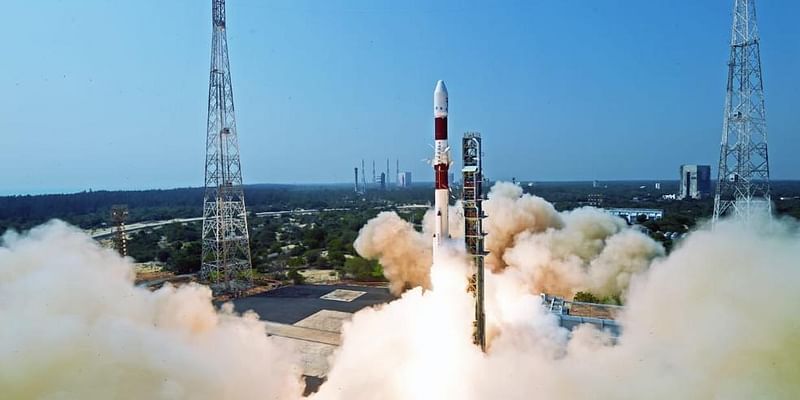
The first commercially built PSLV rocket is expected to place in orbit the Oceansat satellite early next year, a top L&T executive said.
The consortium of Hindustan Aeronautics Limited (HAL) and Larsen & Toubro have built the first PSLV rocket entirely on their own, marking a new chapter in India’s space journey.
"We have started delivering the PSLV hardware. We are hopeful that next year we will probably have two or three launches," A T Ramchandani, Senior Vice President and Head, L&T Precision Engineering and Systems, said on the sidelines of the India International Space Conclave organised by the Indian Space Association.
Ramchandani recently took over as Chairman of the Indian Space Association, the industry body for the space sector in the country.
ISRO had signed a contract with the HAL-L&T consortium for end-to-end manufacture of five PSLV-XL rockets in 2022 as part of efforts to hive off production of proven rockets to the industry as it focuses on new missions and research.
"ISRO feels that the demand for satellites is high. And, we may end up doing another ten launches after these five," Ramchandani said, adding that the space agency was keen to step back from manufacturing the PSLV and encourage the industry to produce the proven rocket.
He said the first PSLV built by the HAL-L&T consortium will launch the Oceansat satellite early next year.
Ramchandani said the consortium faced certain challenges in manufacturing some components of the launch systems, but ISRO stepped in to help resolve the issues.
He said the consortium has been receiving inquiries about probable launch opportunities from within India as well as abroad.
"A lot of companies are now reaching out to us. People are realising that we are part of the game. Today, we have also not stepped out, reaching out to customers. But, I suppose that is the next step after a couple of launches," Ramchandani said.
ISRO also transferred the technology to manufacture the Small Satellite Launch Vehicle (SSLV) to HAL, which will now fully own and operate the launch vehicle business.
Earlier this week, SIDBI Venture Capital Ltd (SVCL) announced the first close of the Antariksh Venture Capital Fund at Rs 1,005 crore, marking a significant step in India’s effort to deepen private sector participation in its fast-expanding space ecosystem.
The fund has secured a Rs 1,000 crore commitment from the Indian National Space Promotion and Authorisation Centre (IN-SPACe), which acts as the anchor investor.
The new fund builds on India’s recent policy push to improve access to capital for space enterprises. The government previously established a dedicated Rs 1,000 crore venture capital fund managed by IN-SPACe to support promising spacetech startups. That allocation has now taken shape as the anchor commitment in the Antariksh Fund.
Alongside this, the Fund of Funds for Startups scheme operated by SIDBI has earmarked Rs 211 crore towards deeptech and spacetech-focused venture funds.
(With inputs from PTI.)
Edited by Jyoti Narayan
Original Article
(Disclaimer – This post is auto-fetched from publicly available RSS feeds. Original source: Yourstory. All rights belong to the respective publisher.)