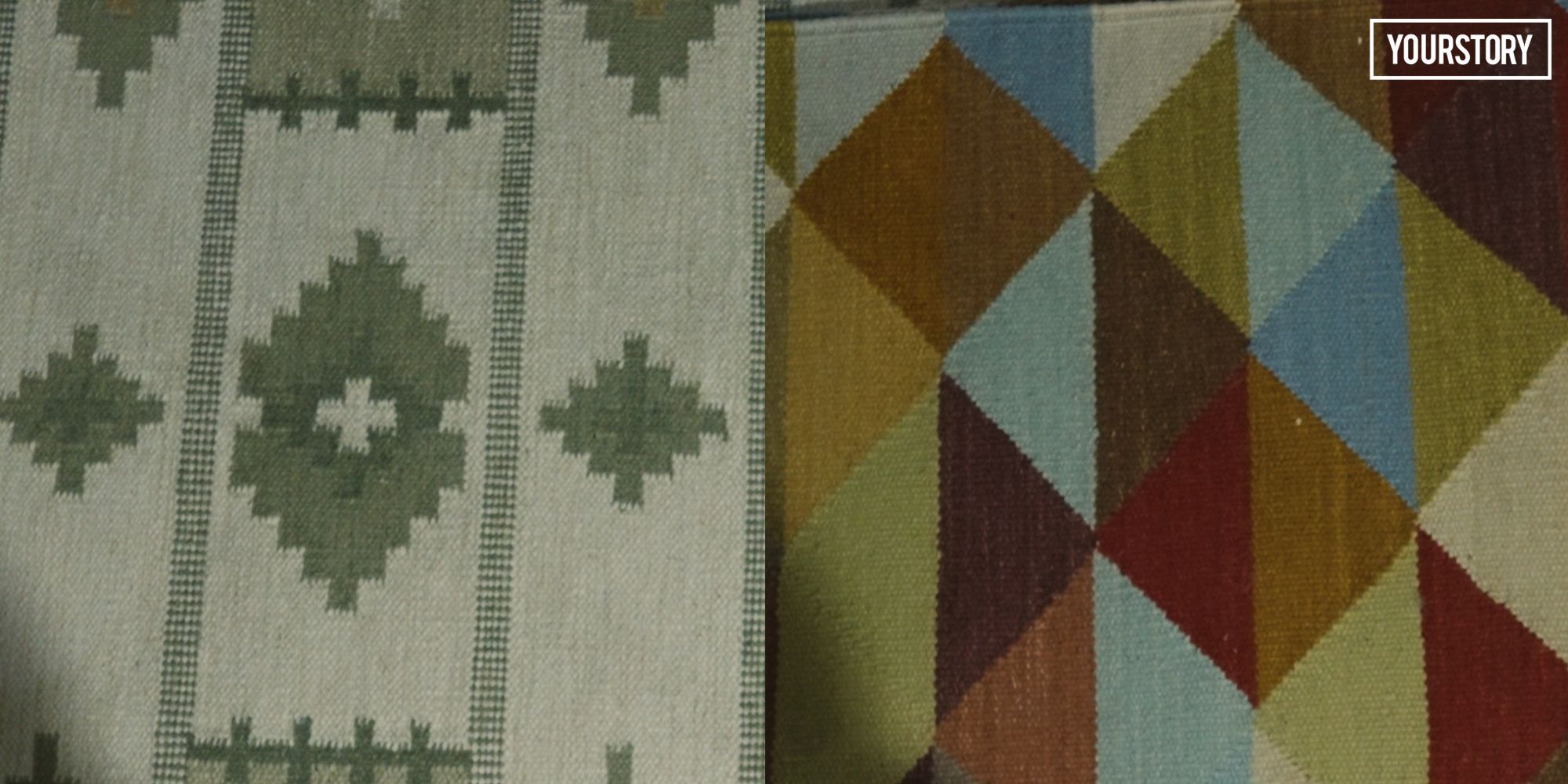
Across homes, prayer areas, and winter bedding arrangements, woollen durries serve as floor coverings and layered spreads valued for their warmth, durability, and firm grip. Each piece reflects a detailed production cycle that begins with fibre preparation and spinning, moves through loom setting and pattern planning, and concludes with weaving and finishing. The work is distributed across households, linking multiple hands in a shared rural production system.
In Uttar Pradesh’s Jaunpur district, particularly in villages such as Jamalapur, handloom weaving continues to shape the making of woollen durries. Among the artisans engaged in this craft is Udayraj Patel, who works with a small local network that includes women yarn spinners and loom weavers.
A defining feature of Jaunpur’s durries lies in their structure. Cotton is typically used for the warp, providing strength and stability, while wool forms the primary weft that gives the rug its warmth and body. Depending on buyer preference, some pieces are woven entirely in wool.
The production process begins with yarn spinning within village homes. Women prepare the yarn, which is then transferred to the loom for weaving. The loom is carefully prepared by setting the warp threads and adjusting tension through the “pech” mechanism to ensure uniform alignment. Essential components such as the panja (comb) and other fittings are installed to maintain evenness during weaving.
Design selection depends on market demand. Patterns are prepared according to buyer specifications, and weaving proceeds with wool as the principal fibre. During weaving, the “kamana” is adjusted to alternate the shed, allowing the weft to pass through and maintain the weave sequence. Once the rug is completed, finishing processes prepare it for supply.
Skill transfer within the weaving community takes place informally. Learning happens through observation and practice, with knowledge passing from one generation to the next without structured training systems.
Patel’s family has been associated with this craft since 1980. Over time, however, the number of active looms in the villages has declined, with weaving now concentrated among fewer artisans. Many younger workers migrate to cities such as Mumbai and Ahmedabad in search of higher daily wages, while others opt for different occupations.
Despite these shifts, Jaunpur’s woollen durries continue to move through established market channels. A significant share of production is routed to buyers in Bhadohi, while exhibitions and fairs in Delhi, Lucknow, and Noida provide additional exposure. Export orders are typically handled through Bhadohi-based firms rather than directly by village weavers.
Recognised as Jaunpur’s notified product under the One District One Product (ODOP) programme, woollen rugs have enabled artisans like Patel to access institutional support. Through an ODOP-linked loan of ₹2 lakh, he was able to procure raw materials at better cash rates and expand production capacity.
Today, weaving activity in Jaunpur operates within a defined set of local skills, market linkages, and institutional backing. Sustained buyer engagement and steady demand remain central to maintaining the continuity of this handloom-based rural enterprise.
Original Article
(Disclaimer – This post is auto-fetched from publicly available RSS feeds. Original source: Yourstory. All rights belong to the respective publisher.)