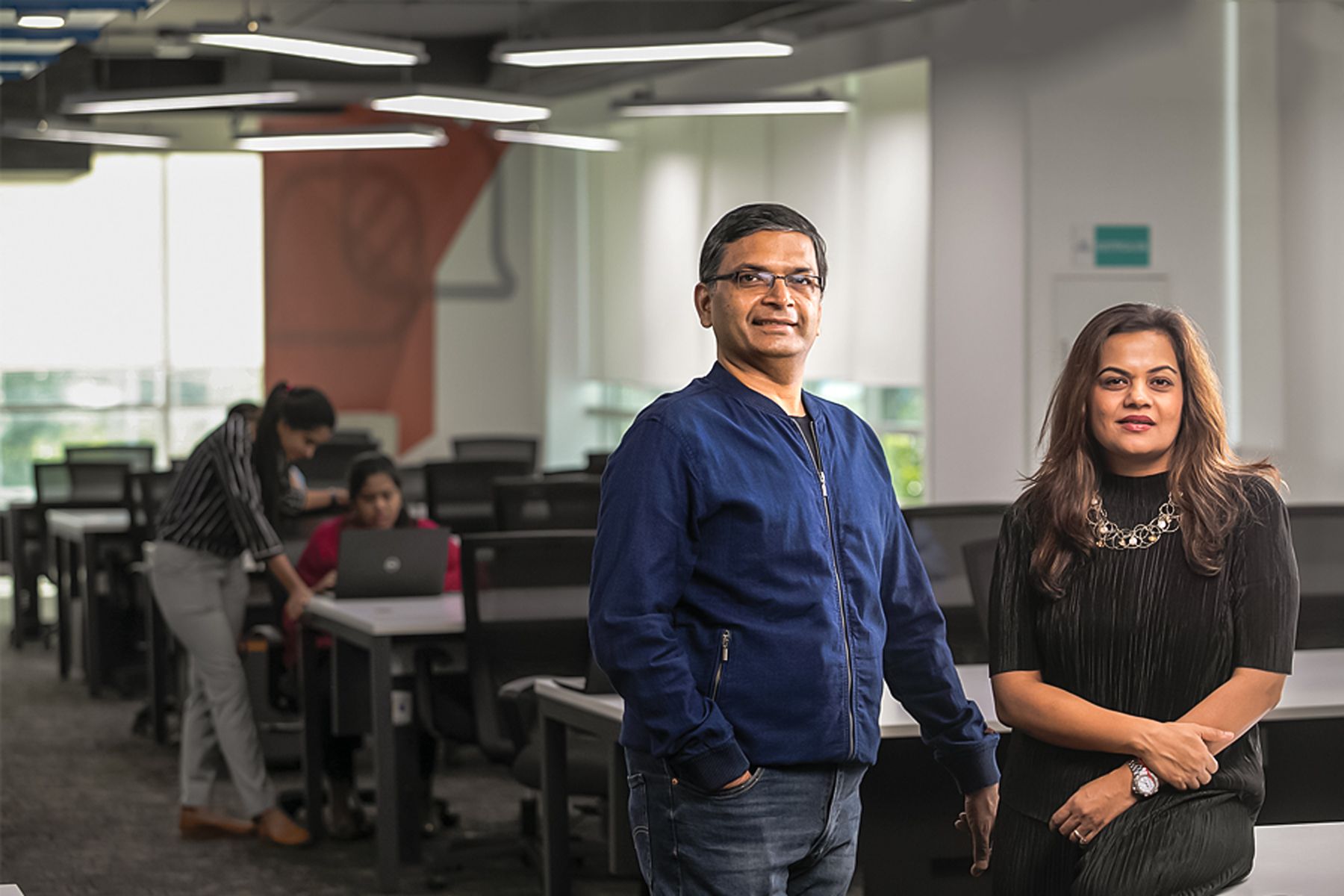
Not many entrepreneurs manage to build a profitable business in one of India’s most capital-intensive sectors without overextending or losing focus. Even fewer have done it as co-founders and life partners. But that’s exactly what Rishi Das and Meghna Agarwal have pulled off with IndiQube, a tech-enabled workspace solutions company that’s grown from a single property in Bengaluru into a pan-India platform managing over 9.14 million sq. ft. across 125 centers.
From the outside, it looks like a classic flex-space success story. But what they’ve built is far more layered, and future-facing. In fact, IndiQube is an evolving response to how India works today, how it will work tomorrow, and what businesses really need beyond four walls and fast WiFi.
One saw the gap, the other scaled the solution
Before they were co-founders, Rishi and Meghna were on different career paths. Rishi, with his track record in building HR and talent ventures like CareerNet and HirePro, had a front-row seat to how rapidly India's tech economy was scaling, and how broken traditional commercial real estate was for modern businesses. Leases were inflexible. Designs were uninspired. And service was almost always an afterthought.
Meghna, with her grounding in finance and operations, brought the structure and systems thinking required to turn a vision into a viable, scalable business.
Together, they founded IndiQube in 2015, not as just another co-working venture, but as a full-stack workspace platform built for growth-stage startups, Global Capability Centers (GCCs), and enterprises that needed flexible, tech-forward, and scalable offices.
Built to flex, not fray
IndiQube’s real differentiation lies in its ability to offer the agility of co-working with the security, infrastructure, and customisation of a Grade A facility. Their proposition resonated with companies looking to scale fast, especially the wave of GCCs entering and expanding across India. Post-2020, as companies re-evaluated everything from HQ footprints to team distribution, IndiQube quietly scaled its own portfolio, staying profitable and growing its seat capacity to over 2 lakh.
And growth hasn’t been confined to metros. While Bengaluru remains the company’s largest base with 69 centers and 5.87 million sq. ft., it has a growing presence in Chennai, Pune, Gurugram, and Tier II hubs like Coimbatore, Kochi, Madurai, and Jaipur. Their footprint has expanded significantly from 74 centers and 4.94 million sq. ft. in March 2023, growing at a CAGR of 30% over two years.
IndiQube’s client roster today includes a diverse mix of high-growth startups and established enterprises such as Myntra, Zerodha, NoBroker, upGrad, Siemens, Juspay, Perfios, Moglix, Ninjacart, Narayana Health, and Allegis.
The company’s expansion closely follows the movement of India’s talent economy, setting up where businesses want to be, not just where real estate is available.
The GCC edge
IndiQube’s enterprise-first approach has positioned it as a natural choice for Global Capability Centers (GCCs), which today make up 40% of its 800+ client portfolio. More than 65% of its occupied area comes from clients leasing 300+ seats, while 40% of revenue is generated from companies operating out of multiple centers, spanning sectors like BFSI, healthcare, automotive, IT, consumer tech, and manufacturing. What keeps them coming back is IndiQube’s ability to launch secure, compliant, and scalable offices in under 90 days, often with customized design specs and integrated tech infrastructure.
What distinguishes IndiQube is not just its real estate but in how intelligently it’s run. Its proprietary in-house platform, MiQube, manages everything from workspace access and resource booking to visitor authentication and energy usage tracking.
In sectors like finance and healthcare, where compliance and data security are non-negotiable, MiQube provides real-time visibility and control, while AI-powered tools enable everything from automated check-ins to predictive maintenance. In FY25 alone, MiQube recorded over 1 million transactions, pointing to high adoption and embedded value.
The platform also supports regulatory and operational needs for clients in sectors like BFSI and life sciences, providing tools for real-time tracking, automation, and seamless reporting. In effect, IndiQube has turned workspace operations into a scalable operating system—one that’s measurable, efficient, and built for modern enterprises.
The founders have essentially productised workspace management, turning office operations into something measurable, efficient, and scalable. This has helped them keep their operational costs lean and their service levels high.
Sustainability that goes beyond the brochure
Even as workspace demand rebounds, tenants, especially global firms, are increasingly asking: what’s the environmental footprint?
Rishi and Meghna have been intentional about ESG long before it became a boardroom priority. From solar rooftops and rainwater harvesting to organic waste composting and energy-efficient lighting, sustainability is embedded into the way IndiQube designs and runs its spaces.
The company has focused on retrofitting older Grade B buildings into green-certified properties, with 28% of its portfolio now consisting of upgraded spaces and over 30% receiving green certifications.
Across its centers, sustainability practices include solar rooftops, rainwater harvesting, organic composting, water reuse systems, and EV charging stations. A newly operational 20 MW solar farm adds to its long-term clean energy efforts. This has earned the company multiple recognitions, including the Green Champion Award, and positioned it as a founding member of the Indian Green Building Council (IGBC).
Their focus on modular design and reusability has also enabled faster build-outs with lower environmental impact – a win for both business and the planet.
Tier II isn’t secondary
While metros will continue to dominate workspace demand, IndiQube is betting big on the next wave of GCCs emerging in cities like Coimbatore, Ahmedabad, Vadodara, and Jaipur. These markets now host over 220 GCCs, up from just 90 in 2019, and offer access to a growing STEM talent pool, competitive costs, and rising state-level support.
IndiQube’s success in Coimbatore, where they operate over 314K sq. ft. across four centers, has shaped their blueprint for future expansion. Their ‘follow the talent’ strategy has allowed them to enter these markets early, building first-mover advantage while meeting the unique needs of decentralised teams.
The road ahead
IndiQube’s next chapter will likely involve deeper tech integration, newer markets, and tighter alignment with global ESG goals. But the core philosophy will remain: build workspaces that are designed for how teams want to work, not how landlords want to lease.
For Rishi and Meghna, it’s never been about being the loudest brand in the room. It’s about being the most reliable one. And in an industry often plagued by excess, their quiet, consistent, and purpose-led approach might just be the blueprint others start to follow.
Original Article
(Disclaimer – This post is auto-fetched from publicly available RSS feeds. Original source: Yourstory. All rights belong to the respective publisher.)