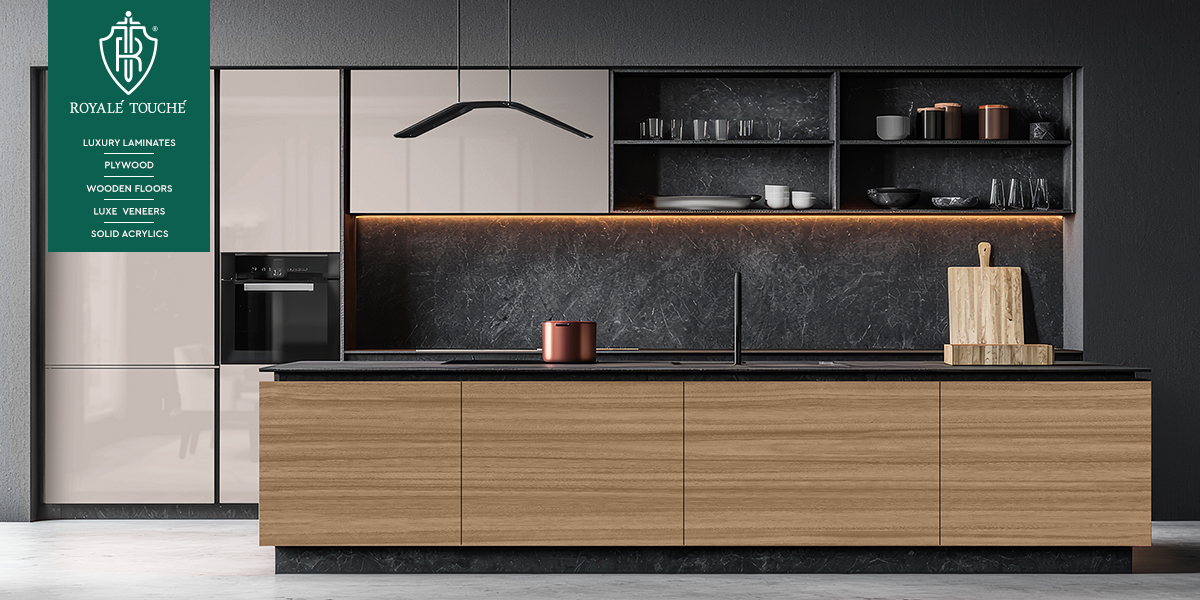
India’s urban housing expansion is fundamentally reshaping how homes are designed and built. Across metropolitan markets, modular kitchens and factory-built interiors are no longer premium upgrades; they are rapidly becoming standard. As homeowners invest more in permanent fixtures such as kitchens and wardrobes, material decisions are shifting from purely aesthetic preferences to performance-driven evaluations.
Today’s urban Indian home must withstand intense summer heat, prolonged monsoon humidity, compact layouts, and heavy daily usage. Surfaces are expected to resist scratches, manage moisture exposure, retain color stability under natural light, and comply with stricter emission and safety standards—all while maintaining refined visual appeal. This evolving expectation has accelerated demand for engineered materials that balance design sophistication with structural reliability.
Against this backdrop, luxe veneer and solid acrylic surfaces are emerging as preferred choices for modular interiors. India’s premium interior-surfaces market is currently growing at an estimated 8–10% annually, driven by housing upgrades and the rapid adoption of modular systems. As factory-built cabinetry becomes standard across residential developments, materials must align with precision manufacturing while delivering long-term resilience. Brands such as Royale Touche have expanded their portfolios to include engineered veneer and solid acrylic solutions tailored to these evolving requirements.
When wood meets engineering: The structural evolution of veneer
Wood has long held cultural and architectural significance in Indian interiors. Its grain softens light, its texture adds warmth, and its tonal variations introduce depth into otherwise linear spaces. Veneer captures this authenticity in a refined format—thin slices of natural wood that preserve timber’s character while allowing greater structural control within engineered systems.
Unlike reconstructed veneers that rely on printed repetition, natural luxe veneers originate from real timber. Through cross-lamination, bonding, and controlled slicing techniques, manufacturers can ensure visual consistency while retaining the individuality of organic grain patterns.
Thickness plays a critical role in performance. While many engineered veneers available in India measure approximately 0.25mm, certain premium collections offer 0.5mm thickness—doubling the material layer and enhancing grain visibility, sanding flexibility, and finish depth.
Engineered veneers are often mounted on stable plywood bases, such as Indonesian hardwood plywood, to improve dimensional integrity. Adhesives compliant with E1 European emission standards further ensure indoor air quality performance—an increasingly important factor for urban homeowners who are more aware of formaldehyde levels and environmental safety.
The organised modular is projected to grow at over 20% CAGR over the next five years. Urbanisation, rising disposable incomes, and shrinking apartment sizes are accelerating the adoption of modular systems that prioritise installation efficiency and predictable outcomes. Surface materials must, therefore, meet factory-level standards of uniformity and precision.
In modular fabrication environments, edge precision and uniform reflectivity are essential. The fused polymer composition of solid acrylic ensures clean routing, consistent finishing, and dimensional stability—key performance indicators in factory-built cabinetry.
Why these materials are defining India’s modular interior shift
The growing prominence of luxe veneer and solid acrylic is not driven by aesthetics alone. It reflects structural, economic, and behavioural changes in the housing ecosystem.
Factory-built compatibility
Modular interiors are produced using precision machinery. Materials must be dimensionally stable, uniform in thickness, and compatible with automated processes. Engineered veneer bonded to stable plywood and fused solid acrylic sheets meet these technical requirements.
Climate responsiveness
Indian kitchens face oil vapour, humidity, and heat exposure. Solid acrylic’s thermal and moisture resistance addresses these environmental pressures, while engineered veneer, when properly processed, maintains durability without compromising natural texture.
Spatial efficiency
In compact apartments, cabinetry dominates visual real estate. Veneer introduces tactile warmth that offsets minimal layouts, while acrylic’s reflective surfaces enhance brightness and perceived spaciousness.
Informed consumer behaviour
Homeowners are increasingly attentive to specifications such as veneer thickness, emission compliance, UV warranties, and substrate quality. Differences such as 0.5mm versus 0.25mm veneer layers or extended UV guarantees are viewed as long-term performance indicators rather than marginal technicalities.
Market and policy momentum:
India’s premium interior-surfaces market continues to grow at 8–10% annually. The broader home-interiors sector is expected to nearly double by 2030, indicating sustained demand for engineered materials. Policy emphasis on value-added manufacturing, wooden furniture production, and global trade alignment further strengthens the ecosystem, supporting high-quality surface innovation.
Collectively, these forces are positioning luxe veneer and solid acrylic as foundational materials in India’s next phase of modular interior growth, offering warmth without fragility and precision without compromise.
Experiencing materials at full scale
In a category where decisions are often made using small swatches, scale significantly alters perception. Full-sheet displays allow designers and homeowners to evaluate uninterrupted grain flow, gloss depth, edge detailing, and light interaction—factors that are difficult to assess in sample fragments.
Recognising this, surface manufacturers are investing in experience-driven retail formats. With an expanding network of galleries across India, brands such as Royale Touche present complete collections, including veneer, solid acrylic, laminates, wooden flooring, and plywood solutions, within integrated environments. This approach mirrors how contemporary interiors are conceptualised: as interconnected systems rather than isolated components.
As modular living continues to define India’s urban housing landscape, material selection is evolving from decorative choice to performance strategy. Veneer and solid acrylic are not simply surface finishes; they are engineered responses to the climatic, spatial, and functional realities of modern Indian homes.
(Disclaimer: The views and opinions expressed in this article are those of the author and do not necessarily reflect the views of YourStory.)
Original Article
(Disclaimer – This post is auto-fetched from publicly available RSS feeds. Original source: Yourstory. All rights belong to the respective publisher.)