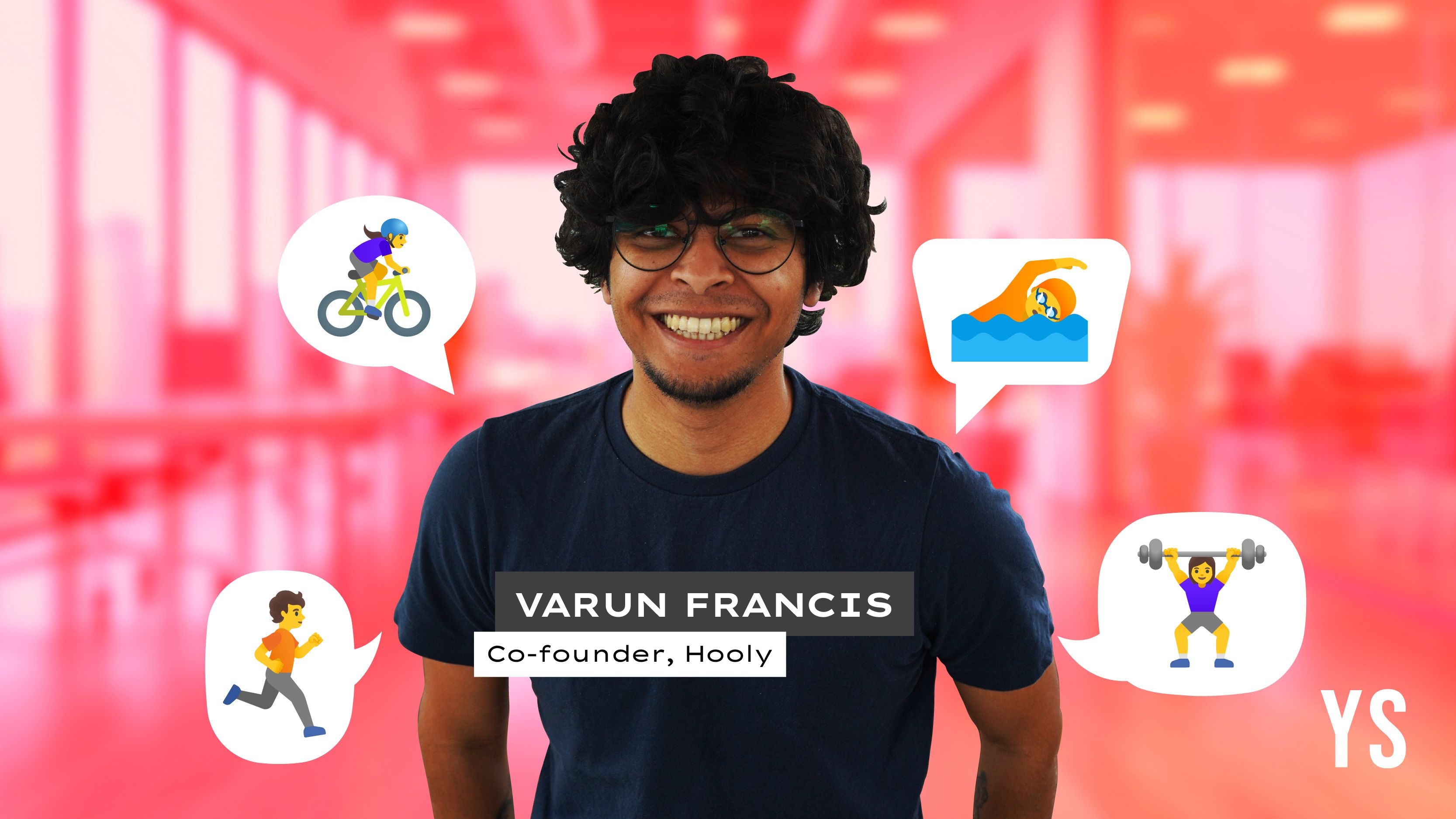
Last year, when Varun Francis and Pavan Gowda started building Hooly—whose name draws inspiration from the American sitcom Silicon Valley—their initial plan was to create an AI agent for customer support and quality assurance. But the idea didn’t take root, and the founders soon realised they needed to rethink their approach.
“We weren’t relating to the problems we were picking up, and at some point, we were trying to validate a solution rather than solve a real problem,” says Gowda. “Simply put, instead of finding a problem to solve, we were trying to fit our solution to problems.”
Although the startup had begun generating some revenue, Francis describes it as a “false positive”. In October, the Bengaluru-based startup pivoted to a new direction; it is now building an AI-powered fitness accountability coach aimed at people who struggle with motivation.
“Hooly understands who you are as a person: your goals, how busy your schedule is, and your current physical condition. Based on this, it formulates what kind of exercise you need to do to reach your health goal,” says Francis.
The healthtech startup is targeting users between the ages of 35 and 50. It already has 70 users across India, the United States, the UAE, and Italy. For now, Francis and Gowda are the company’s only employees.
A health coach that understands motivation
According to a 2024 report, only one in 10 Indians exercises on any given day. Historically, Indians have not prioritised structured fitness in the way people in Western countries have. Hooly is built with this reality in mind.
Francis explains that while India may not have a strong gym culture, it has always had a deep-rooted focus on health through practices like yoga and nutrition. But the country’s diversity makes it very difficult to apply a one-size-fits-all approach to fitness or diet, especially when compared to relatively homogeneous markets like North America.
“Very few people have tried to solve this problem for the Indian subcontinent while keeping its diversity in mind. That’s where personalisation, enabled with AI, comes in.
“A 45-year-old man with a knee injury will have very different health goals from someone in their 20s. With Hooly, we want to be that personalised health coach,” says Francis.
Gowda approaches the challenge with optimism. “India is going to catch up with the rest of the world soon. We underestimate how large this market will become over the next decade. While it is challenging right now, I believe things will greatly improve over the next 10 years,” he says.
Also Read Odds Fitness is helping people reclaim their health with personalised plans
At its core, Hooly is designed to keep users accountable in practical, empathetic ways. If a user misses a workout due to a meeting, Hooly’s AI might recommend a 15-minute mobility workout. If someone is craving a snack, it suggests options that won’t derail their goals. For women nearing their periods, it suggests suitable supplements and offers alternatives to manage PMS-related cravings.
One of Hooly’s most effective motivation tools is its nudging feature, which, the founders say, has been widely welcomed by users.
“A lot of our users come back and say, ‘Hey, you haven’t nudged me in a while’,” Francis says. “People prefer gentle nudges over a bot texting their daily plan. Our AI coach needs to be proactive; otherwise, it becomes just another fitness app.”
Standing out in a crowded fitness ecosystem
While fitness adoption across India may be uneven, metropolitan cities are showing greater awareness.
Morning runs, crowded gyms, older adults on daily walks, and widespread use of health and fitness apps are now common sights. In an ecosystem packed with wellness platforms, the obvious question is: how is Hooly any different, and why is it needed?
Francis says the answer lies in how the product is architected.
“Our architecture allows us to be proactive in a way most apps are not able to. If you think of habit formation as a loop of trigger action, and feedback, most apps operate in the feedback stage. You do something, and it tells you how well you did. We come in the trigger and action stages of the cycle.”
He adds that when users tell Hooly that they are unable to complete a certain exercise, the AI has been able to change their minds 30% of the time, often by suggesting a simpler or more realistic alternative.
Another key differentiator is access. Hooly operates on WhatsApp, removing the friction of downloading yet another app.
The founders have also consciously designed the product to avoid information overload.
“LLMs like ChatGPT tend to answer queries with long explanations. But sometimes, users don’t want to learn; they just want a quick answer. We keep our responses to one or two lines at the most,” says Francis.
On the technology side, Hooly uses OpenAI’s GPT models for conversational responses, while more analytical outputs (such as weekly performance feedback) are powered by Anthropic’s Claude Opus 4.6. It uses ElevenLabs for voice check-ins.
Users tend to share a lot of personal information with the AI. This brings up the issues of data privacy and security.
Also Read This healthtech startup is using AI to standardise India’s chaotic medical records
The founders say that while the startup is still in its MVP stage, data privacy and end-to-end encryption are part of the roadmap.
“I’ll be honest. Data privacy at scale isn’ t our biggest concern at the moment, given where we are. But we have already started thinking about how to make the product more private and encrypted as we grow,” says Francis.
Initially, Hooly was priced at Rs 2,727 ($30) per month, mainly for early users in the US. Since then, the healthtech startup has experimented with monthly pricing between Rs 600 and Rs 2,400. Currently, the product is priced at Rs 999 per month.
“Some of our power users are still happy to pay the older $30 price. But at scale, and especially for India, that pricing was too expensive. At Rs 999 or even at $30, we are far cheaper compared to a personal trainer or an online coach with the added benefits of personalisation and 24X7 availability,” says Gowda.
Funding and the road ahead
Ahead of its pivot in 2025, Hooly raised Rs 10 lakh from friends and family. The startup is now preparing to raise $500,000 in a pre-seed round to fuel its next phase of growth.
“The idea is to use the funding to double down on our go-to-market strategy and get to 10,000 active users,” Francis says.
Hooly competes with other Bengaluru-based startups like SuperLiving and HealthifyMe. Francis says Hooly’s capacity for personalisation separates it from others.
“Users don’t need to download another app to talk to Hooly. It also is far more conversational and proactive in both training and nutrition,” he says.
While many consumer healthtech startups choose to build and scale from the US or other high-demand markets, Francis and Gowda have decided to remain headquartered in India.
“That’s a question we ask ourselves all the time,” Francis says. “Hand to heart, I really love Bengaluru. The US market is very crowded, and most players are focused on younger users, and not the slightly older segment we are building for. From a business standpoint, there’s a white space we can capture in India—and on a personal level, I genuinely like being here.”
Edited by Swetha Kannan
Original Article
(Disclaimer – This post is auto-fetched from publicly available RSS feeds. Original source: Yourstory. All rights belong to the respective publisher.)