Inside the Zepto Business Model of 10-Minute Delivery
How dark stores, product sales, fees and advertising fit together at Zepto

Key Takeaways
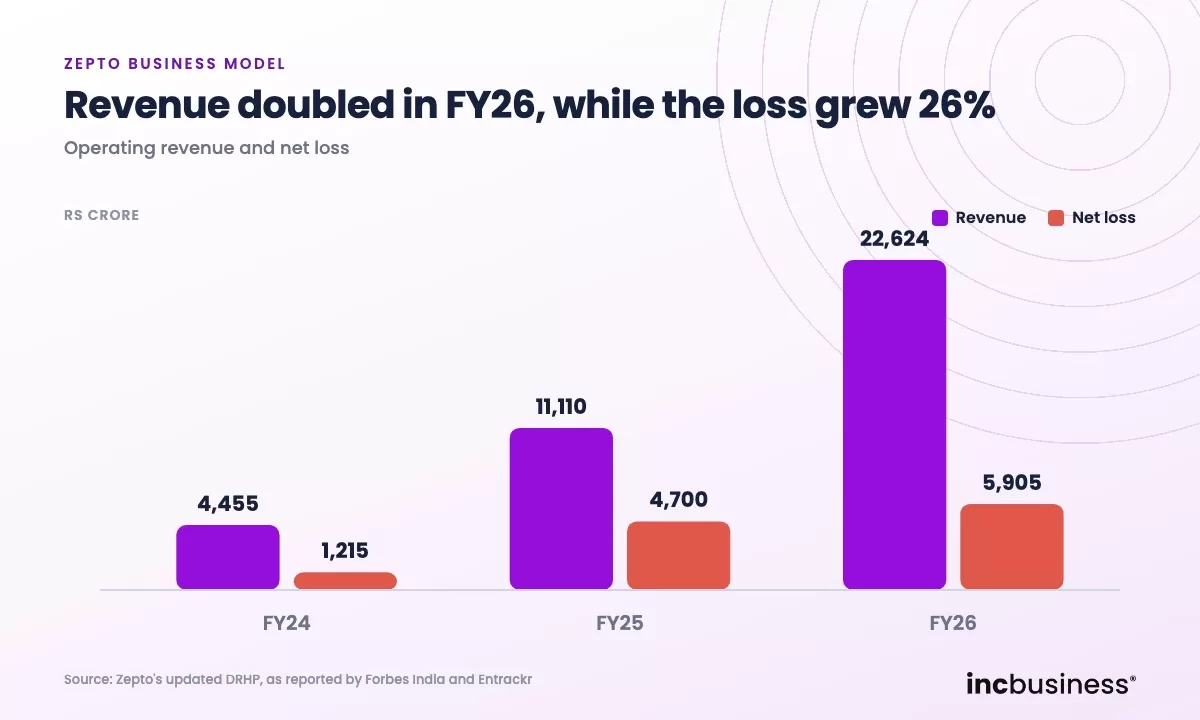
- Zepto's FY26 revenue doubled to Rs 22,624 crore; the net loss grew 26% to Rs 5,905 crore.
- About 78% of revenue comes from selling products; ads, services and platform fees make up the rest.
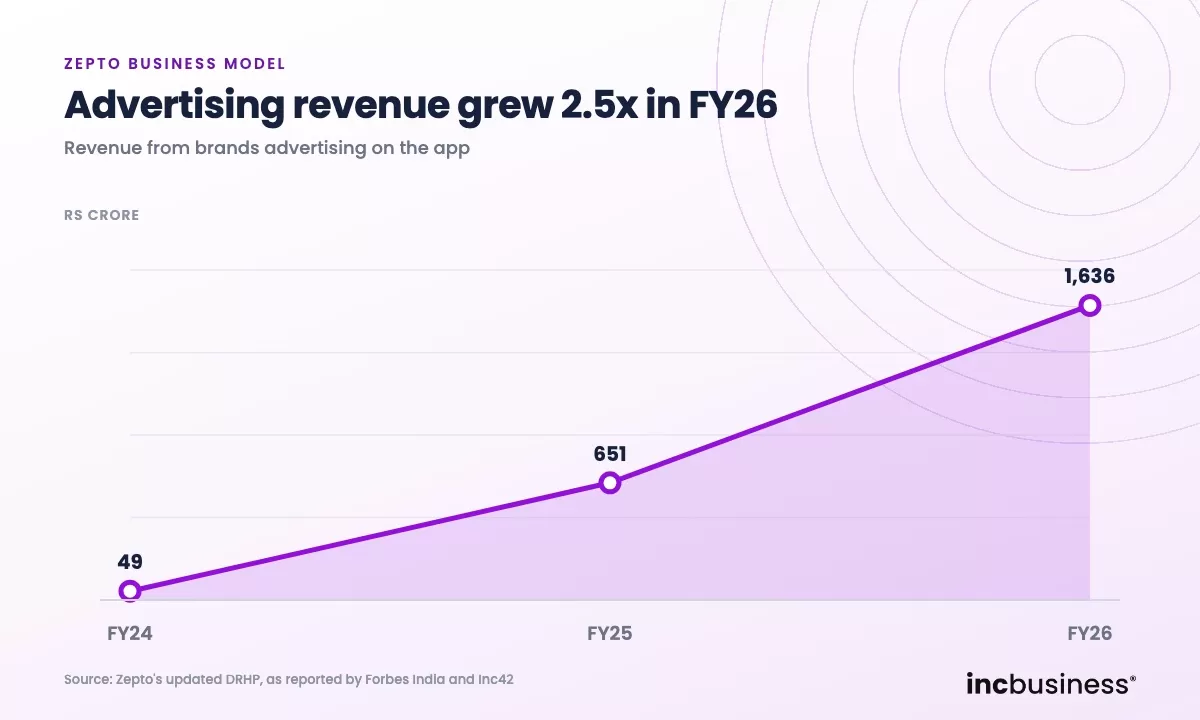
- Advertising revenue grew about 2.5 times to Rs 1,636 crore in FY26.
- Zepto spent about Rs 128 for every Rs 100 it earned, but its adjusted EBITDA loss per order fell to Rs 78.75.
- Its 1,139 dark stores in 66 cities handled about 2.33 million orders a day in January to March 2026.
The Zepto business model is simple to describe and very hard to run: keep thousands of everyday products in small neighbourhood warehouses called dark stores, and deliver them to your door in minutes. In FY26 that model brought in Rs 22,624 crore of revenue, double the year before, while the company still lost Rs 5,905 crore.
This is how Zepto makes money, where the money goes, and why the losses per order are falling even as the total loss grows. The revenue, cost and loss figures below come from Zepto's own IPO papers, as reported by at least two publications.
Zepto at a glance
| Detail | Zepto |
|---|---|
| What it does | Quick commerce: groceries and everyday items delivered in minutes from dark stores |
| Launched | 2021 |
| Founders | Aadit Palicha and Kaivalya Vohra |
| Revenue (FY26) | Rs 22,624 crore |
| Net loss (FY26) | Rs 5,905 crore |
| Dark stores | 1,139 in 66 cities (March 2026) |
| Orders | About 2.33 million a day (January to March 2026) |
| Valuation | $7 billion in October 2025; a pre-IPO round in mid-2026 was reportedly at about $4.5 billion |
| IPO | Updated draft papers filed in June 2026, with a Rs 8,010 crore fresh issue; paused in July 2026 |
What Zepto does
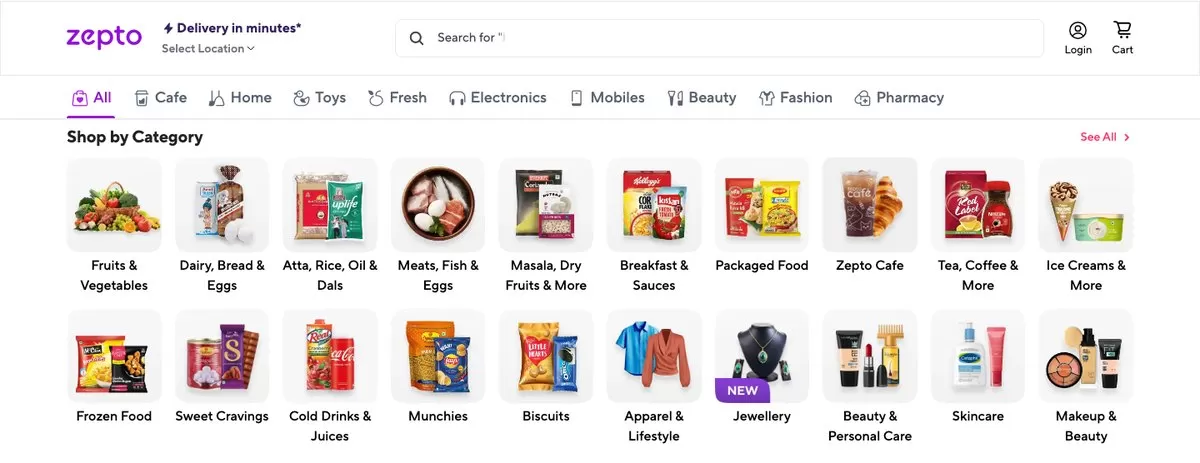
Zepto runs an app where people in cities order groceries, snacks, personal care, electronics and more, and get them in minutes. Instead of shipping from a big warehouse far away, it keeps stock in small dark stores close to where customers live. A dark store is a warehouse that is not open to walk-in shoppers: staff pick and pack orders, and delivery partners take them the last few kilometres.
The range has grown well beyond groceries. According to Zepto's IPO papers, an average dark store offered 46,623 products (SKUs) in FY26, up from 12,312 in FY24, and 49,602 in the January to March 2026 quarter. Zepto Cafe sells ready-to-eat food and drinks that can be added to the same order.
How the Zepto business model makes money from five revenue streams
Zepto's FY26 operating revenue of Rs 22,624 crore came from five places. Most of it is the money it earns by selling products, but the faster-growing parts are the fees and the advertising it earns around those sales.
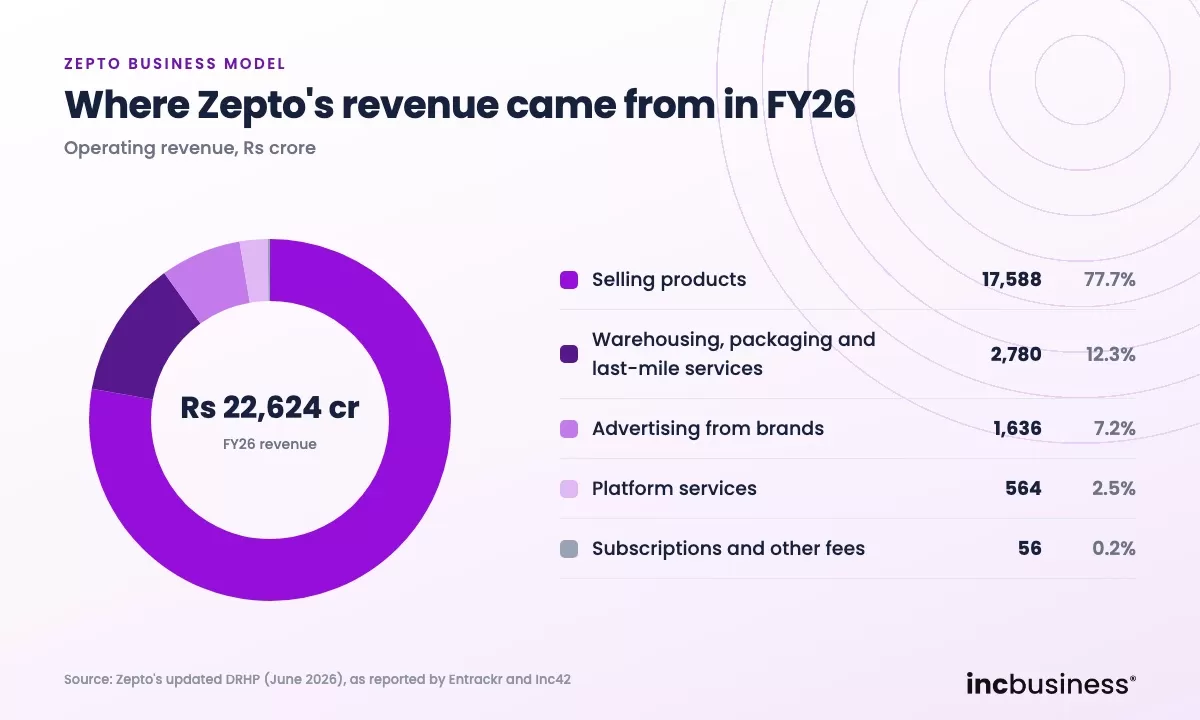
- Selling products (Rs 17,588 crore): about 78% of revenue. Zepto buys goods and sells them to customers. In FY26 the cost of the products it sold was Rs 18,199 crore, more than the Rs 17,588 crore it earned from selling them.
- Warehousing, packaging and last-mile services (Rs 2,780 crore): fees for warehousing, packaging and last-mile delivery services.
- Advertising (Rs 1,636 crore): brands pay to show up at the top of searches and on the app's shelves, right when a customer is about to buy.
- Platform services (Rs 564 crore): fees for using the platform.
- Subscriptions and other fees (about Rs 56 crore): the rest, including membership fees.
Advertising has grown quickly. It grew from Rs 49 crore in FY24 to Rs 651 crore in FY25 and Rs 1,636 crore in FY26, about 2.5 times in a single year. Its share of revenue rose from about 1% in FY24 to about 7% in FY26.
Zepto Cafe adds food and drinks to the same delivery. In November 2024, Zepto said the cafe had reached an annual run rate of Rs 160 crore in gross merchandise value, the total value of orders before costs.
Zepto's Business Model Canvas
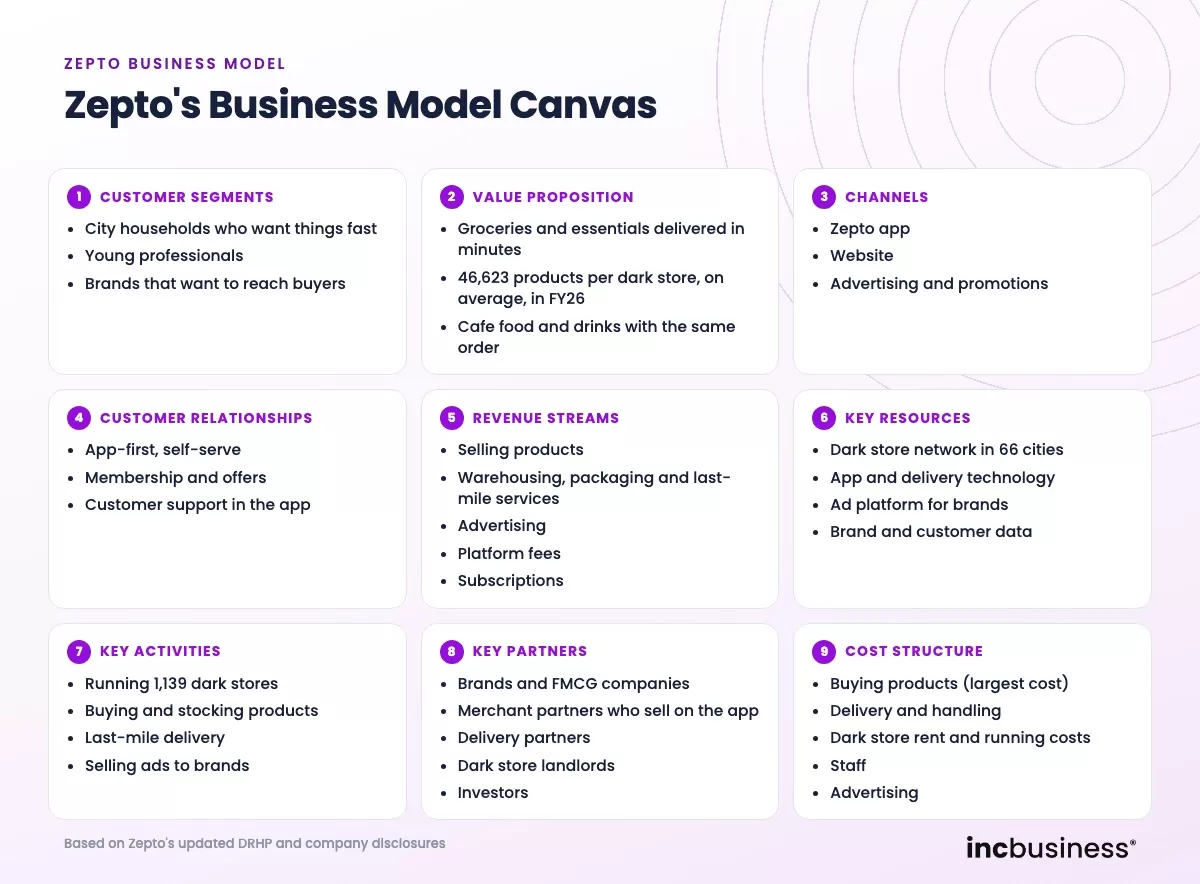
The Business Model Canvas puts the whole model on one page: who Zepto serves, what it offers them, how it reaches them, what it needs to run, and how money comes in and goes out.
Where Zepto's money goes
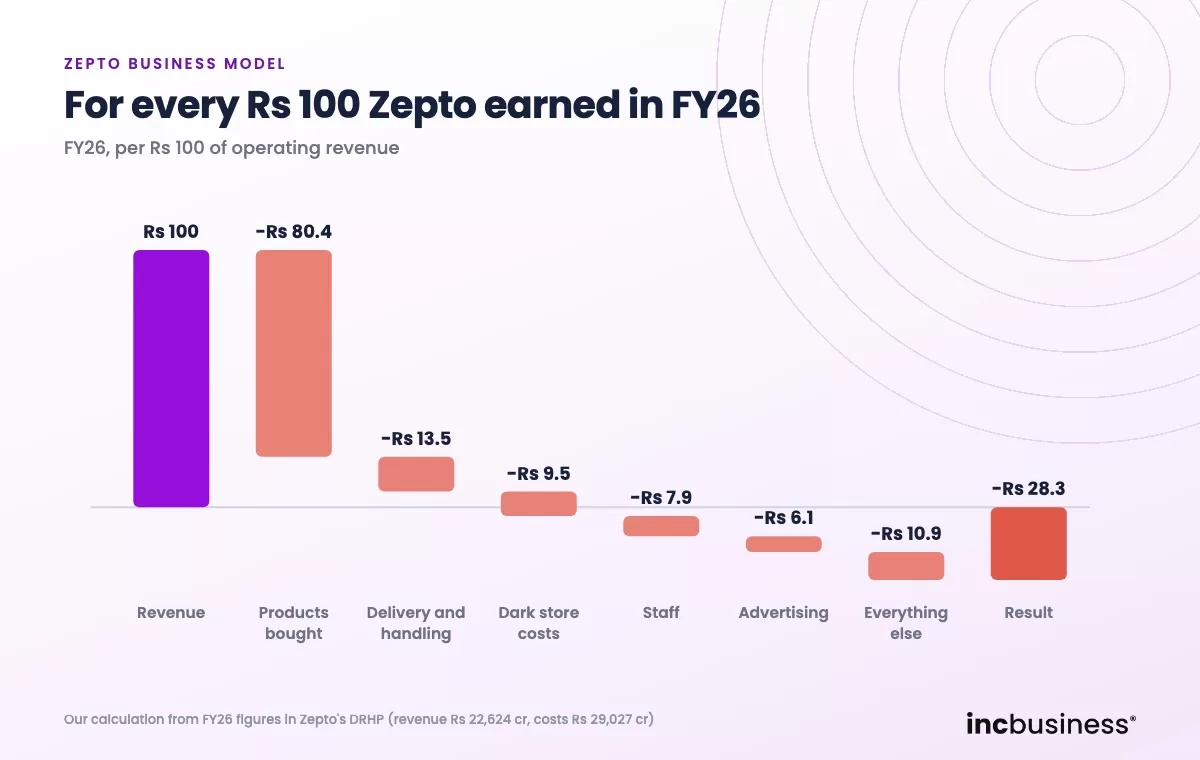
In FY26 Zepto spent Rs 29,027 crore to earn Rs 22,624 crore of revenue. Put simply, for every Rs 100 it earned, it spent about Rs 128.
| Cost (FY26) | Rs crore |
|---|---|
| Buying the products it sells | 18,199 |
| Delivery and handling | 3,046 |
| Dark store costs | 2,150 |
| Staff | 1,785 |
| Advertising and promotion | 1,389 |
| Total costs | 29,027 |
The biggest cost is the stock itself. After that, delivery and the dark stores are what make quick commerce expensive: delivery and handling costs rose more than 90% in FY26 as the network grew.
Revenue doubled, while the loss grew 26%
Zepto's revenue has grown about five times in two years, from about Rs 4,455 crore in FY24 to Rs 22,624 crore in FY26. The net loss grew too, but more slowly: up 26% in FY26 to Rs 5,905 crore.
| Year | Revenue (Rs crore) | Net loss (Rs crore) |
|---|---|---|
| FY24 | About 4,455 | About 1,215 |
| FY25 | 11,110 | About 4,700 |
| FY26 | 22,624 | 5,905 |
Zepto's unit economics per order
A key number in Zepto's IPO papers is how much it loses on each order before one-off and non-cash costs. That adjusted EBITDA loss per order fell from Rs 136.15 in FY25 to Rs 78.75 in FY26, and to Rs 59.4 in the January to March 2026 quarter.
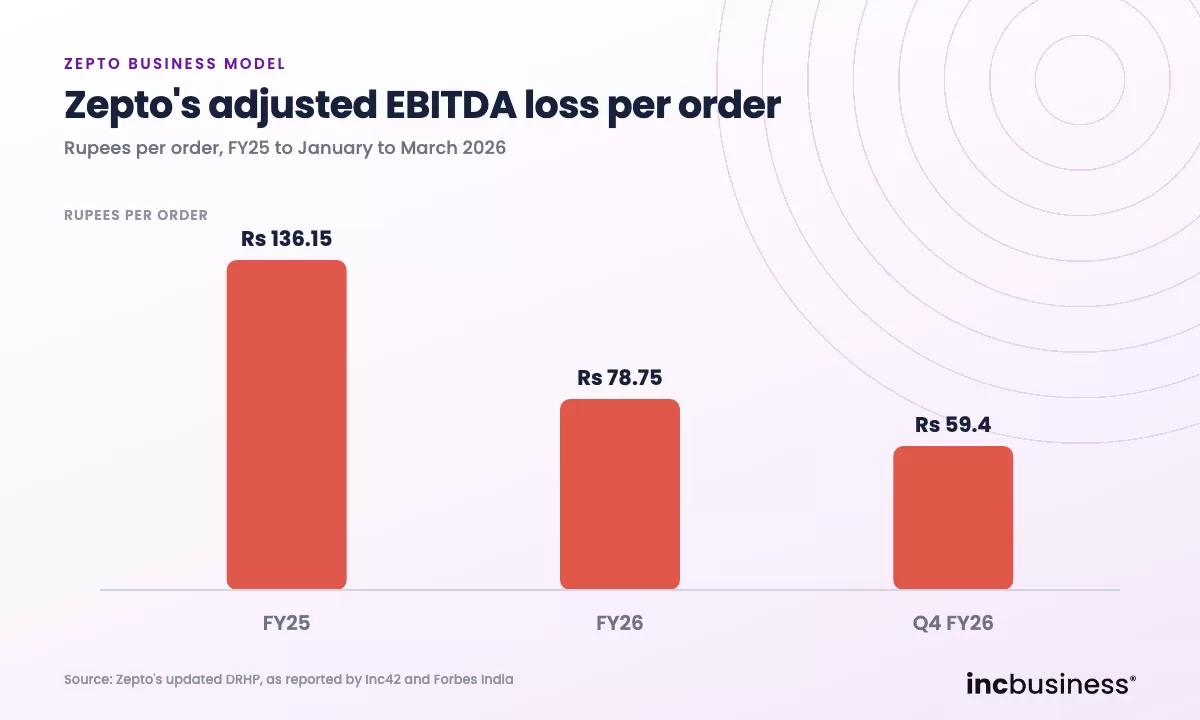
Each dark store has fixed costs, such as rent and staff. When more orders go through the same store, those costs are shared across more orders, so the loss on each order can fall even while total losses rise.
Zepto's dark store network
Zepto's network grew from 337 dark stores in 11 cities in March 2024 to 1,139 stores in 66 cities in March 2026, more than three times as many. In the January to March 2026 quarter, they handled about 2.33 million orders a day.
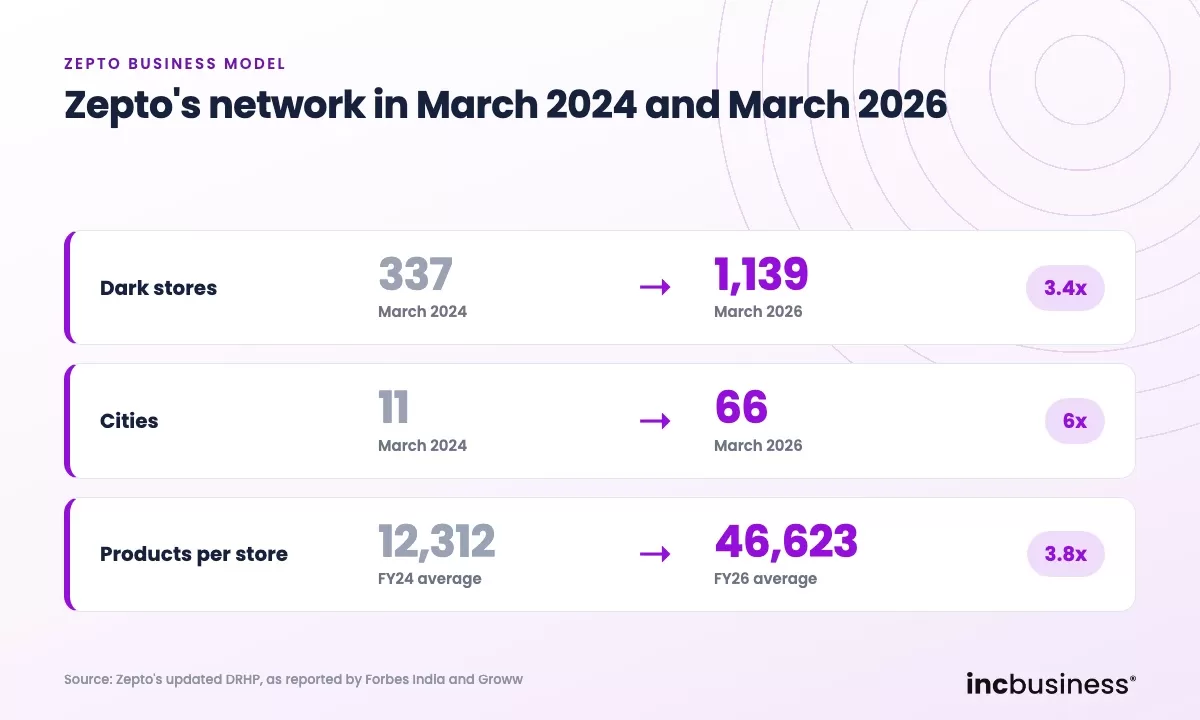
More stores means faster deliveries and new customers, but a new store usually loses money until it has enough orders. That is why a fast-growing quick commerce company can show rising losses even while its older stores improve.
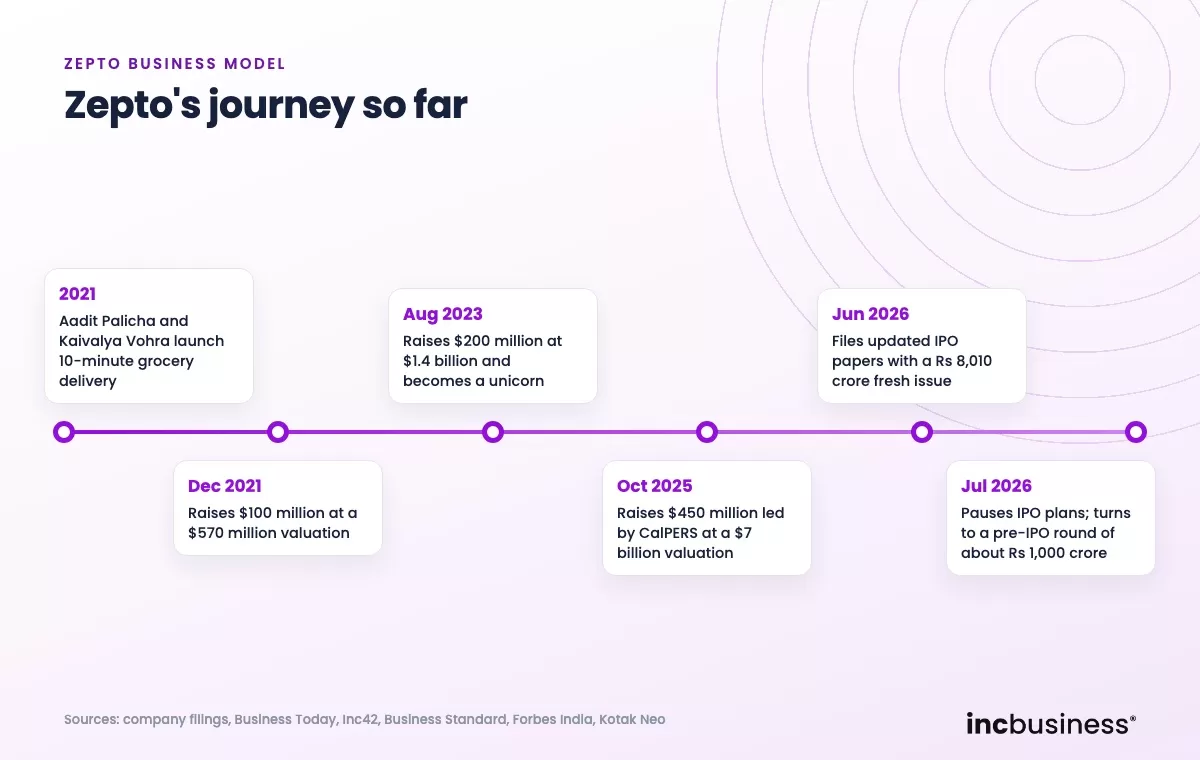
Zepto's journey so far
| When | What happened |
|---|---|
| 2021 | Aadit Palicha and Kaivalya Vohra launch Zepto for 10-minute grocery delivery |
| December 2021 | Raises $100 million at a valuation of $570 million |
| August 2023 | Raises $200 million at a $1.4 billion valuation, becoming a unicorn |
| March 2024 | 337 dark stores in 11 cities |
| October 2025 | Raises $450 million in a round led by CalPERS at a $7 billion valuation |
| March 2026 | 1,139 dark stores in 66 cities |
| June 2026 | Files updated IPO papers with a Rs 8,010 crore fresh issue |
| July 2026 | Pauses its IPO plans and turns to a pre-IPO round of about Rs 1,000 crore, reportedly at about $4.5 billion |
Who Zepto competes with
Zepto is one of several large players racing for the same city shoppers. Blinkit, owned by Eternal, and Swiggy's Instamart are its closest rivals, and Amazon and Flipkart have also moved into fast delivery.
Challenges Zepto faces
- Losses and cash burn: Zepto used about Rs 4,330 crore more cash than it brought in during FY26.
- Costly expansion: new dark stores usually lose money at first; Zepto's total loss rose 26% in FY26 even as its loss per order fell.
- Tough rivals: deep-pocketed competitors can match prices and speed.
- The IPO is on hold: Zepto paused its IPO plans in July 2026, and as of October 2026 it had not announced a price band or a listing date.
Conclusion on the Zepto business model
The Zepto business model rests on small dark stores close to customers, a wide range of everyday products and delivery in minutes. Most of its money comes from selling those products, with services, advertising, platform fees and subscriptions making up the rest.
In FY26 Zepto's revenue doubled to Rs 22,624 crore and it reported a net loss of Rs 5,905 crore, while its adjusted EBITDA loss per order fell to Rs 78.75. It ran 1,139 dark stores in 66 cities in March 2026, filed updated IPO papers in June 2026 and paused its IPO plans in July 2026.
